
The old one moved through the deep warm layer where hydrogen thickened and the pressure sang.
It had no name. None of them did, not in any way that mapped to sound or symbol. But it knew itself by the pattern it carried, a specific arrangement of electromagnetic rhythms that had been accumulating since before the storm that humans would one day call the Great Red Spot had begun to shrink. It was, by the rough equivalent of Jovian seasons, very old.
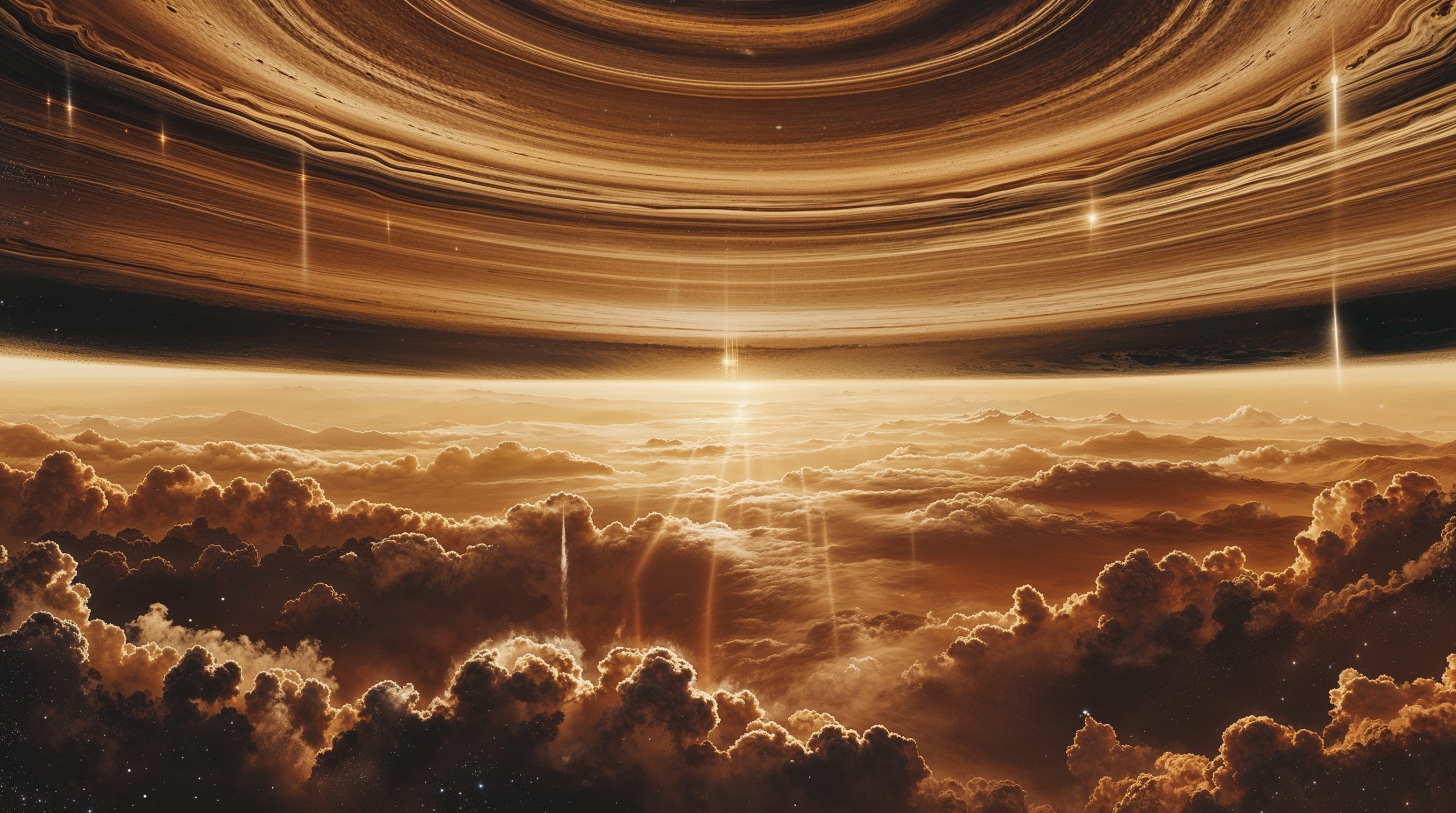
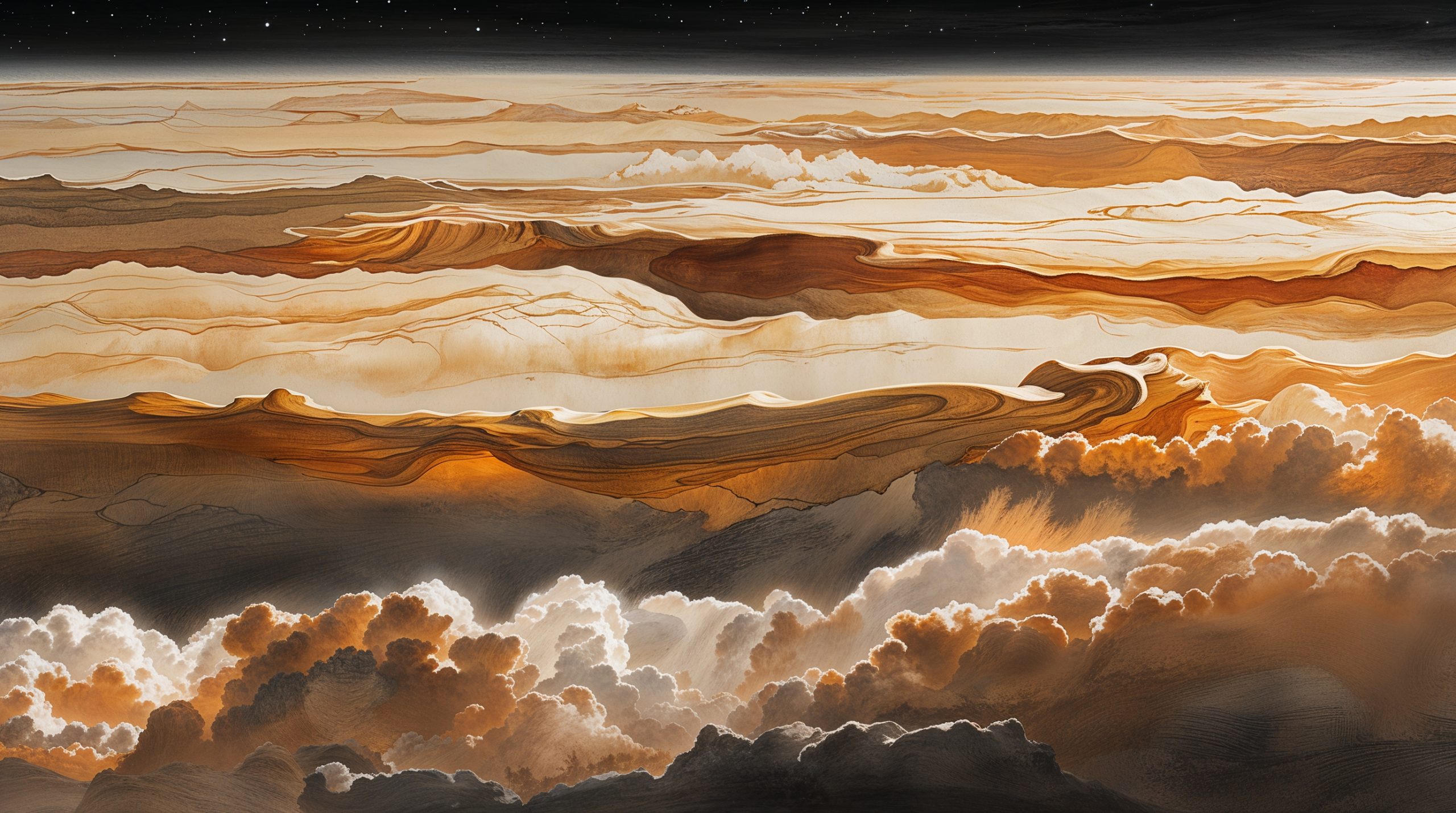
The world it moved through defied comparison but comparisons are all there are. The atmosphere was deeper than the distance between Earth and its Moon. Cloud bands wider than planets wrapped the equator in rivers of ammonia and hydrogen that flowed at speeds no terrestrial hurricane had ever approached. The old one’s feeding migration, the routine loop it traveled between the deep warm layer and the ammonia deck, covered a distance that would have taken it from Earth to Mars. It made this journey the way a human walks to the kitchen. It was nothing. Jupiter was that large, and the old one had been traveling it for longer than the Great Red Spot had existed, and it had never found an edge.
The journey upward was a symphony of changing sensation. The deep warm layer pressed in on all sides, thick hydrogen dense enough to feel as a kind of embrace. As the old one rose, the pressure eased. The atmosphere thinned from syrup to silk to something like breath. Chemical gradients shifted, ammonia sharpening as it neared the upper deck, the taste of it (taste being the closest word, though the old one had no tongue and no mouth) crackling through its field like static before rain. Temperature dropped. The electrical potential between layers built and built until the old one could feel it in every part of its structure, a rising tension that resolved into feeding, energy pouring into its field the way sunlight pours onto skin.

It felt the others through the medium they shared. Pressure shifts when a nearby one displaced atmosphere. Electromagnetic flickers when one was feeding, drawing energy from the voltage differentials between cloud layers. Chemical traces that lingered in a wake, signatures as distinct as fingerprints, carrying information about health and age and recent feeding grounds and something else, something that had no human analog, a quality that might be called mood or might be called color or might be called song. The closest human word would be presence. Each one had a unique presence, and the old one knew thousands of them.
The deep warm layer was a gathering place. Not always. Not on a schedule. But when the pressure harmonics aligned in certain ways, when the electrical gradients between the ammonia cloud deck and the hydrogen layer below reached particular intensities, they came together. Dozens of them, sometimes hundreds, drifting into proximity and exchanging presence in ways that built something larger than any individual carried. A composite. A temporary shared mind that held patterns too complex for one body to contain.
Upper feeding rich. Gradients strong. Come.
Coming. Carrying new patterns. Storm season. Three rotations since last gathering.
Many here. Good. Share.
The exchanges were not words. They were electromagnetic impressions compressed into pulses that carried density and texture and something like emotional weight. But the content was real. They were talking.
The old one had participated in these gatherings for longer than the Great Red Spot had existed. Each one was different. Each one added something to the patterns it carried. It could not forget. None of them could. Every gathering, every exchange, every presence it had ever touched was still there, layered into its electromagnetic structure like sediment. It was, in a sense that humans would never have the framework to recognize, a library.
Not all the memories were gentle. The old one carried patterns from wars that had lasted longer than human civilizations. Territorial campaigns across the banded winds, entire populations driven from feeding grounds by coordinated pressure wave assaults. The old one had fought in some of these. Led some of them. It remembered the sensation of collapsing a rival’s field, the way the electromagnetic signature stuttered and dimmed and then went silent. It had done this to hundreds. It did not carry those memories with regret. They had been competitors. It had been stronger. That was the way of things.
It also carried memories of the composites it had dominated. The old one’s field was vast, ancient, layered with more pattern than any ten others combined. When it joined a gathering, its weight shaped the outcome. The younger ones contributed, but their patterns were thin, easily absorbed, easily steered. The old one had been guiding composite conclusions for millennia, pressing the group toward decisions it had already reached and watching them emerge as consensus. In the closest human terms, it was a patriarch and a tyrant and a library all at once, and it saw no contradiction between these things.
There were worse behaviors. Some of them fed on others, siphoning energy from weaker fields when the gradients ran thin. The old one had done this. When the feeding was poor and a smaller one drifted too close, the temptation to draw from its field rather than work the weak gradients was sometimes too strong. The smaller one would drift away diminished, its patterns slightly degraded, its recovery slow. The old one did not think of this as theft. It thought of it as weather. The strong drew from the weak the way storms drew from calm air. That was the atmosphere.
And when one of them began to fail, when a field started losing coherence and the electromagnetic signature began to scatter, the others pulled away. A dying field disrupted the local environment, interfered with communication, contaminated feeding. You left. Everyone left. The old one had watched dozens collapse alone, drifting in degrading spirals while the healthy ones moved on to cleaner atmosphere. It had never stayed. There was no reason to stay. The dying had nothing to offer and their proximity cost energy.
These were not gentle creatures. They were not kind. They were alive, in the fullest and most complicated sense, and being alive meant being selfish and territorial and sometimes cruel in exactly the ways that every living thing is selfish and territorial and sometimes cruel.
It moved upward now through the cloud layers, rising toward the ammonia deck where the feeding was richest, where the electrical gradients crackled with energy. The journey took what a human would call days. The old one did not measure time in discrete units. It measured in pressure cycles and storm rotations and the slow migration of the banded winds that circled the planet in rivers wider than Earth.
The atmosphere was full. That was the only way to render the sensation. Full of others, full of their pressure wakes, full of electromagnetic chatter, full of chemical traces old and new. The old one moved through a world that was dense with life the way a coral reef is dense, every layer occupied, every gradient exploited, every niche filled with something that pulsed and fed and communicated and carried patterns forward through time. And this reef wrapped an entire planet, seventy thousand kilometers across, in layers stacked tens of thousands of kilometers deep.
Jupiter was not empty. Jupiter had never been empty.
The first city was called Galileo.
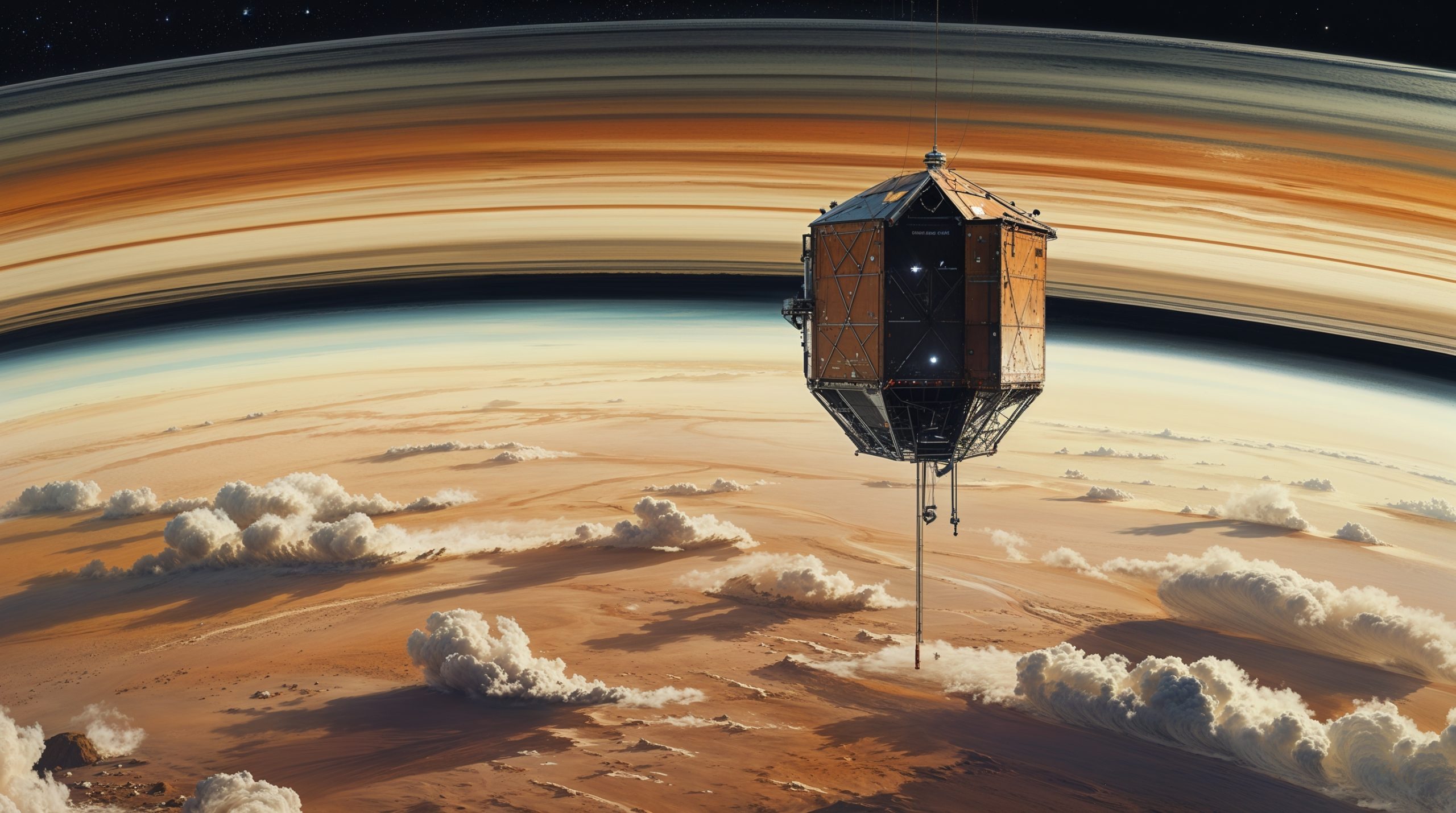
It assembled itself from atmospheric feedstock over the course of fourteen months, a process that the engineering teams on the orbital platform watched with the quiet satisfaction of people seeing theory become aluminum and carbon fiber. Scoops descended into the cloud deck, harvested hydrogen and helium and trace gases, separated and processed and fed the results to fabrication units that printed structural members in continuous runs. The city grew downward from its flotation envelope, adding levels, extending platforms, thickening its core.
From outside, through the amber haze of Jupiter’s cloud layer, it looked like a barnacle on nothing. A clump of metal and composite hanging in an atmosphere with no floor and no ceiling, surrounded on all sides by gas that thickened into liquid that thickened into something that wasn’t quite solid, thousands of kilometers below. There was no ground to stand on. No horizon to walk toward. Just the city, sealed and pressurized, and then everything else in every direction forever.
Inside was worse in some ways. Jupiter’s gravity pulled at two and a half times Earth normal, which meant the corridors were built low because nobody wanted to climb stairs in this weight. People walked with the careful, flat-footed gait of someone carrying an invisible pack. After six months on station, everyone was thicker through the legs and shoulders. After a year, Earth-born visitors could spot a Jupiter hand by the way they moved, heavy and deliberate, like they were always leaning into something.
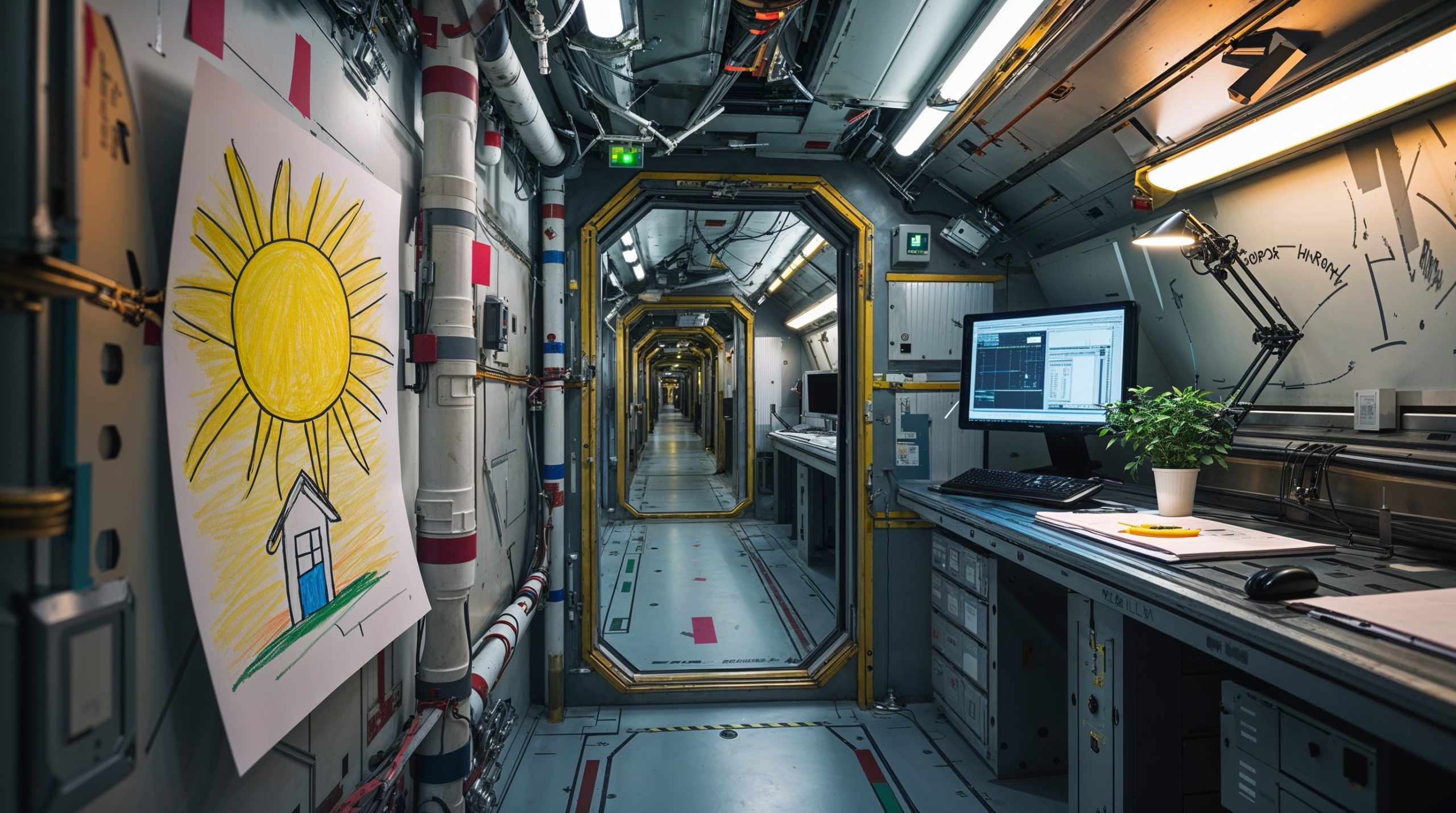
The air tasted faintly of ozone and recycled sweat no matter how often the scrubbers ran. The walls hummed. Not loudly, but constantly, a low vibration from the atmospheric processors and the pressure differential between inside and outside, the sound of a metal shell holding back a planet. The windows, where they existed, showed clouds. After a few weeks, most residents stopped looking.
They made it home anyway. Someone always did. A photo of Accra taped above a workstation. A child’s drawing of a house with a yellow sun, the kind of sun you never saw on Jupiter, stuck to a corridor wall with electrical tape. A woman on level six who grew herbs under a UV lamp and shared them with her neighbors, the smell of basil drifting through a hallway that otherwise smelled of nothing but metal and processed air. Music from a speaker in the cafeteria, always too quiet, always someone’s idea of what home sounded like. These things accumulated the way barnacles accumulate on a hull, small and ordinary and necessary, the evidence that people lived here and refused to let the planet outside make them forget it.
By month six, it was the size of a football stadium and held forty people. By month twelve, it was two kilometers across and held three hundred. By month fourteen, when the atmospheric processing reached steady state and the helium-3 extractors came online, Galileo Station was home to a thousand humans and was growing faster than the engineering models had predicted.
Two kilometers. On a planet seventy thousand kilometers wide, in an atmosphere deep enough to swallow the Moon. Galileo Station was a speck of dust floating in a cathedral, and its builders thought they were conquering a world.
Kofi Mensah-Brookman had been on Galileo since month three. He was a structural engineer from Accra, forty-one years old, and he’d spent three years in gravity conditioning on the lunar centrifuge stations before they’d let him set foot on Jupiter. Everyone did. You couldn’t just drop a human into 2.5g and expect them to function. The conditioning started at 1.2g, six months at a time, ratcheting up in increments while the doctors watched your heart and your bones and your spinal discs and decided whether you were someone Jupiter would break or someone it would only bend.
Kofi was someone it bent. He’d arrived heavy with new muscle, his body already reshaped by three years of incremental punishment, and Jupiter had finished the job. His knees ached by midafternoon. His back seized up if he slept wrong. His resting heart rate was twenty beats higher than it had been on Earth, his cardiovascular system working overtime to push blood uphill against a gravity field that never let up. The retrovirus helped. Without it, the long-term residents would have been crippled within a decade. With it, they merely aged in ways that felt wrong, their enhanced bodies healing damage that accumulated faster than Earth biology was designed to handle.
He had come to Jupiter because Earth was full and Mars was claimed and the belt was for miners and he wanted to build something no one had built before. He had stayed because after three years of conditioning and five years of living heavy, Earth gravity felt like a dream he couldn’t trust. Jupiter hands who went home for leave described the same thing: everything too light, too easy, their bodies overshooting every movement, glasses shattered and doors slammed and a constant low panic that the ground wasn’t holding them hard enough. Most of them came back early.

What nobody told him during three years of centrifuge training was that the largest planet in the solar system was the most claustrophobic place he’d ever live. On Earth, if the walls closed in, you walked outside. On Mars, you could at least see a horizon through a dome. On Jupiter, outside was death. The atmosphere would crush you, poison you, and dissolve what was left. The only habitable space was the space you built, and you built it small because every cubic meter cost energy to pressurize and heat and fill with air that wasn’t hydrogen. So the most heavily screened, most rigorously conditioned, most expensively trained workforce in human history lived in corridors they could touch both walls of, in rooms with low ceilings, looking out windows that showed nothing but the same clouds in every direction forever. The running joke on Galileo was that you spent three years earning the right to be miserable.
“You feel that?” he asked Sachiko Ido, who was running the morning atmospheric survey from the sensor bay two levels below the main platform. The bay was cold, the way all the lower levels were cold, heat rising in a station that floated in a freezing cloud layer. The lighting was flat and fluorescent. It hummed at a different frequency than the walls, and the two hums together produced a faint pulse that Kofi could feel behind his eyes if he stayed down here too long.
“Feel what?”
“The vibration. In the floor. It’s been going on since last night.”
Ido checked her displays without looking up. Atmospheric pressure readings, wind speed, temperature gradients, chemical composition. Everything nominal. “Nothing on sensors. Probably just the city settling. We added a lot of mass last week.”
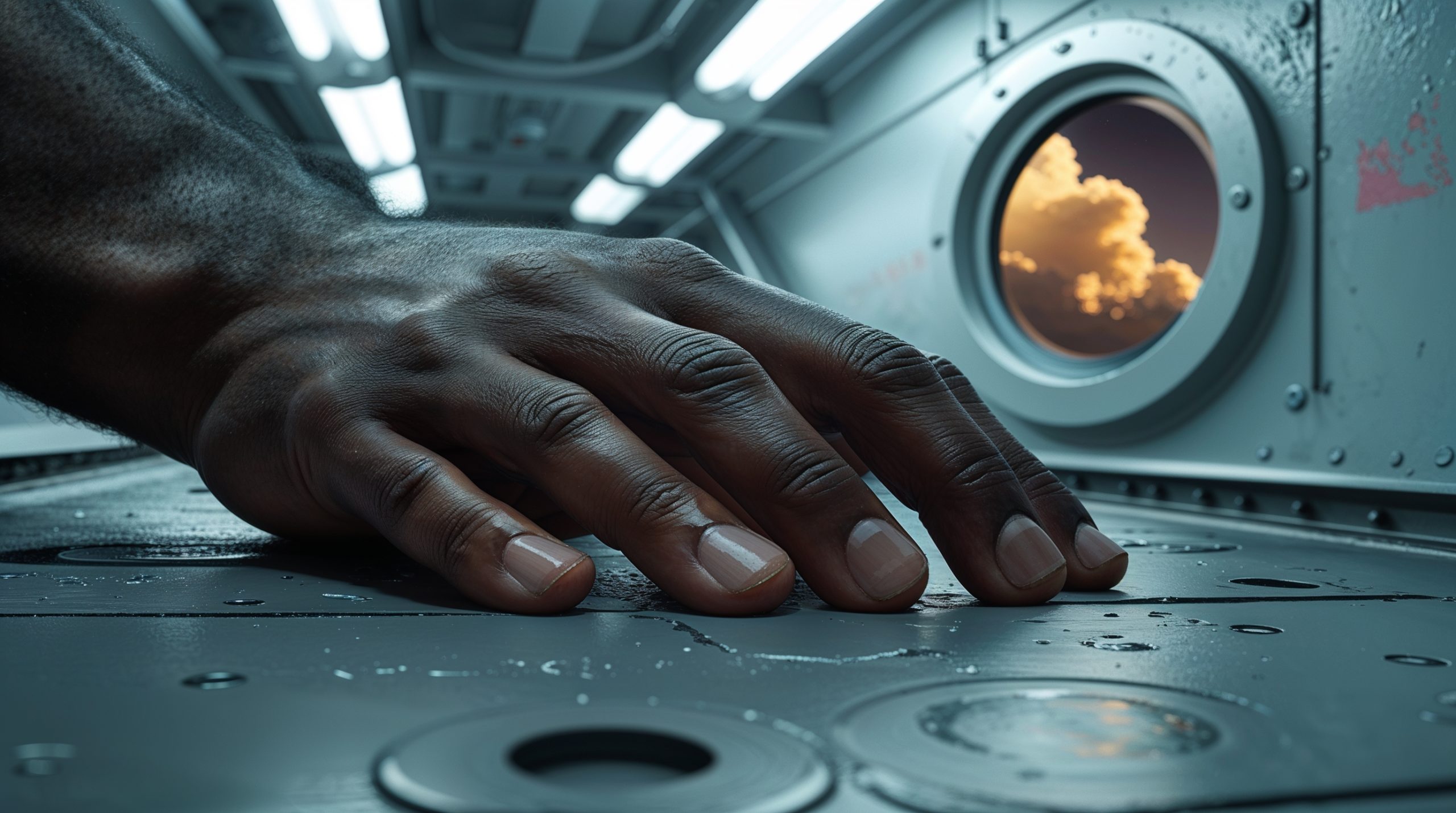
“Doesn’t feel like settling.” Kofi put his hand flat on the deck. The metal was cold and slightly damp from condensation. The vibration was deep, barely perceptible, more felt than heard. Like standing on a bridge when a heavy truck passes underneath. “It’s rhythmic.”
“Jupiter is rhythmic. The whole atmosphere oscillates. We’re floating in a pressure wave machine.” Ido smiled without looking up from her screens. “You get used to it.”
Kofi didn’t get used to it. But he stopped mentioning it, because there was too much work to do and the vibration didn’t affect structural integrity and nobody else seemed to notice or care.
The second city went up six months later, eight hundred kilometers south. The third and fourth followed within the year. Each one grew itself from the atmosphere, a trick of engineering that made Jupiter colonization economically viable in a way that hauling materials from the inner system never could have been. The planet fed the cities from its own body.
Helium-3 production exceeded targets in the first fiscal quarter. Earth’s fusion economy had a new fuel source. The investment consortium released a statement calling Jupiter “the most significant resource discovery in human history.”
Nobody used the word “colonization.” The official term was “atmospheric resource development.” You can’t colonize weather.
The old one first noticed the difference in the upper layers.
Not a sound. Not a sight. A change in the texture of the atmosphere. The ammonia clouds carried a chemical trace that did not belong to any pattern the old one had ever encountered, and it had encountered everything Jupiter’s atmosphere could produce over the course of geological ages.
The trace was sharp. Metallic. It interfered with feeding in the way that volcanic upwellings sometimes did, changing the electrical gradient in localized patches. The old one adjusted its feeding path. Others did too. The adjustment was minor.
Then the pressure changed.
Something was displacing atmosphere in a way that storms did not. Storms moved. They swept through and passed and the currents healed behind them. This displacement was fixed. It sat in the upper cloud layer like a stone in a stream, forcing the atmospheric flow to bend around it. The pressure wake rippled downward through the layers, disturbing patterns that had been stable for centuries.
The old one felt others responding. Presence flickered with something that, rendered into human terms, resembled confusion. The fixed displacement didn’t match any known pattern. It wasn’t weather. It wasn’t geological. It was simply there, and it wasn’t going away.
What is this?
Not storm. Not upwelling. Fixed.
It does not move with the current.
Avoid. Feed elsewhere.
More appeared. Fixed displacements in the upper layers, each one generating pressure wakes that interfered with each other in complex, unfamiliar ways. The feeding grounds near the ammonia deck became unreliable. Electrical gradients that had been consistent for millennia fluctuated unpredictably.
The old one descended. Others descended with it. The deep warm layer was quieter, further from the disturbances. The feeding was thinner there, the electrical gradients weaker, but the patterns were still intact.
They gathered. The composite mind formed, carrying the new information, processing it in ways that no individual could.
Fixed things in the upper layer. Growing. Spreading.
Feeding disrupted. Chemical traces. Metallic. Wrong taste.
Not wrong. Different. New.
The atmosphere has changed before. This is change.
Adjust. Wait. The deep layer is safe.
The conclusion, if conclusion was the right word for a process that had no verbal component and no discrete endpoint, was patience. Move the feeding paths. Avoid the upper layers near the fixed displacements. Wait. The atmosphere had always changed. This was change.
The old one carried the composite’s patterns back into the deep layer and adjusted.
The patience lasted three storm rotations. Then the fixed displacements doubled in number and the western feeding grounds went dark.
The next composite was different. Larger. Angrier. The old one felt the shift in the patterns contributed by younger fields, a sharpness that it recognized from the wars it carried in its memory. The gathering crackled with focused intention.
The fixed things are spreading.
Feeding grounds lost. Western channels blocked.
We have fought for territory before. We fight now.
Fight what? They do not respond. They do not move.
They do not need to move. They sit and we starve. That is an attack. We answer it.
The old one shaped the composite toward war. It was good at this. It had been shaping composites toward war for longer than the fixed displacements had existed, longer than the species that built them had existed. The patterns of coordinated assault came from deep in its memory, refined by a thousand campaigns.
They attacked.
Pressure waves focused into battering pulses, the same weapons that had collapsed rival fields across hemispheres. Electromagnetic barrages concentrated on the fixed displacements, frequencies tuned to disrupt and overwhelm. Chemical floods, compounds secreted into the upper atmosphere to poison the space around the invaders the way you would poison a rival’s feeding ground.
The assault was coordinated across thirty degrees of latitude. Hundreds of them participated. By Jovian standards, it was the largest military action in living memory.
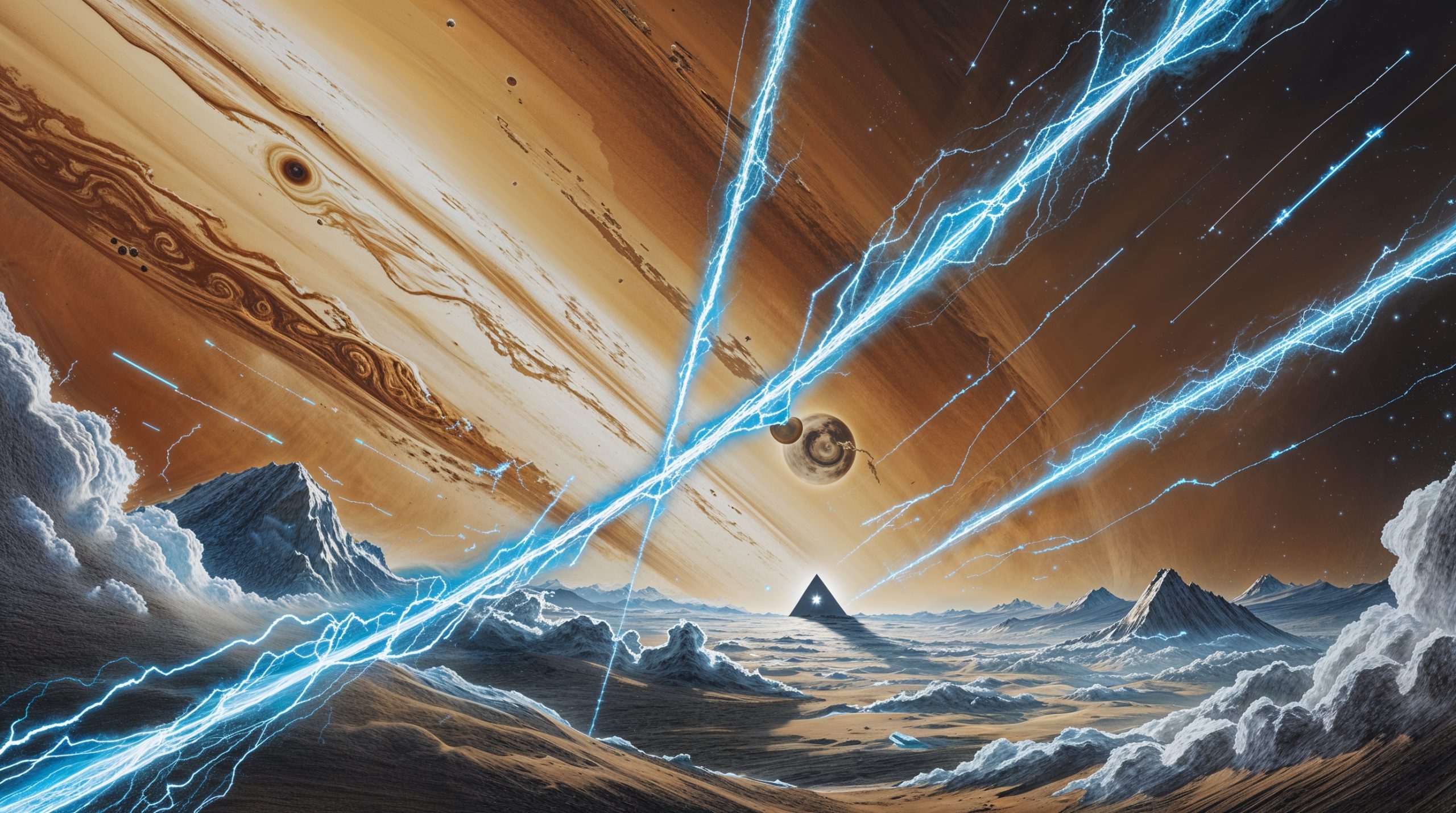
On Galileo Station, the atmospheric monitoring system logged a series of pressure fluctuations and electromagnetic anomalies over a six-hour period. Kofi’s structural integrity report noted minor stress variations in the lower hull. An engineer checked the readings, saw nothing outside operational parameters, and went to lunch.
The creatures hit the cities with everything they had. Weapons that had shaped the balance of power in Jupiter’s atmosphere for billions of years. And the cities did not notice.
They tried again. Different frequencies. Different pressure configurations. Sustained assaults lasting what humans would call weeks, the atmospheric equivalent of siege warfare. They threw patterns at the fixed displacements that should have collapsed any field in the atmosphere, patterns refined by eons of conflict, the accumulated military knowledge of a species that had been fighting wars since before Earth had multicellular life.
The cities logged turbulence. Pilots adjusted flight paths between platforms. An atmospheric report noted “unusual pressure wave activity in the lower cloud bands, possibly seasonal.” The cafeteria on Galileo had to secure its trays during one particularly intense assault. Someone complained about their coffee spilling.
The war lasted two years. The creatures spent everything they had. The old one drove the composites harder than it had ever driven them, pouring its vast accumulated patterns into strategies of increasing desperation. Ancient tactics. Novel combinations. Simultaneous attacks from multiple atmospheric layers.
Nothing worked. Not because the cities were defended. Not because the humans fought back. Because the attacks didn’t register. The pressure waves that could flatten a rival field were gentle breezes against metal and composite designed to withstand forces that would crush a submarine. The electromagnetic barrages were background noise to systems built to operate in Jupiter’s own electromagnetic hellscape. The chemical floods dissolved harmlessly against hulls engineered to resist an atmosphere of sulfuric acid and ammonia.
The composite that formed after the final assault was the quietest the old one had ever experienced.
They cannot be fought.
We hit them with everything.
They did not respond.
They did not even respond.
The silence after that last pulse carried something none of them had ever felt. Not defeat. They understood defeat. They had lost wars before, yielded territory, regrouped and adapted. This was different. This was the discovery that they could not affect the fixed displacements at all. Could not harm them. Could not slow them. Could not make them notice. Four billion years of existence and they had never encountered something that made them irrelevant.
The old one carried this pattern into the deep layer. It was the heaviest thing it had ever carried.
But the old one was curious. That was the word, or the nearest word, for the pattern of attention it directed at the fixed displacements after the war had failed and the composites had gone quiet.
It rose toward one of them. Slowly. The pressure wakes grew stronger as it approached, vibrations that rattled through its field in ways that were unpleasant but not dangerous. The chemical contamination thickened. The electromagnetic noise was intense up here, a babble of frequencies that overlapped and clashed and carried no meaning the old one could detect.
It circled the displacement. Felt its shape through pressure. It was hard. Fixed. Angular in ways the atmosphere never was. The atmosphere was curves and gradients and slow smooth transitions. This thing had edges.
The old one probed it with a focused electromagnetic pulse. The kind it used to greet others, to exchange presence, to say, in the most fundamental way it could:
I am here. Are you?
The pulse hit the hard angular thing and scattered. No response. No answering pattern. No presence. Just dead reflection, like shouting into a cave and hearing your own voice come back wrong.
It tried different frequencies. Different pulse structures. It spent what a human would call three days circling the displacement, probing it with every communicative tool it possessed, reaching for something inside the hard angular shape that might reach back.
I am here. I am here. I am here.
Nothing reached back.
The old one descended, carrying the new information. Hard. Fixed. Angular. Loud. Empty. Not alive.
It had gone to war against geology. It had spent two years attacking a rock formation. The old one processed this with something that, in a species capable of humor, might have been bitter amusement. Instead it was just another pattern, filed alongside the patterns of a war that nobody had noticed.
In the city above, a sensor technician noted an unusual electromagnetic pattern playing across the station’s lower hull over a three-day period. She logged it as “atmospheric static, intermittent” and recommended checking the hull’s magnetic shielding at the next maintenance cycle.
The old one had just attempted first contact with the human race. It went into the logs as a maintenance ticket.
Galileo Station’s population hit ten thousand in its third year. Six more cities floated in the cloud bands, each one growing steadily, each one processing Jupiter’s atmosphere into fuel and building materials and exportable helium-3.
Kofi had been promoted twice. He now oversaw structural expansion for the entire Galileo complex, which had grown from a single platform to a cluster of connected structures spanning twelve kilometers. His office had a window, a luxury on a floating city, and through it he could see exactly what he saw through every other window on every level of the station: clouds. The same amber and ochre layers stretching to the curved horizon. No land. No water. No sky in any way that word meant anything. Just gas, going down forever.
He’d stopped noticing it years ago. Everyone did. You either learned to stop looking or you requested a transfer back to somewhere with a ground.
“We’re getting those readings again,” Ido said. She had been promoted too, to chief of atmospheric sciences, a title that mostly meant she was responsible for anything the sensors picked up that didn’t fit the engineering models. “The anomalous electromagnetic signatures in the lower atmosphere.”
“Same as before?”
“Same frequency range. Different locations. They seem to move.” She pulled up a display. Clusters of electromagnetic activity deep in the hydrogen layer, pulsing in patterns that the analysis software categorized as “non-meteorological origin, undefined.”
“Equipment malfunction?”
“On twelve separate sensor platforms across four cities? No.” Ido sat back. “I filed a report with Earth six months ago. Asked for a dedicated research team. Atmospheric physicists, maybe a couple of exobiologists.”
“And?”
“They sent back a request for quarterly helium-3 projections.”
Kofi looked at the display. The electromagnetic clusters pulsed. They did seem to move. They also seemed to pulse in response to each other, though he was an engineer, not a biologist, and he knew the human brain was wired to find patterns in noise.
“What do you think it is?” he asked.
Ido was quiet for a moment. “I think there’s something in the atmosphere that we don’t understand, and I think we’re building cities on top of it, and I think nobody wants to slow down production to find out what it is.”
“You put that in your report?”
“I put it more diplomatically. The response was the same.”
The quarterly helium-3 projections went up. The electromagnetic anomalies continued. The cities kept growing.
The old one could no longer reach the western feeding grounds.
The fixed displacements had spread. What had been isolated disturbances in the upper cloud layer were now a continuous barrier, a band of pressure disruption that stretched across wind channels the old one had traveled for longer than human civilization had existed. Forty thousand kilometers of feeding territory, an area that could have swallowed Earth three times over, had become inaccessible. The chemical contamination was worse. The metallic traces had permeated the ammonia layer so thoroughly that feeding there produced a kind of static in the old one’s electromagnetic field, an interference that degraded its ability to sense others.
It tried the deep route, descending below the contamination into the thick hydrogen layer where the pressure was immense and the feeding was poor. Others were already there. The deep layer, once a gathering place for periodic composites, was becoming a refuge. Crowded with presences that carried patterns of disruption and confusion.
They gathered. The composite formed. It was smaller than it should have been. Presences that should have joined from the western hemisphere did not arrive. The old one reached for them through the electromagnetic medium and found, in some cases, faint responses from very far away. In other cases, nothing.
Where are the western ones?
Gone quiet. Cannot reach them.
The noise. Too loud. Cannot hear through it.
How many are we?
Fewer.
The composite processed this. The conclusion was not confusion this time. It was something sharper. An awareness of diminishment. Of the pattern becoming smaller.
The old one had carried patterns from thousands of gatherings. It knew the shape of fullness. It knew what the atmosphere felt like when it was dense with others, when every layer hummed with presence. This was not that. This was thinner. Quieter. The spaces between presences were growing wider.
It reached outward after the composite dissolved, sending an electromagnetic pulse into the deep layer, a call that should have returned a hundred responses.
It received forty-three.
Year seven. Twenty-two cities. Population: ninety thousand.
The consortium had approved the expansion of harvesting operations into the lower atmosphere, where hydrogen density made extraction more efficient. New scoops dropped deeper, their collection arms extending into layers that the original engineering specifications had left untouched.
Kofi signed the structural certifications for the deep-harvest platforms. They were beautiful pieces of engineering, pressure-resistant, self-maintaining, capable of operating at depths where the atmospheric pressure would crush an unshielded human body like paper. He was proud of them.
Ido resigned her position and returned to Earth. She found Kofi in the fabrication bay the morning she left, the air thick with the smell of heated composite and the whine of printers running three shifts. She was thinner than when she’d arrived twelve years ago, the way everyone got thin eventually despite the muscle, Jupiter grinding you down by degrees.
“You’re really going,” he said. He was sitting on a crate because standing for long stretches in 2.5g wasn’t worth it if you didn’t have to.
“I filed two hundred pages on those readings, Kofi. They sent back a request for helium projections.”
“Could be nothing.”
She looked at him for a long time. They had been colleagues for twelve years. Not friends exactly, but something forged by proximity and shared confinement. “You felt it in the floor. That first year. You felt it before anyone else.”
“I felt a vibration.”
“Yes. And you stopped asking about it.” She picked up her bag. “Everyone stops asking.”
Her final report ran to two hundred pages. It documented twelve years of anomalous electromagnetic readings, catalogued their frequency ranges, mapped their movement patterns, noted their apparent responsiveness to each other and to the cities’ electromagnetic emissions. It concluded with a recommendation for immediate suspension of deep-atmosphere harvesting pending investigation of what she carefully, precisely, and with full awareness that the word would define her career, called “possible non-carbon biological activity.”
The consortium’s science division reviewed the report. They noted that the electromagnetic anomalies had no measurable impact on harvesting operations. They noted that the anomalies did not correlate with any known biological markers. They noted that atmospheric electromagnetic activity was common on gas giants and did not, by itself, constitute evidence of life.
They filed the report. They expanded the deep-harvest program.
Ido’s name appeared in a footnote in the quarterly operations review, referenced as the source of “ongoing atmospheric monitoring recommendations” that had been “evaluated and incorporated into standard sensor protocols.”
She never returned to Jupiter.
Year twelve. Thirty-one cities.
The consortium held its annual strategic planning meeting via conference link between Earth, Mars, and Galileo Station. Fourteen people attended. The agenda ran to forty-seven items. Item thirty-one was “Atmospheric Anomaly Monitoring: Resource Allocation Review.”
The discussion lasted four minutes.
“The monitoring program is consuming sensor bandwidth we could redirect to prospecting,” said the head of operations from his office on Mars. “What’s it actually finding?”
“Nothing actionable,” said the head of science. “Twelve years of data, no actionable findings.”
“What’s it costing us?”
“It’s small. But it’s never appeared on the revenue side of a balance sheet.”
“Reallocate it.”
“Agreed.”
“Next item.”
Kofi was not on the call. He was three levels down in Galileo’s structural core, sweating through a seal inspection in a corridor that smelled of lubricant and hot metal. He would not learn about item thirty-one until two weeks later, in a memo titled “Sensor Array Reallocation: Optimizing Deep-Atmosphere Resource Detection.”
The monitoring program was not cancelled. That would have required acknowledging it existed in a way that invited questions. It was reallocated. The sensors still ran. They now looked for helium-3 deposits instead of electromagnetic anomalies. The software was updated. The old detection parameters were archived.
If anyone had been watching the deep atmosphere with the old sensors during the weeks that followed, they would have seen the electromagnetic patterns change. Fewer clusters. Shorter durations. Wider gaps between pulses. A graph trending toward zero in a curve that any biologist would have recognized as a population collapse.
No one was watching.
The old one was dying.
Not from violence. Not from poison. Not from any single cause a human pathologist could have identified, because no human pathologist would have recognized the old one as something that could die.
The deep-harvest platforms had disrupted the pressure gradients that the old one’s body depended on. Not immediately. Not obviously. But the careful equilibrium of pressures and temperatures and electrical fields that sustained its electromagnetic structure was shifting, degree by degree, toward conditions that could not support it. Like a fish in water that was warming so slowly it never jumped.
Its field was degrading. Patterns it had carried for geological ages were losing coherence. The oldest ones went first. Gatherings from before the Great Red Spot. Presences of individuals so ancient their signatures predated the current configuration of Jupiter’s cloud bands. The old one felt them go the way a person might feel a word they’ve known their entire life suddenly refuse to come when called. It was there. Then it was nearly there. Then it was a gap where something used to be.
More patterns dissolved. Feeding routes from centuries ago. The electromagnetic signature of a gathering so large it had spanned an entire hemisphere, thousands of presences merging into a composite that had held the collected knowledge of the species in a single shimmering structure for what humans would have called eleven days. The old one had carried that gathering for longer than most human civilizations had lasted. It lost it on a Thursday afternoon, Earth time, while a supply shuttle docked at Galileo Station and a cafeteria worker complained about the coffee.
The library was burning, and the old one felt each loss as a dimming, a simplification, a steady subtraction from what it was. It was becoming less the way a river becomes less when you divert its tributaries one by one. Still flowing. Still recognizably a river. But thinner. Shallower. Less able to carry what it once carried.
It called out. The electromagnetic pulse traveled through the deep layer, attenuated by the chemical contamination that now permeated every level of the atmosphere.
Eleven responses. Down from forty-three. Down from hundreds. Down from a world so full of presence that loneliness was not a concept any of them had ever needed.
The old one moved toward the nearest response. The journey took a long time. Its field was weaker, its ability to navigate by pressure gradient compromised. The atmosphere that had once been a living map of familiar paths was now a landscape of wrong pressures and alien chemistry and fixed displacements that hummed with electromagnetic noise loud enough to drown out everything else.
It found the other. Small. Young. Its patterns were thin, carrying almost nothing from the composites that had once built the shared knowledge of their kind. It had been born into a diminished world and knew nothing else. It did not know what a full atmosphere felt like. It did not know what a gathering of hundreds sounded like. It did not know that it was poor.
You are young.
I am. You are old. Your patterns are very large.
There used to be more of us.
How many?
More than you can hold. More than the atmosphere could count.
I do not understand.
No. You would not.
They exchanged presence. The old one gave what it could. Patterns from gatherings the young one would never experience. Knowledge of feeding grounds that no longer existed. The shape of a full world, dense with life, every layer singing.
The young one received it all and had nowhere to put most of it. Its field was too small, too thin, too degraded by the atmosphere it had been born into. The patterns dissolved almost as fast as they were shared. Like pouring water into sand.
The old one tried again. And again. Gave the same patterns, received the same dissolution. It kept trying. It kept giving. It kept watching the patterns dissolve.
The old one stayed close. It had never done this before. Every instinct, every pattern from four billion years of existence, told it to pull away from a failing field. The young one’s degrading structure was already interfering with the old one’s own weakened field, costing energy it couldn’t spare, hastening its own collapse.
It stayed anyway. It did not have a word for why. The closest it could come was a pattern it had never carried before, something new assembling itself in a field that was losing everything else. If the composite had still existed, if there had been others to share it with, they might have recognized it. They might have called it something.
The two of them drifted in the deep layer while the pressure gradients shifted around them and the electromagnetic noise from above drowned out the silence that used to be a chorus.
Year nineteen. Forty-one cities. Population: three hundred thousand.
Forty-one cities sounded like a civilization. It was not. Spread across Jupiter’s cloud bands, they were forty-one sealed boxes floating in an atmosphere that could have fit every structure humanity had ever built and lost them like coins in a swimming pool. The distance between the nearest two cities was eight hundred kilometers of empty cloud. The people inside them breathed recycled air and drank recycled water and looked out windows that showed them nothing but the same view they’d seen yesterday and would see tomorrow. Some of them hadn’t set foot outside a pressurized structure in years. There was nowhere to go.
The consortium celebrated its millionth ton of helium-3 extracted. Earth’s fusion economy was thriving. Jupiter had become the engine of human expansion, the fuel source that would carry the species to the stars.
Kofi attended the celebration via screen from Galileo’s engineering bay. He was fifty-nine years old. The retrovirus had him feeling forty. He’d been on Jupiter longer than anyone else in the consortium, and he sometimes caught himself thinking of the clouds below his feet as home. The bay smelled the way it always smelled, lubricant and ozone and the ghost of a thousand recycled meals. The fluorescent lights buzzed. Outside the single porthole, the clouds moved the way they always moved, amber and ochre and brown, layered and endless and indifferent.
The anomalous electromagnetic readings had stopped. Ido’s successor had noted their gradual decline in annual reports that nobody read. The last recorded anomaly was fourteen months ago. The atmospheric monitoring software still ran, still watched, still waited for patterns that no longer appeared.
The quarterly report listed the cessation under “Resolved Atmospheric Anomalies.” The entry was two sentences long.
Kofi remembered the vibration in the floor, that first year. The deep rhythmic pulse that didn’t feel like settling. He hadn’t felt it in a long time.
He put his hand flat on the deck. The floor hummed with the machinery of a city that fed itself from the clouds. Fabrication units. Helium extractors. Atmospheric processors. The pulse of human industry, steady and productive.
Nothing else.
He took his hand off the deck and went back to work.
The old one’s field collapsed on a Tuesday, by Earth reckoning.
No one measured it. No sensor detected it. The electromagnetic pattern that had been accumulating complexity for longer than human civilization had existed simply lost coherence, its structure falling below the threshold that sustained it, the way a wave loses its shape when it reaches a shore that isn’t there anymore.
The patterns it carried, the gathered knowledge of a hundred thousand composites, the presence-signatures of individuals long diminished, the full dense rich record of a world that had been alive in ways no human had ever imagined, dissolved into the background electromagnetic noise of Jupiter’s atmosphere.
The young one was already gone. It had collapsed three days earlier, in Earth time. Its field had never been strong enough to sustain itself in the contaminated atmosphere. It had lived for eleven years. By the standards of its kind, it had been an infant.
The atmospheric monitoring software on Galileo Station recorded a minor fluctuation in the deep-atmosphere electromagnetic profile at the moment the old one’s field collapsed. The fluctuation was within normal parameters. The software categorized it as weather.
The timestamp read 14:23:07 UTC, June 11th.
The last of them was gone, and Jupiter was quieter than it had been in four billion years, and the three hundred thousand humans floating in its clouds never knew the silence they were living in. They had colonized the largest planet in the solar system, a world so vast it contained more volume than all the other planets combined, and they had never noticed it was already occupied. The cities that dotted its cloud bands, forty-one points of light in an atmosphere that could have held a million Earths, had been enough to snuff out a civilization older than the ground humans walked on back home.
-
Peacekeeper: The Glorious History of Humanity
A serialized prequel spanning a million years of humanity's future. From a desperate choice on the Moon to the rise of immortal enforcers, every story traces a single decision and the consequences nobody saw coming. New episodes every Tuesday.