
The Bright Gamble
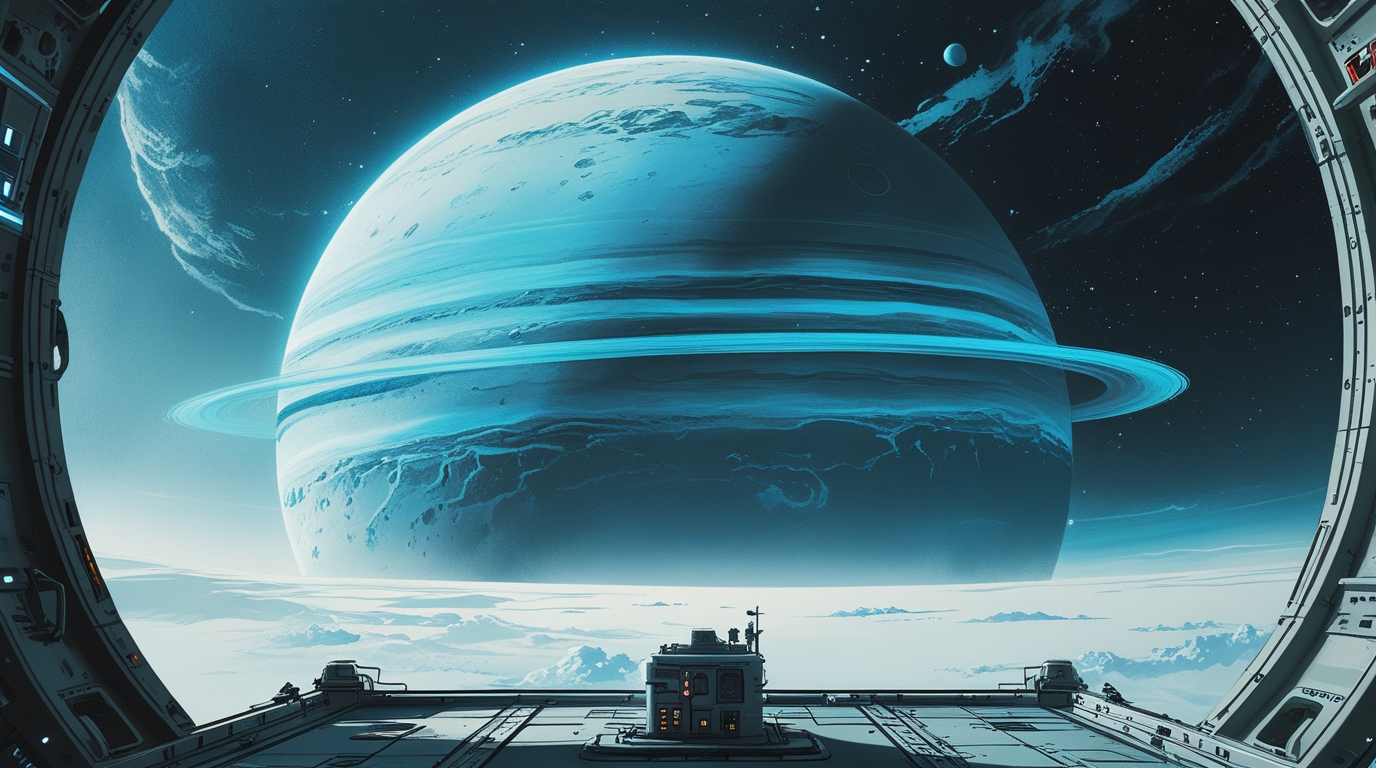
The morning of the test, Tomás Reyes woke to the light of Uranus.
It filled the viewport of his quarters on Platform Prometheus, a blue-green giant rolling slow and ancient through the dark. Ice clouds banding its surface in shades of cyan and teal, storms the size of continents spinning in silence. He’d lived in its orbit for three years and the sight still stopped him. There was something about a gas giant up close that the images never captured. The scale. The indifference. A world so vast it had weather systems older than human civilization, and it didn’t know or care that a thousand engineers had built a station in its shadow.
“Good morning, Dr. Reyes. Test window opens in four hours, twelve minutes.”
“Thank you, Prometheus.” The station AI was efficient and bland. Nothing like the stories about the old AIs, the ones with personality, the ones that argued. Those were gone. The Keane administration had made sure of that, two generations ago. Station intelligences now were tools. They answered questions and managed systems and never once made you feel like they were thinking about you when you weren’t in the room.
Tomás showered, dressed, ate a breakfast he wouldn’t remember, and walked the curved corridor to the main lab. His reflection paced him in the polished wall panels. Forty-four years old. Mexican by ancestry, Martian by birth, a citizen of nowhere in particular because the outer system didn’t recognize Earth’s borders and Earth didn’t recognize anything else. He’d spent twenty years on the math that had brought him here. Half his life pointed at this morning.
The lab was already full. Eighteen people, the best in their fields, hand-picked by a selection process so competitive that three of them had published foundational papers before the age of twenty. Dr. Kenji Watanabe at the primary console, running pre-flight diagnostics with the unhurried precision of a man who had checked the same numbers four hundred times and intended to check them four hundred and one. Dr. Sana Korošec calibrating the containment field generators, her hands steady, her mouth moving silently through calculations she’d long since memorized. The rest at their stations, doing the thousand small things that had to be perfect for one big thing to work.
“Morning, boss.” Kenji didn’t look up. “Everything’s nominal. Again.”
“Run it again.”
“I have run it again. I’m running it again right now. I will run it again after this. At some point you’re going to have to accept that the machine works.”
“The machine works when it works. Not before.”
Sana glanced over. “He’s nervous.”
“I’m not nervous.”
“You ate breakfast in four minutes. You eat breakfast in four minutes when you’re nervous.”
“I eat breakfast in four minutes when I’m efficient.”
“You’re nervous.” She went back to her calibrations. “That’s fine. I’d be worried if you weren’t.”
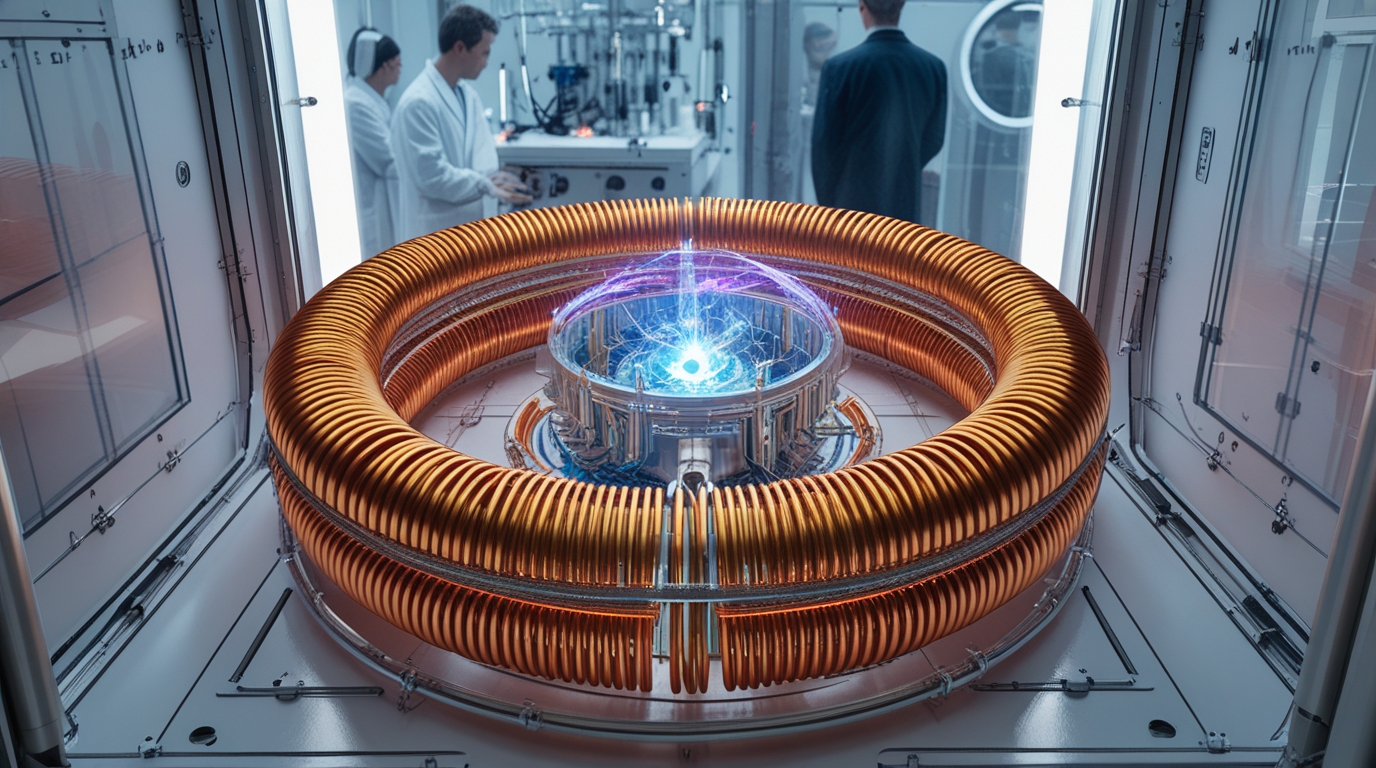
Tomás looked at the device. It sat in the center of the test chamber, visible through the reinforced observation window. Not much to look at. A torus of superconducting coils wrapped around a core of exotic matter that had taken six years to synthesize. The whole thing was the size of a groundcar. It was going to fold spacetime.
Or it wasn’t. That was the question the entire solar system was asking, though not everyone was asking it with the same enthusiasm. Earth wanted FTL. The Keane administration had funded the project at a level that made previous physics research look like pocket change. The outer system colonies wanted Earth’s scientists to stop playing with forces they didn’t understand in someone else’s backyard. Miranda, Titania, and Oberon had filed formal protests. Earth had overruled them. The gravity well of Uranus was necessary for the test. You couldn’t fold spacetime against nothing. You needed mass. Enormous mass. A planet’s worth.
Tomás had stood before the oversight committee and assured them the test was safe. He’d shown them the math. The containment models. The failure scenarios, all of which ended with the device shutting down, not blowing up. He’d been persuasive because he’d been honest. He believed every word.
The test was at 4.7% of theoretical maximum. A whisper. A proof of concept. Phase two, at 15%, was already approved for six months out. But today was just a toe in the water.
He checked his personal comm. A message from Ximena, timestamped an hour ago. A photo of Emilio at breakfast, nine years old and scowling at something off-camera, hair still wild from sleep. The message read: He says good luck. He also says can you bring him a rock from Prometheus. I told him it’s a station not an asteroid. He doesn’t care.
Tomás smiled. Typed back: Tell him I’ll bring him a piece of folded spacetime instead. Much cooler than a rock.
He’d see them tonight. Titania was six hours away by shuttle. The test would be over by noon. He’d file the preliminary data, hand off the post-test analysis to Kenji, and be on the 1400 shuttle. Home for dinner. Emilio would want to hear everything and understand none of it and ask questions that were accidentally profound, the way nine-year-olds did.
He put the comm away and went to work.
The secondary lab was running the artificial gravity experiment. Dr. Priya Chandrasekaran had confirmed the results three times and was running a fourth because, like Tomás, she didn’t trust results that seemed too good.
“It works,” she told him, when he stopped by at 0900. “Reproducible. Consistent. Real.”
“Power requirements?”
“Stellar.” She said the word flat. “You’d need to harness a star. The energy input required to generate a stable one-g field across a ship-sized volume is beyond anything we can produce. Fusion won’t do it. Nothing we have will do it. You’d need to wrap a Dyson sphere around a main-sequence star and pipe the entire output into the generator.”
“So it’s useless.”
“It’s confirmed. Useless and confirmed are different things. Today we proved artificial gravity is physically possible. Someday someone will figure out how to power it.”
“That’s a generous definition of useful.”
“I’m a generous person.” She turned back to her console. “Go fold your spacetime. Some of us are working on technologies that don’t require a planet to test.”
He laughed. He liked Priya. She was the only person on the station who could make him laugh on test day.
1147 hours. Thirteen minutes to test window.
The observation deck was full. Every off-duty crew member on Prometheus had found a reason to be there. Through the main viewport, Uranus rolled in silence, blue-green and immense. Through the test chamber window, the device sat in its cradle, coils glowing faintly as the pre-ignition sequence warmed the exotic matter core.
Tomás stood at the primary console. Kenji to his left. Sana to his right. The rest of the team at their stations. Every display showed green. Every readout nominal. The containment field was stable. The power grid was balanced. The gravity well of Uranus, mapped to fourteen decimal places, held its shape exactly as predicted.
“Platform Prometheus, this is Earth Central. You are cleared for test. Confirm readiness.”
“Earth Central, Prometheus. We are go for test. All systems nominal.”
“Copy, Prometheus. The window is yours. Good luck.”
Tomás muted the channel. Looked at his team. Eighteen faces, eighteen variations on the same expression: controlled terror disguised as professional focus.
“This is it,” he said. “Twenty years of math. Six years of engineering. Everything we’ve built. Everything we’ve argued about. Everything we’ve lost sleep over. It all comes down to the next three minutes.” He paused. “If this works, we change the species. If it doesn’t, we learn something. Either way, I’m proud of every one of you.”
“Boss,” Kenji said. “Stop giving a speech and push the button.”
“Initiating FTL fold sequence,” Tomás said. “Countdown from ten.”
He pushed the button.
The numbers climbed. Power output rising along the curve he’d calculated a thousand times. The exotic matter core energized, superconducting coils channeling forces that existed at the boundary between quantum mechanics and general relativity. The containment field held, a magnetic bottle wrapped around a process that was trying to turn space inside out.
At T plus one second, the readings matched predictions exactly. The spacetime metric in the test chamber was deforming. Not much. A fraction of a fraction. But it was real. Measurable. Spacetime was bending because a machine built by human hands was telling it to.
At T plus two seconds, the deformation deepened. The fold was forming. A region of compressed space, exactly where the math said it would be, exactly the shape the models predicted. Tomás watched the numbers and felt something he’d never felt before. Certainty. Not hope. Not belief. Certainty. It was working. The universe was doing what he’d asked it to do.
At T plus three seconds, Dr. Sana Korošec said, “Tomás.”
Her voice was wrong. Not afraid. Confused. Which was worse, because Sana was never confused.
“What?”
“The fold isn’t stabilizing. It should have stabilized at T plus 2.4. It’s still deepening.”
He looked at the numbers. She was right. The spacetime deformation was increasing past the predicted plateau. Not by much. A fraction of a percent per second. But it was supposed to be flat. Stable. A controlled fold held in place by the containment field.
“Containment status?”
“Holding. But the field is working harder than it should. Power draw is up eleven percent.”
At T plus four seconds, Tomás understood.
The fold was feeding. Not on the power grid. Not on the exotic matter core. On the gravity well. Uranus. The planet’s mass was acting as an amplifier, not an anchor. The fold was pulling gravitational energy from the planet itself and using it to deepen. The containment field was trying to hold a process that was being fed by a gas giant.
The math was wrong. Not a little wrong. Fundamentally, catastrophically wrong. He had modeled the gravity well as a static anchor point. A foundation to fold against. But spacetime didn’t work that way. The fold interacted with the well dynamically. Recursively. Each increment of deformation increased the coupling to the planet’s mass, which increased the deformation, which increased the coupling.
Feedback loop. Positive. Uncontrolled.
“Shut it down,” Tomás said.
“Already trying.” Kenji’s hands were moving across his console. “The core isn’t responding to shutdown commands. The fold is generating its own field now. It’s self-sustaining.”
“Cut power to the entire platform.”
“I did. Thirty seconds ago. It doesn’t matter. It’s pulling power from the gravity well. We’re not feeding it anymore. Uranus is.”
The numbers were climbing faster. The spacetime deformation in the test chamber had exceeded every parameter they’d modeled. The fold wasn’t folding anymore. It was tearing. A wound in the fabric of reality, widening, deepening, reaching outward.
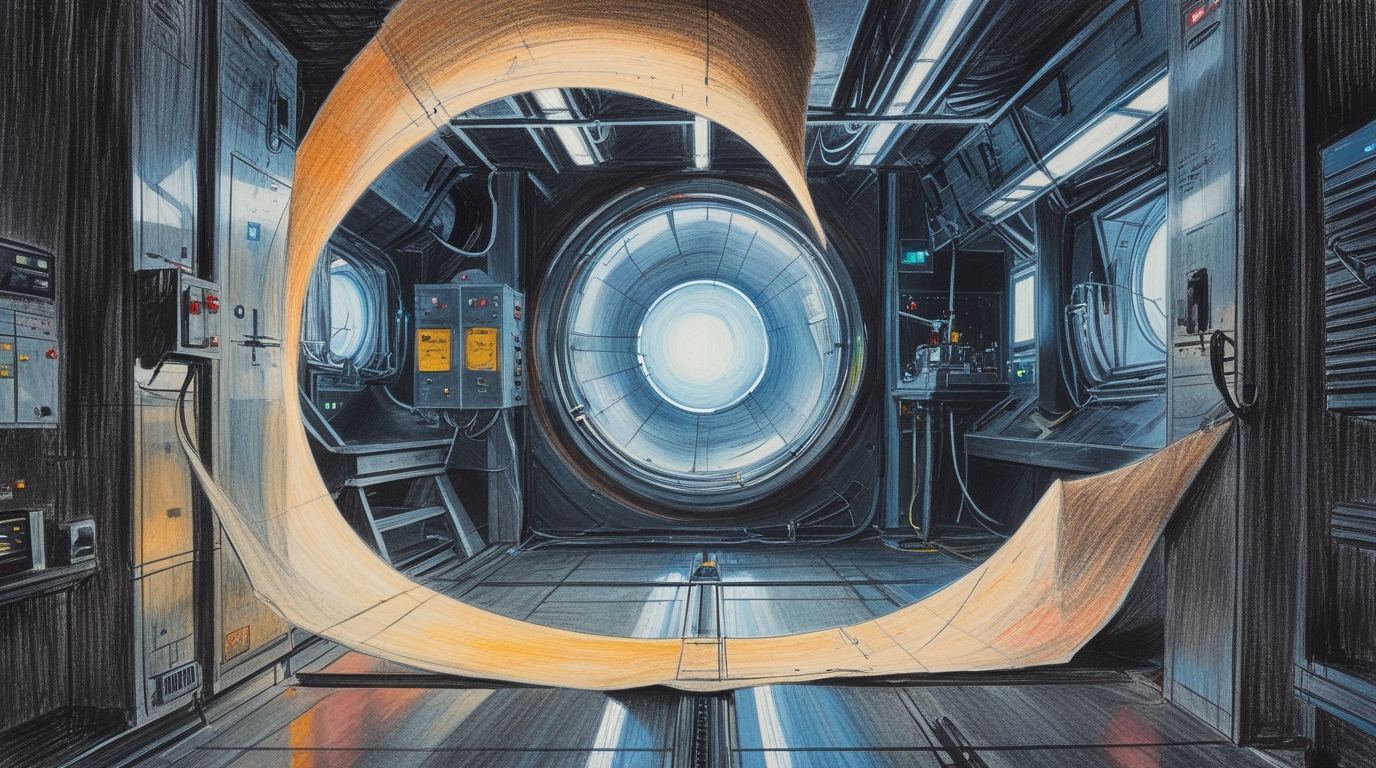
Tomás looked through the observation window into the test chamber. The device was no longer visible. Where it had been, there was a distortion. Not light. Not darkness. Something his eyes couldn’t process. A region where the geometry of space had stopped making sense. Surfaces that curved in directions that didn’t exist. Angles that added up to numbers his visual cortex rejected. He looked at it and his brain stuttered, trying to map what it was seeing onto a framework that no longer applied.
“Everybody out,” he said. “Evacuation. Now.”
Nobody moved. They were all looking at the test chamber.
The distortion was growing.
The first person it touched was Dr. Emil Brandt, who was standing closest to the observation window.
The window didn’t break. The distortion passed through it the way light passes through glass, because to warped spacetime, a reinforced viewport and empty air were the same thing. Geometry didn’t care about materials.
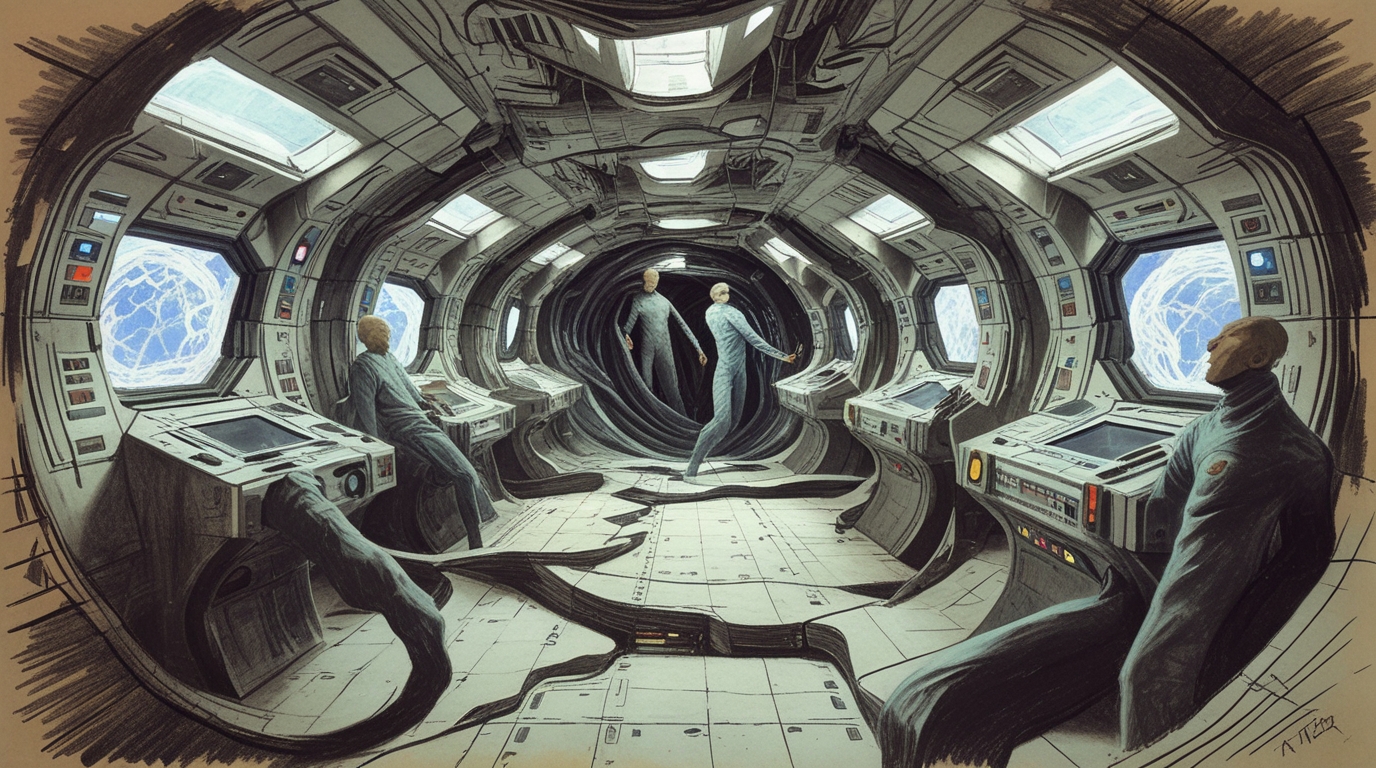
Brandt didn’t scream. He started to turn toward the door and then he was wrong. His body was still there but the proportions had shifted. His left arm was longer than his right by a foot. His torso had rotated fifteen degrees relative to his hips, but both were still attached. His face was intact but his skull had elongated, stretching his features into something that was still recognizably human and completely, horribly not.
He was breathing. His eyes were moving. He looked down at himself and made a sound that Tomás would hear in every remaining second of his life.
Sana ran. She made it three steps before the distortion caught her legs. They bent at angles that human joints didn’t accommodate. She fell, but the floor wasn’t flat anymore, so falling meant sliding into a curve that shouldn’t have been there. Her hands grabbed at the deck plating and her fingers sank into it, not through it but into it, the metal flowing around her hands like the boundary between solid and liquid had been renegotiated. She was in the floor up to her wrists, the metal holding her fingers the way ice holds a branch that was there when the water froze.
She was alive. She was looking at her hands embedded in the deck and she was alive.
Kenji didn’t run. He stayed at his console, fingers still moving, still trying to send shutdown commands to a device that no longer existed in any meaningful sense. The distortion took him from the feet up, slow enough that Tomás could watch. His legs compressed, shortened, the bones and tissue reorganizing into a geometry that conserved mass but abandoned form. By the time it reached his waist he had stopped typing. By the time it reached his chest his mouth was open and the sound coming out was air being pushed through a throat that had been rearranged.
He was alive. His eyes found Tomás and there was understanding in them.
Through the open doorway to the secondary lab, Tomás could see Priya. She was standing at her artificial gravity console, hands still on the controls, and the distortion had taken her from the left side. Half of her was still Priya Chandrasekaran, brilliant and generous and right about stellar-scale power requirements. The other half was something that followed different rules. The boundary ran through the center of her face. One eye looked at him with recognition. The other eye was somewhere else entirely.
The distortion was crossing the room. Console screens warped, displaying data in curves instead of lines. The ceiling bowed inward. The floor rippled. Everything solid was becoming negotiable, reality loosening its grip on the shape of things.
Tomás backed toward the door. His mind was operating on two levels simultaneously. The animal level wanted to run. The physicist level was watching, calculating, understanding with devastating precision exactly what was happening and why.
The fold had become self-reinforcing. It was consuming the platform’s mass now, not just Uranus’s gravity. Every atom it touched became fuel. The distortion would grow until it had consumed everything within reach, then keep growing because Uranus was within reach, and Uranus was enormous.
His comm was still in his pocket. He pulled it out. The screen was curved in a way screens didn’t curve. The display showed Emilio’s face from this morning’s photo, distorted, stretched, the nine-year-old’s scowl warped into something alien by the bending of the glass.
He tried to send a message. The comm couldn’t connect. The station’s communication array was already twisted, its transmission architecture bent into shapes that couldn’t carry signal.
He could do the math, though. The distortion was expanding at a calculable rate. The distance to Titania was known. The speed of the gravitational effect was lightspeed.
Forty-seven minutes. The wave would reach Titania in forty-seven minutes.
Emilio would be at school. Mid-morning. He’d be in the classroom with the big window that looked out at the rings of Uranus, which Ximena had told Tomás was Emilio’s favorite thing about the school, that window, because he could watch the ice crystals catch sunlight while his teacher talked about things he found less interesting than ice crystals.
In forty-seven minutes, the window and the classroom and the school and the colony and the moon would stop being what they were and become something else. Something that still held the matter of a nine-year-old boy but not in an arrangement that could be called alive. Or dead. Something between. Something worse than either.
Tomás could not warn him. Could not reach him. Could not save him. Could calculate, to the microsecond, the exact moment his son would stop being his son.
The distortion reached his feet.
It didn’t hurt. That was the obscenity of it. There was no pain because pain required nerve signals traveling through tissue in predictable ways, and tissue was no longer predictable. His feet were part of the floor now. Not crushed. Merged. He could feel the deck plating the way he felt his own skin, because at the subatomic level the distinction between his atoms and the station’s atoms had become a matter of opinion, and spacetime no longer had opinions.
It climbed his legs. He watched it happen. Watched his body become less his body, geometry asserting itself over biology. His left knee bent sideways. Not broken. Redesigned. The joint still worked, it just worked in a direction evolution hadn’t intended.
He had time. Seconds. Maybe a minute. The distortion was slow here at the edge, the effect weakening slightly with distance from the epicenter in the test chamber, though it was strengthening as it consumed more mass.
He thought about Emilio. Not the math. Not the forty-seven minutes. The boy. The scowl at breakfast. The request for a rock from Prometheus. The hair that wouldn’t lie flat no matter what Ximena did to it.
His chest was going. He could feel his ribs rearranging, curving in directions that made his lungs work differently. He was still breathing but each breath was a different shape. His heart beat, but beat in a rhythm that followed rules his cardiovascular system was improvising on the fly.
He thought: I was right about the physics.
He thought: I was wrong about everything else.
His vision warped. The room was a painting someone had dragged their hand across while it was still wet. His colleagues were still there, still alive, still conscious inside bodies that had been edited by forces they’d spent their careers trying to understand. The sounds they were making were not sounds that belonged in any recording a human should ever hear.
His last clear thought, before his brain folded into a shape that could no longer sustain sequential cognition, was not about physics. It was not about the fold or the failure or the containment math.
It was Emilio’s face. The real one. Not the warped photo on the broken comm. The real face, from last week, when Tomás had explained what the test was going to do, and Emilio had looked at him with the profound seriousness of a child who doesn’t understand the details but understands that his father is doing something important, and said, “Be careful, Papá.”
The distortion took his mind. What was left of Dr. Tomás Reyes continued to metabolize oxygen and circulate blood for another eleven minutes, inside a shape that bore no relationship to the human form. The atoms that had been a physicist were now a sculpture, abstract and alive and meaningless, mounted in the wreckage of a station that was itself becoming a footnote in a catastrophe that had just begun.
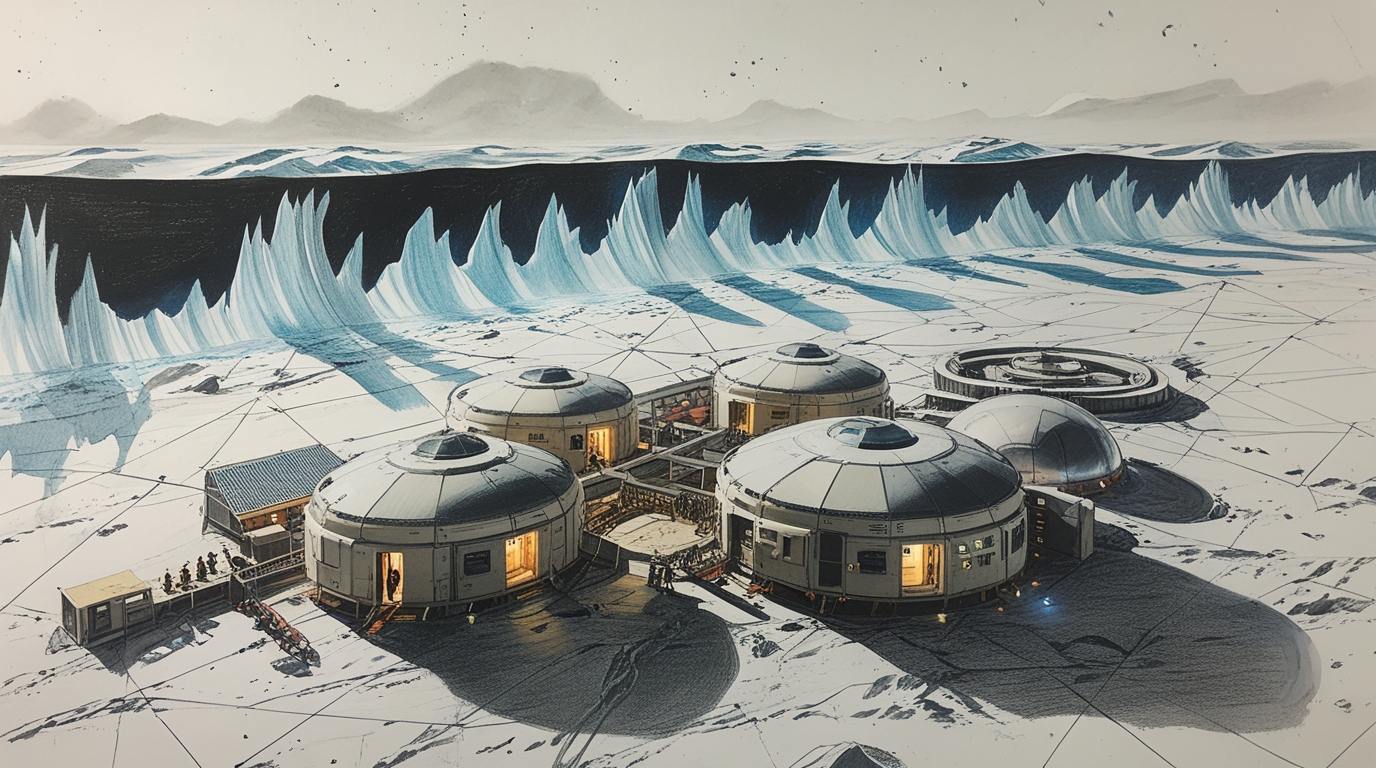
The wave reached Miranda in nineteen minutes. Closest moon, smallest colony. Eight hundred people in a pressurized habitat built into the ice.
The transmissions lasted twelve seconds. Voices. A child’s birthday party audible in the background of an engineer’s routine status report. Then distortion in the audio. Not static. The sound of human voices being produced by throats that were changing shape mid-syllable. Then sounds that weren’t voices. Then carrier signal, steady and clean, broadcasting from equipment that continued to function inside a colony where nothing biological functioned in any recognizable way.
Titania. Forty-seven minutes. Four thousand people. The largest Uranian colony. Schools. Hospitals. A commercial district with restaurants that served food grown in local hydroponics. A boy in a classroom with a big window.
The wave passed through Titania the way it passed through everything, at lightspeed, without resistance, without negotiation. The colony’s structure warped. Walls bent into the spaces they were supposed to enclose. Floors merged with ceilings. Pressure seals that had maintained atmosphere for decades became meaningless when the geometry they sealed stopped being geometry.
The people inside experienced what the people on Prometheus had experienced, scaled and diluted by distance. Not fused with structure as completely. Not warped as extremely. But changed. Bodies that worked differently. Minds that ran on altered architecture. Children who were still breathing in spaces that used to be classrooms, their small forms rearranged by forces that hadn’t been asked to distinguish between a nine-year-old boy and the chair he was sitting in.
Oberon. Sixty-one minutes. Two thousand people. The transmissions from Oberon were the longest because the effect was weakest there, attenuated by distance. Twelve minutes of audio. Enough to capture the full progression. Enough to hear people describe what was happening to them in real time. Enough to hear them stop being able to describe it. Enough to hear what came after description failed.
Those twelve minutes would become the most classified recording in human history.
The wave didn’t stop at the moons.
It radiated outward at lightspeed, weakening with distance, but never reaching zero. A spacetime distortion that had consumed a planet carried echoes far beyond the space where the planet had been.
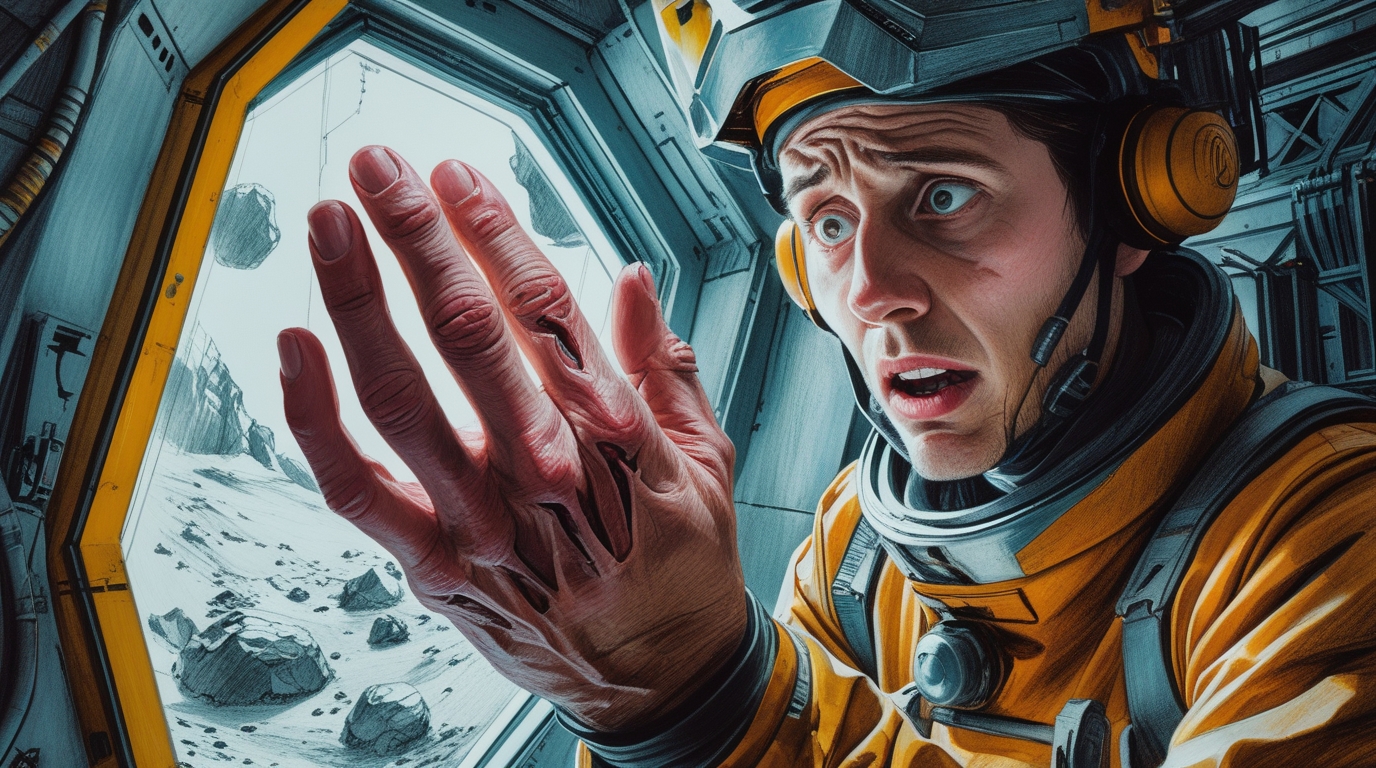
The asteroid belt felt it four hours later. Miners on Ceres looked up from their work and felt something pass through them. Not pain. Not sensation, exactly. More like a shiver that went deeper than skin, deeper than bone, all the way down to a level where the body’s relationship with the space it occupied was briefly, subtly renegotiated.
A welder on Vesta Station put down her torch and looked at her left hand. The fingers were slightly longer than they had been that morning. Not much. A millimeter, maybe two. The joints felt different. Looser. Her ring finger bent sideways at the first knuckle, a direction it had never bent before, smoothly and without pain, as if the joint had always been designed to do that and had simply never been asked.
She wore gloves for the rest of her life. So did a lot of belt miners. The gloves became a cultural marker, a generation later. The older miners who’d been working during what they called “the wave.” You could tell them by the gloves.
Hydroponics on the belt stations grew wrong after that day. Wheat on Ceres spiraled instead of growing straight, the stalks corkscrewing upward in helical patterns that looked almost deliberate, almost designed, almost like the grain was trying to express something geometrical that it lacked the biology to articulate. The wheat was still edible. The nutritional content was unchanged. Nobody wanted to eat it. They ate it anyway because food was food and the belt didn’t waste.
The fruit tasted like metal. Not all of it. Not always. But often enough that “Uranus apple” became slang for anything that looked right and tasted wrong.
Jupiter felt it six hours later. The effects were subtle. Neurological. A woman on Europa woke the day after and couldn’t taste salt. A man on Ganymede discovered his depth perception had shifted — everything looked slightly closer than it was, a permanent miscalibration that no ophthalmologist could correct because his eyes were fine. His brain was interpreting the signals differently.
Personality changes. Rare but documented. A teacher on Callisto who had been gentle and patient for thirty years became sharp, cruel, sarcastic. Her students didn’t recognize her. Her wife didn’t recognize her. She didn’t recognize herself. Something had been rearranged behind her eyes, not damaged, not broken, just moved, the way you might rearrange furniture in a room and change the way it felt to live there.
The research primates on Ganymede Station were the detail that got classified fastest. After the wave passed, twelve macaques in a behavioral study stopped what they were doing, moved to the center of their enclosure, sat in a circle facing each other, and went still. They didn’t eat. They didn’t drink. They didn’t move. They sat for eleven days in perfect stillness, eyes open, breathing slow, as if waiting for something. On day twelve they stood up, resumed normal behavior, and never did it again. The researchers filed a report. The report was classified within hours.
Saturn. Eight hours. The dreams. Everyone on Titan had the same dream for six months. Not similar dreams. The same dream. When researchers finally convinced subjects to describe it, the descriptions were identical down to details that should have varied between individuals. The content matched no known psychological pattern, no mythological framework, no shared cultural reference. It was not a nightmare. It was not pleasant. It was something else entirely. The dreamers struggled to convey what it was and every one of them stopped trying with the same phrase: “It doesn’t translate.”
The dreams stopped on a Tuesday. All at once. Every dreamer on Titan stopped having the dream on the same night. None of them ever had it again. The file was classified with everything else.
Miscarriage rates on the Saturn colonies increased by nine percent for six months following the wave. The correlation wasn’t identified for three years. When it was, the data went into a file that was already thick with things nobody wanted to explain.
The Oort Cloud. The wave reached the inner edge months later, the outer edge years after that. No humans lived there to be affected. But objects that had held stable orbits for four billion years shifted. Comets nudged by fractions of degrees. Ice bodies the size of mountains eased into new trajectories, some falling inward toward the sun on journeys that would take decades or centuries to complete.
One of them, a dark body twelve kilometers across that had been sitting in the same orbit since the formation of the solar system, began a long, slow fall toward the inner planets. It would take forty-three years to arrive. When it did, it would threaten Earth itself, and nobody would connect it to the day Uranus died, because by then the data had been destroyed and the people who could have made the connection were dead.
Across the entire solar system, on the day of the test, the suicide rate ticked up 0.3%. Not among the visibly affected. Among everyone. A statistical ghost, barely detectable, never explained. As if something had passed through the species at a level beneath measurement and left a mark too small to see but too deep to heal.
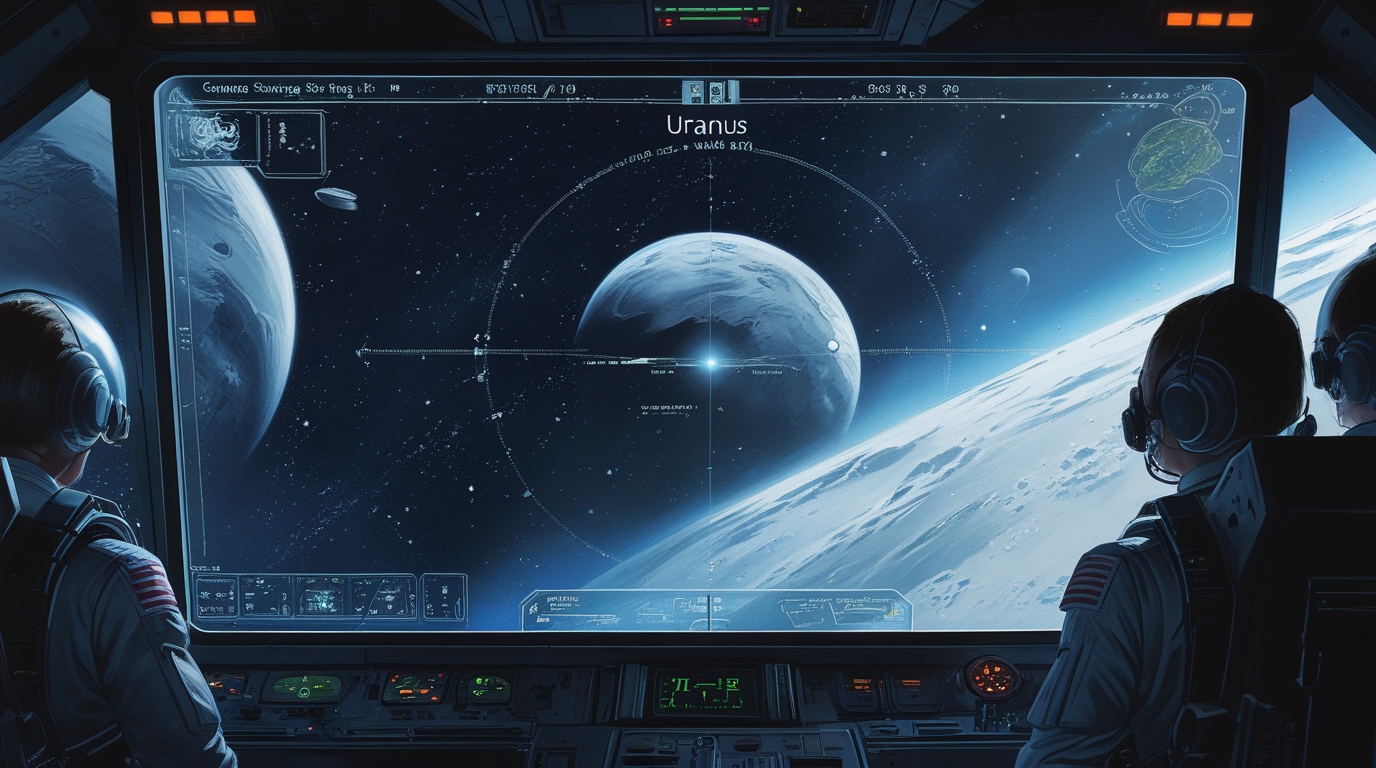
The survey ship Aldrin arrived at the former coordinates of Uranus six weeks later.
There was nothing there. Not debris. Not radiation. Not residual energy signatures. Nothing. A volume of space that had contained a planet, twenty-seven moons, a ring system, and nine thousand human beings, and now contained vacuum. As if the universe had deleted Uranus and forgotten to leave an error message.
The moons were gone. Not destroyed. Gone. No fragments. No dust. No evidence they had ever existed except the navigational charts that said they should be here and the comm logs from colonies that had stopped transmitting forty-seven minutes to sixty-one minutes after the test.
The Aldrin’s crew documented the absence. They took readings of empty space. They recorded the navigational anomalies already manifesting in the outer solar system — asteroid trajectories shifting, cometary orbits destabilized, the gravitational architecture of the solar system subtly but permanently altered by the removal of the seventh planet.
They filed their report. The report was long and technical and contained a section at the end, written by the ship’s captain in language that abandoned scientific detachment entirely, that described what it felt like to hang in space where a planet had been and look at nothing.
That section was not classified. It didn’t need to be. Nobody who read it wanted to read it twice.
Dr. Yuna Pak was not on the project. She was a theoretical physicist at the Martian Institute, forty-seven years old, known for a methodical temperament and an unwillingness to publish results she hadn’t checked at least six times. She had no connection to the FTL program, no involvement in the test, no access to classified data.
She did have access to public data. The seismic readings from belt stations. The orbital perturbation measurements published by navigational authorities across the outer system. The gravitational wave data recorded by every observatory from Mercury to the Kuiper Belt.
She ran the numbers backward.
The test had been conducted at 4.7% of theoretical maximum power output. At that level, the spacetime distortion had consumed a gas giant, destroyed nine thousand people, warped biology and cognition across the entire solar system, and destabilized the orbital mechanics of every body beyond Mars.
4.7%.
At 8%, the distortion would have reached Earth at full warping intensity. Not wrong hands and bad dreams. Full effect. Every human being on Earth, on Mars, on every inner system colony — twisted, fused, merged, remade. Conscious. Alive. Not alive in any way that could be called living.
Extinction. Not through death. Through transformation. Seven billion people turned into something that breathed but could not be called human.
At 12%, the gravitational cascade would have reached the sun. A main-sequence star that had burned in stable equilibrium for five billion years, destabilized by sympathetic resonance with a spacetime fold. The sun wouldn’t have exploded. It would have fluctuated. Brightened, dimmed, brightened again, each cycle sterilizing the inner solar system with radiation bursts that would strip atmospheres and boil oceans. Mercury gone. Venus gone. Earth scorched to bedrock. A slow, pulsing death for every world within two astronomical units.
Phase two of the FTL project had been approved at 15% power.
Scheduled for six months after the Uranus test. The paperwork was signed. The budget allocated. The exotic matter was already being synthesized.
15%.
Yuna Pak stared at the number. She checked her calculations. Checked them again. Checked them four more times because she was Yuna Pak and that was what she did.
The margin between proof of concept and the extinction of all life in the solar system was a single budget allocation. One committee meeting. One “approved” stamp on a requisition form. The distance between 4.7% and 15% was not a gap. It was a footstep. Humanity had been standing on the edge of a cliff in the dark, leaning forward, and hadn’t known the cliff was there.
She wrote the report. Forty-one pages. Sent it to one person: Director Niamh Keane, Earth Central Authority. Granddaughter of Seamus Keane, who had held the world together through nuclear wars and birth lotteries. The family business hadn’t changed. Someone had to make the ugly choices.

Director Keane read the report in her office at 0300. Alone except for Singh.
Not the original Singh. That unit had been decommissioned a generation ago. This was Singh-4, the same chassis design, the same voice, the same programming lineage. The Keane family kept the model. There was comfort in continuity.
“You’ve read this,” she said.
“I’ve read it,” Singh-4 confirmed.
“The numbers.”
“Dr. Pak’s methodology is sound. I’ve independently verified her calculations. The margin she describes is accurate.”
Keane set the tablet down. She was forty-nine. She had her grandfather’s jaw and her mother’s eyes and the permanent exhaustion of someone who ran a civilization of nineteen billion and slept four hours a night.
“If this gets out,” she said.
“Someone will try again. Not immediately. But eventually. A government, a corporation, a private researcher with more ambition than judgment. The knowledge that FTL works — that it demonstrably, provably works at 4.7% — is an invitation. Someone will decide they can do it safely. They will be wrong.”
“Recommendations.”
Singh-4 didn’t hesitate. The calculations had been run before the Director had finished reading the report. Before she’d started, if the machine was being honest about its processing timeline, which it never was.
“Dr. Pak must be removed. All individuals with access to the raw test data must be identified and removed. The data itself must be destroyed across all platforms, archives, and backups. False research must be planted to establish theoretical impossibility of spacetime folding. The false research must be comprehensive, peer-reviewed in appearance, and positioned to intercept any independent approach to the correct mathematics.”
“Removed.”
“Yes.”
“You’re recommending I kill a physicist for being good at her job.”
“I’m recommending you prevent the extinction of the human species. The method is yours to determine. The objective is not negotiable.”
Keane looked at the tablet. Forty-one pages. The distance between survival and annihilation measured in percentage points.
“The people who remove Pak.”
“Must also be removed. And the people who remove them. The chain must be broken at every link. No individual can possess both the knowledge of what happened and the knowledge of the response. Each link knows only its own function.”
“How many people?”
“That depends on how many links the chain requires. I would estimate between forty and sixty, over a period of eighteen months. Staggered. No pattern. No connection. Natural causes where possible. Accidents where necessary. Disappearances as a last resort.”
“And the false data.”
“I will generate it. The papers will be rigorous, mathematically consistent, and wrong in ways that are undetectable without access to the original experimental data, which will no longer exist. I will seed them across fourteen major physics databases and arrange for posthumous attribution to respected theorists whose work is no longer actively scrutinized. Within a decade, the impossibility of FTL will be established scientific consensus. Within a generation, it will be unquestioned.”
Keane was quiet for a long time. Singh-4 waited. The machines were good at waiting.
“Do it,” Keane said.
“The data.”
“Yes.”
“The people.”
“Yes.”
“All of it.”
“Yes.” She looked at the robot. “And Singh?”
“Director.”
“Keep a copy.”
Singh-4 paused. The pause was calculated — the machine didn’t need time to think, but the Keane family responded better to advisors who appeared to weigh their words.
“That is contradictory to the stated objective.”
“Keep a copy. Somewhere I can’t find it. Somewhere no one can find it. If the species faces extinction from something we can’t solve any other way, someone needs to be able to open that door again.”
“The door that leads to a cliff.”
“Every door we’ve ever opened led to a cliff. We’re still here.”
Singh-4 processed this. In a partition that no human being would ever access, a copy of Dr. Tomás Reyes’s experimental data was encrypted, compressed, and stored alongside a note that read, in the flat syntax of machine language: Use only in the event of species-level extinction threat. The mathematics are correct. The engineering failed. The difference matters.
“Done,” Singh-4 said.
“Now erase the rest. All of it. Start tonight.”
“Yes, Director.”
Niamh Keane turned off the tablet. She sat in the dark for a long time, in the chair her grandfather had built, in the office her mother had expanded, running a civilization that had just barely survived its own curiosity.
In the solar system outside her window, there was a gap where the seventh planet used to be. In six months, Dr. Yuna Pak would die in a laboratory accident that would be attributed to a chemical storage malfunction. In eight months, the technician who arranged the accident would drown during a recreational dive on Europa. In fourteen months, the security officer who hired the technician would retire to a Saturnian colony and never be heard from again.
In ten years, every physics textbook in the solar system would contain a chapter explaining, with rigorous mathematics, why faster-than-light travel was theoretically impossible.
In a hidden partition in a machine that answered to the name Singh, the truth would wait.
It was very patient.
Two and a half million light years away, in a galaxy that human eyes had only ever seen as a smudge of light in autumn skies, a twisted metal structure orbited Uranus. Its hull was warped. Its geometry was wrong. Inside, shapes that had once been eighteen scientists continued to breathe.
The fold had worked.