
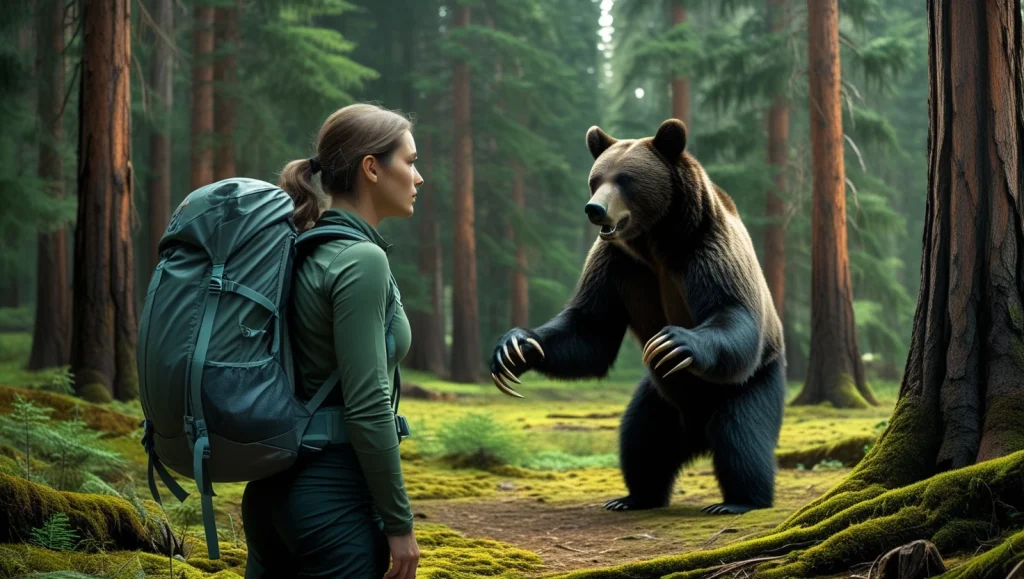
The interviewer leaned forward, digital recorder extended between them. “So, Sarah, you’ve been alone in the wilderness for three days now. If you had to choose between encountering a bear or a strange man out here, which would you pick?”
Sarah shifted against the granite boulder she’d been using as a backrest, pine needles crackling under her boots. Three days ago, she would have given the expected answer, the diplomatic one that wouldn’t ruffle feathers at dinner parties. But three days of hiking solo through the Cascade Range had stripped pretense down to survival instinct.
“The bear.” No hesitation.
“Really? Can you explain why?”
Sarah adjusted her pack straps, the nylon webbing damp with sweat. “I know what the bear wants. Food, territory, to be left alone. I can make myself big, back away slowly, speak in calm tones. There are rules with bears. Predictable ones.”
She rubbed the back of her neck, remembering the man at the gas station before her hike. How he’d insisted on walking her to her car, gotten angry when she politely declined his offer to “keep her company” on the trail. His breath had smelled like energy drinks and menthol cigarettes.
“With a bear, if I respect its space and show I’m not a threat, it’ll probably leave me alone. If it attacks, it’s because it’s scared, protecting cubs, or genuinely hungry. I can understand that. It’s honest.”
The interviewer shifted on his portable camping chair. “And with a man?”
“A man might want anything.” Sarah picked at a loose thread on her hiking pants. “He might want to help, genuinely help. Or he might want something from me that I can’t give. He might smile while deciding whether I’m worth the trouble.”
The afternoon shadows were lengthening across their makeshift interview spot, a small clearing beside the trail marker for Mile 47.
Two hours later, the interview equipment lay scattered across the forest floor. The digital recorder blinked red, still recording static and the distant sound of rushing water from the creek below.
Sarah had heard the rustling first, heavy, deliberate movement through the salmonberry bushes. She’d done everything right: raised her arms to appear larger, spoke in low, steady tones, backed away slowly toward a cluster of Douglas firs. But the sow had cubs nearby, and Sarah had unknowingly positioned herself between mother and young.
The attack lasted twenty-three seconds. Massive claws raked across her torso as four hundred pounds of muscle and maternal fury knocked her to the mossy ground. She tried to play dead, curling into a tight ball, but shock was already setting in from the blood loss. Her hiking shirt, soaked through, clung to the gouges along her ribs.
The bear left as quickly as it had appeared, gathering its two cubs with urgent grunts and moving deeper into the old-growth forest.
Sarah’s final thought, as Douglas fir needles pressed against her cheek and the forest grew quiet around her, was bitter and sharp: at least no one would spend the next day asking what she’d been wearing, or why she’d been hiking alone, or what she’d done to provoke it.
Maybe a man would have been a better choice.
Free Stories, Straight to Your Inbox
Start with Nine Doors, nine short stories across nine genres, yours free the moment you sign up. After that, the occasional new collection and a note when there's a new book worth your time. No spam, no daily clutter. Just good stories.
We use MailerLite to manage our list and send these emails. Your address is used only to send you what you signed up for. We will not sell it, share it, or use it for anything else, and you can unsubscribe anytime.