
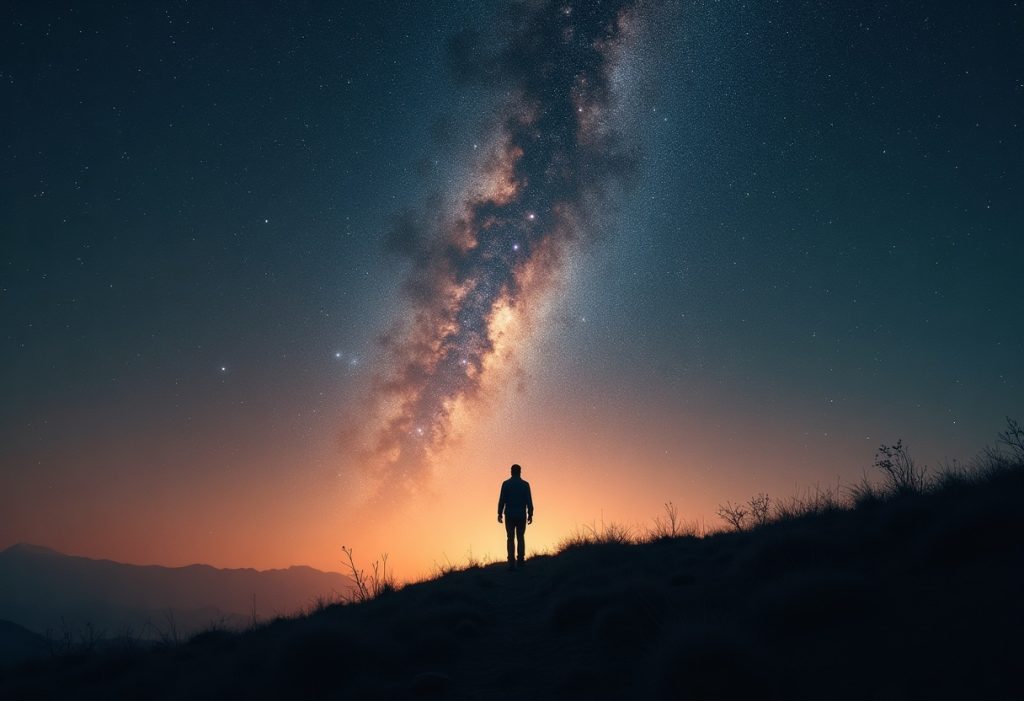
Almost everyone has heard the phrase. Almost no one knows what it means. The Big Bang sounds like an explosion in space, a bomb going off in a dark room, with the universe as the shrapnel. That picture is wrong in every part. There was no bomb, no dark room, and nothing for the shrapnel to fly through, because space itself was part of what was expanding. The Big Bang was not an explosion in the universe. It was the universe.
Here is what the term actually points at, what we know about the first sliver of a second, and the honest answer to the question everyone really wants answered, which is what came before.
The Big Bang was not a bang
Start by throwing out the explosion. An explosion happens at a place. It has a center, and it throws material outward into the space around it. The Big Bang had no center and no surrounding space. The best evidence says the early universe was hot and dense everywhere at once, and then it expanded everywhere at once. There was no empty stage for it to expand into. The stage was expanding too.
This is the part that breaks people’s brains, and it should, because nothing in daily life prepares you for it. When we say the universe is getting bigger, we do not mean galaxies are flying away from a central point through some pre-existing emptiness. We mean the space between things is stretching. Imagine dots drawn on a balloon. Blow the balloon up and every dot moves away from every other dot, not because the dots are traveling across the rubber, but because the rubber itself is growing. There is no special dot at the center. Every dot sees all the others retreating. That is what astronomers see when they look out at the galaxies. Everything is moving away from us, not because we are special, but because that is what happens to dots on a balloon that is being inflated.
Run that backward and you get the whole idea. If everything is spreading apart now, then everything was closer together in the past. Keep rewinding and the universe gets smaller, hotter, and denser, until you reach a moment about 13.8 billion years ago when all of it, every galaxy and star and atom that exists today, was packed into a state smaller and hotter than anything we have words for. That moment is what we call the Big Bang. It is not the bang. It is the beginning of the expansion.
The first nanosecond, slowed down
People assume the interesting action took place over millions of years. The opposite is true. The most dramatic events in the history of the universe happened in the first tiny fraction of the first second, and after that things settled into a long slow grind. If you want the strange stuff, you want the first nanosecond, and even that is too coarse. The real action is in slices of time so small that a nanosecond is an eternity by comparison.
Cosmologists divide that first instant into eras. The numbers look absurd, and they are, but they are the best map we have.
At the very start sits the Planck era, the first ten million trillion trillion trillionth of a second or so. This is the wall. Our physics does not work past it. At that scale gravity and the quantum world are tangled together in a way no current theory can describe, and honest scientists will tell you they do not know what was happening, only that something was. Everything before the Planck time is a locked room, and the key is a working theory of quantum gravity that nobody has yet built.
Then, somewhere around a trillionth of a trillionth of a trillionth of a second in, the universe did something violent. It inflated. For a flash of time it expanded faster than light, doubling in size over and over, growing from smaller than a proton to something enormous in less time than it takes to say the word. This is called cosmic inflation, and while it has not been nailed down beyond all doubt, it explains so many otherwise baffling features of the universe that most cosmologists treat it as the leading account. Inflation is the reason the universe looks smooth and flat and similar in every direction. The wild early expansion ironed out the wrinkles.
When inflation stopped, the energy that drove it dumped into the universe as a blast of particles, a hot soup of the most basic building blocks of matter. At this point the four forces that run reality, gravity, electromagnetism, and the two nuclear forces, had not yet separated into the distinct things we know. They peeled apart one by one as the universe cooled, like ingredients separating as a sauce cools and sets. Gravity went first. The strong nuclear force split off next. The last two, electromagnetism and the weak force, stayed merged as a single electroweak force until about a hundred billionth of a second in, when they finally parted and the universe got the physics it still runs on today.
All of that, the inflation, the soup, the splitting of the forces, happened inside the first nanosecond. By the time one full second had passed, the worst of the drama was over and the universe was a hot fog of particles getting on with the long business of cooling down, forming atoms, and eventually, billions of years later, getting around to stars and planets and the people who would argue about how it all started.
What the fog became
It is worth following the story a little past that first second, because the leap from a particle fog to a universe with stars is its own kind of strange, and it happened in stages anyone can picture.
For the first few minutes, the universe was hot enough to act like the inside of a star. In that window the simplest atomic nuclei formed, mostly hydrogen and helium, in a ratio we can still measure today and that matches the prediction almost exactly. That match is one of the strongest pieces of evidence for the whole picture. The recipe wrote itself in the first three minutes, and the universe has been roughly three-quarters hydrogen and one-quarter helium ever since.
Then nothing much happened for a long time, by which I mean about 380,000 years, which is nothing on a cosmic clock. The universe was still too hot for atoms to hold together properly. It was an opaque fog of loose particles, glowing, impossible to see through. When it finally cooled enough for electrons to settle into atoms, the fog cleared, and light could travel freely for the first time. That first freed light is the glow we still detect across the whole sky today, the baby picture mentioned above. The moment the universe became transparent is the earliest thing we can directly see. Everything before it is blocked from view, like trying to look into the sun.
After that came the long dark. No stars yet, just cooling gas drifting in the dark for a few hundred million years, slowly clumping under gravity, until the first clumps grew dense enough to ignite. The first stars switched on, the dark ended, and the universe you would recognize began to assemble itself out of the wreckage of the beginning. Everything since, the galaxies, the planets, the carbon in your hands, was cooked in stars that formed from that fog.
What we actually know versus what we guess
It helps to be honest about the confidence levels, because they are not all the same.
The expansion is not in doubt. We can see it. Galaxies are moving apart, and the light from the young universe still reaches us as a faint glow filling the whole sky, called the cosmic microwave background, which is exactly what you would expect to find if the universe was once a hot dense fog that has since cooled and thinned. That glow is a baby picture of the universe, and it matches the prediction. The basic story holds.
The first nanosecond is shakier. We cannot observe it directly. We work it out from physics tested in particle accelerators here on Earth, then push that physics back to conditions far more extreme than anything we can reproduce. Inflation is well supported but not proven. The Planck era is guesswork dressed in math. The further back you go, the more the science turns from observation into careful theory, and a reader deserves to know which is which.
What came before
Now the real question. If the universe began with the Big Bang, what was there before it?
The most deflating answer, and possibly the correct one, is that the question may not mean anything. Time, as far as we can tell, is part of the universe, not a backdrop the universe sits inside. If time itself began at the Big Bang, then asking what happened before is like asking what is north of the North Pole. The words form a sentence, but there is no place the sentence points to. The physicist Stephen Hawking favored a version of this, where the early universe has no boundary and no first moment, the way the surface of the Earth has no edge. You never fall off. There is just nowhere earlier to go.
That answer satisfies no one, so people keep looking, and there are a few serious ideas.
One is the Big Bounce. In this picture our Big Bang was not the beginning but a rebound. A previous universe collapsed inward, got smaller and denser, and instead of crushing all the way down to a point, some quantum effect kicked in and shoved it back outward. What we call the Big Bang was the bounce, the moment the contraction reversed into expansion. Some versions have this happening over and over forever, a universe that breathes in and out across endless cycles. Certain approaches to quantum gravity keep producing this bounce in their math, which is why the idea has legs.
Another is eternal inflation, which leads to the multiverse. The thought here is that the rapid expansion at the start was not a one-time event but an ongoing process that never fully stops. In some regions it ends, and a universe like ours settles out. In others it keeps going, spawning more regions, each becoming its own separate universe, sealed off from the rest. Our universe would be one bubble in an endless foam of them, with no way to ever see or touch the others. In this view there was no single beginning. There was always inflation, churning out universes, and ours is just the one we happen to live in.
A third comes from the physicist Roger Penrose, who proposes that the Big Bang was a handoff between cosmic ages he calls aeons. A universe expands until it is so old and spread out that everything has decayed and even the black holes have evaporated, leaving nothing but faint radiation. By a mathematical trick, that cold empty end state looks identical to the hot dense start of a new universe, and so one aeon’s death becomes the next aeon’s Big Bang, forever. Our universe is one aeon in an infinite chain.
Notice what these have in common. Almost all of them are attempts to avoid a true beginning, to replace the uncomfortable idea of something coming from nothing with a universe that always was, in one form or another. That preference may say more about how human minds work than about how the cosmos works. We do not like beginnings without causes, so we build models where there is no first beginning to explain.
And here is the catch that makes the whole question maddening. If inflation really happened, it may have erased the evidence. The violent early expansion would have stretched and diluted any trace of what came before until it is undetectable. The thing that explains so much about our universe may also be the thing that hides its origin from us permanently. We could be asking a question that the universe has arranged to make unanswerable.
Why any of this matters
You could shrug at all of this. None of it changes your commute. But the Big Bang is the oldest story there is, the actual origin of everything, and humans have been telling origin stories since before they could write. This is the version with math behind it, evidence in the sky, and a glow left over from the first fog still reaching our telescopes after 13.8 billion years.
What makes it worth your attention is not that science has the whole thing solved. It is that science has worked out so much of it, all the way back to the first sliver of a second, from clues as faint as old light and as indirect as physics done in a lab. And it is honest about where the map runs out. Past the Planck wall, before inflation, in whatever came before, the answer is that we do not know yet, and might never. That is not a failure. That is the edge of human knowledge, and it is a more interesting place to stand than any tidy story would be.
Free Stories, Straight to Your Inbox
Start with Nine Doors, nine short stories across nine genres, yours free the moment you sign up. After that, the occasional new collection and a note when there's a new book worth your time. No spam, no daily clutter. Just good stories.
We use MailerLite to manage our list and send these emails. Your address is used only to send you what you signed up for. We will not sell it, share it, or use it for anything else, and you can unsubscribe anytime.