
When Atlantis Drowned Again
Every civilization thinks it’s the one that will last. The Romans thought so. The Byzantines thought so. The British Empire thought so. I wanted to write about Atlantis not as a myth but as a pattern that keeps repeating. The twist isn’t that Atlantis sinks. The twist is that it always sinks, and they always rebuild on the same spot, and they never learn why it happened the last time. The most human thing about the story isn’t the drowning. It’s the part where they drain the water, lay new foundations, and say “this time will be different.” It never is.
They found Atlantis in the spring of 2031, sitting in twelve meters of water off the coast of Sardinia, exactly where no serious archaeologist had ever looked for it. The discovery was made by a graduate student named Irene Theopoulos, who was supposed to be mapping Roman-era shipwrecks and instead mapped the submerged ruins of a city that predated Rome by approximately six thousand years.
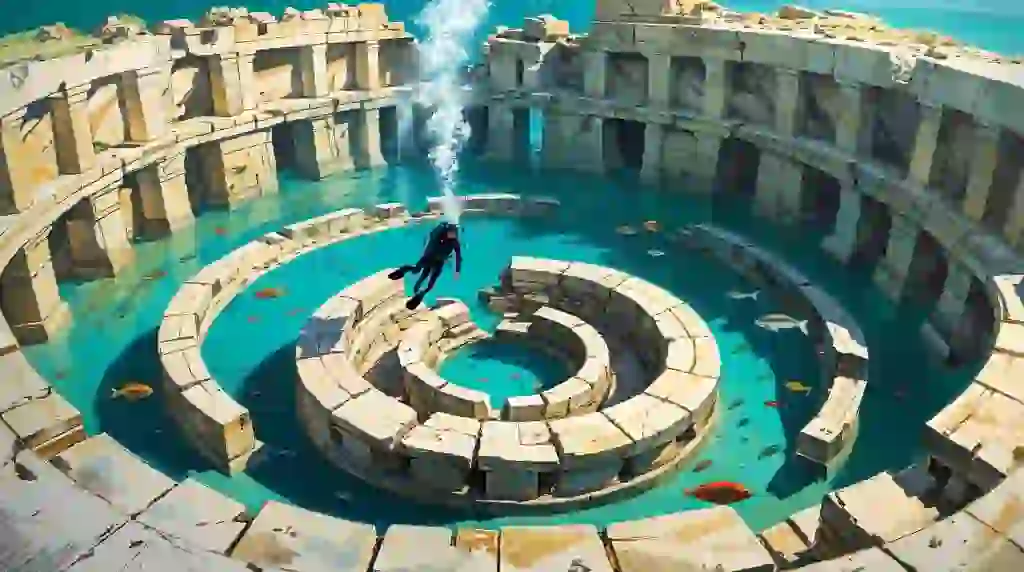
The ruins were extensive. Concentric ring walls, just as Plato had described. A central island with the remains of a structure that might have been a temple or a palace or something that had no modern equivalent. Canal systems radiating outward like spokes on a wheel. The scale was staggering: the outermost ring measured nearly five kilometers in diameter, enclosing an area larger than ancient Athens at its peak.
The world lost its mind.
Within weeks, the waters off Sardinia were a floating city of research vessels, media boats, and private yachts owned by billionaires who wanted to be near something historical for reasons that seemed to involve champagne and drone photography. The Italian government, the Greek government, the EU, NATO, the UN, and seventeen separate academic institutions all claimed jurisdiction or involvement. The arguments generated more heat than light and consumed bandwidth that would have been better spent on actual archaeology.
Irene, who was twenty-six and had been prepared for a career of quiet academic obscurity, found herself at the center of a media storm that made her want to swim to the bottom of the Mediterranean and stay there.
“I’m an archaeologist,” she told a CNN reporter who’d asked her how it felt to be “the woman who found Atlantis.” “I found ruins. Whether they’re Atlantis is a question that will take decades to answer.”
“But the concentric rings. The canal system. It matches Plato’s description perfectly.”
“Plato was writing a philosophical allegory, not a field report. The fact that these ruins share some features with his description doesn’t mean they’re the same place. It might mean Plato was drawing on folk memories of a real civilization. It might mean the concentric ring design was common in ancient maritime cultures. It might mean coincidence.”
“You don’t think it’s Atlantis?”
“I think it’s an extraordinary archaeological site that deserves careful study, not a brand name.”
Nobody listened. “Atlantis” was too good a story. It was too old, too romantic, too embedded in the collective imagination for nuance to compete with it. The ruins off Sardinia became Atlantis in the public consciousness within days of the announcement, and no amount of academic caution was going to change that.
The first dive season revealed the basics. The city had been built on a shallow continental shelf that had gradually subsided over millennia, sinking beneath the waves at a rate so slow that generations could live and die without noticing the change. The architecture was sophisticated: cut stone blocks fitted without mortar, a technique that required advanced engineering and a precision that rivaled anything produced by later civilizations. The canal system had been functional, connecting the inner rings to the open sea and allowing boats to navigate deep into the city’s interior. The central structure was built from a pale stone that geologists couldn’t identify, a marble-like material with trace elements that didn’t match any known quarry in the Mediterranean basin.
Carbon dating placed the earliest structures around 7000 BCE. Five thousand years before the Egyptian pyramids. Three thousand years before the oldest known cities in Mesopotamia. The dates were checked, rechecked, and checked again by three independent labs. They held.
The implications kept the entire archaeological establishment awake for weeks. Urban settlement, monumental architecture, hydraulic engineering, stone-cutting precision, all of it pushed back by millennia. The accepted timeline of civilization, the neat progression from hunter-gatherers to farmers to city-builders, had a hole in it the size of Sardinia.
In the second dive season, they found the tablets.
They were in a sealed chamber beneath the central structure, preserved in anaerobic conditions that had prevented decay. Over three hundred stone tablets, each roughly the size of a textbook, inscribed with a script that nobody had ever seen. The characters were angular, geometric, with a regularity that suggested a formal writing system rather than pictographic notation.
The tablets went to a team of linguists at the University of Oxford, who spent fourteen months attempting to decode the script. They failed. The language had no known relatives, no cognates in any existing language family. It was a linguistic isolate, orphaned by time, a voice from a civilization so old that nothing else from its world had survived to provide context.
Then a retired mathematician from Sao Paulo named Helio Cavalcante published a paper suggesting that the script wasn’t a language at all. It was mathematics. The angular characters were a numerical notation system, base-twelve rather than the base-ten system modern humans used, and the tablets contained calculations: astronomical observations, tidal predictions, and what appeared to be a detailed mathematical model of sea-level rise.
The model predicted, with remarkable accuracy, the submergence of the city.
They’d known. The builders of this place had known it was going to sink. They’d calculated the rate of subsidence, projected the timeline across centuries, and documented it in stone tablets sealed in a waterproof chamber designed to survive the flooding.
“They didn’t just know,” Cavalcante told Irene during a video call that crossed two continents and felt like a conversation between two people standing at the edge of the same cliff. “They planned for it. The sealed chamber, the durable tablets, the mathematical notation instead of a perishable language, all of it was designed to communicate with whoever found the ruins after the water came.”
“What were they trying to communicate?”
“A warning. The tablets aren’t just recording the submergence of their city. They’re recording the conditions that caused it. Tectonic activity, yes, but also thermal expansion. Ocean temperature increases. The same mechanisms driving sea-level rise today.”
Irene felt the hair rise on her arms. “You’re saying they experienced climate-driven sea-level rise eight thousand years ago?”
“I’m saying they documented it with mathematical precision and sealed the documentation in a vault designed to survive the flooding. They weren’t just recording history. They were sending a message forward in time.”
The message, decoded over the following year by Cavalcante’s team and a growing consortium of mathematicians and climate scientists, was both simple and devastating. The civilization had monitored its own destruction over a period of approximately three centuries. They’d watched the water rise, measured the rate, projected the outcome, and realized they couldn’t stop it. The city was doomed. Not by a single catastrophe, not by a flood or an earthquake, but by a slow, relentless process that they could calculate with extraordinary precision but could not prevent.
Their response was not to flee. Or rather, not only to flee. Some did, presumably, relocating to higher ground, dispersing into the populations that would eventually become the civilizations of the historical record. But the mathematicians and engineers who remained did something else entirely. They recorded everything they’d learned about the process, every observation, every calculation, every failed attempt at intervention. They inscribed it in stone. They sealed it in a vault beneath the only structure strong enough to survive the submergence. And they waited for someone to find it.
Eight thousand years later, Irene found it.
The parallels were inescapable, and Irene, who was a scientist and preferred data to drama, found herself unable to present the findings without acknowledging them. She delivered the keynote at a conference in Athens, standing before an audience of archaeologists, climatologists, and policy makers, and watched the room grow quiet in a way that had nothing to do with acoustics.
“They left us a message,” she said. “They told us what happened to them. They told us the mechanisms, the mathematics, the timeline. And they sealed it in stone because they knew that whatever came after them would need to understand how a civilization can watch itself disappear and be powerless to stop it.”
A climate scientist in the front row raised his hand. “Are you suggesting that their experience is predictive of ours?”
“I’m suggesting that they faced the same physics we face. Water expands when it warms. Ice melts. Coastlines recede. They couldn’t stop it. The question is whether we can.”
“They didn’t have the technology we have.”
“No. But they had something we’re still struggling with. They had the honesty to document their own failure. They didn’t deny what was happening. They didn’t argue about whether it was real. They didn’t form committees to study whether the water was actually rising while the water rose around their ankles. They measured it, recorded it, and passed the data forward, because they understood that even if they couldn’t save themselves, they might be able to save whoever came next.”
The conference ended. The findings were published. The public reaction followed the familiar pattern: a surge of interest, a wave of commentary, a gradual recession of attention as the news cycle moved on to the next thing. Within three months, the tablets from an eight-thousand-year-old civilization were competing for public attention with celebrity breakups and political scandals and a viral video of a dog that could apparently play chess (it couldn’t, but the algorithm didn’t care about accuracy, only engagement). The pattern was so familiar that Irene found herself wondering whether the builders of the submerged city had faced the same problem, whether their warnings had been drowned out not by water but by the noise of a civilization too busy to listen to the people telling them the floor was sinking.
Cavalcante, with whom she’d developed the kind of long-distance intellectual partnership that sustains people working at the frontier of impossible things, shared her frustration. “We decoded a message that took eight thousand years to deliver,” he told her during one of their weekly calls. “And the world read the headline and moved on. The builders sealed their warning in stone. We posted ours on the internet. I’m not sure which medium is more permanent.”
“Stone,” Irene said.
“Stone,” he agreed.
The tablets from an eight-thousand-year-old city competed for airtime with celebrity divorces and political scandals and lost, because the human capacity for sustained attention to existential threats is approximately the same now as it was in 7000 BCE.
The tablets remained. The ruins remained. The message from eight thousand years ago, inscribed in stone by a civilization that had watched the water rise and chosen to leave a record rather than a monument, sat in climate-controlled storage at the University of Oxford, waiting to be fully understood by a species that was, at present, busy arguing about whether the water was actually rising.
Irene went back to Sardinia the following spring. She dove alone, early morning, descending to the central structure in water so clear that the sunlight reached the ruins and made the pale stone glow. She floated in the dim green water above the vault where the tablets had been found. The stone walls were encrusted with marine life, sponges and anemones and tiny fish that darted through the concentric rings like commuters on a flooded highway.
She hung there, neutrally buoyant, twelve meters down, in the drowned heart of a civilization that had known this was coming and prepared for it the only way they could: by telling the truth, in math, in stone, to whoever came next.
She hoped whoever came next was listening. But she’d been an archaeologist long enough to know that civilizations rarely listened to warnings, even when the warnings were carved in rock and sealed in vaults designed to last forever.
The water was warm. It was getting warmer every year. The tablets had predicted that too.
She ascended slowly, watching the ruins recede below her, the pale stone of the temple fading into the blue-green distance. Eight thousand years of silence, broken by a graduate student with a sonar array and a research grant that barely covered her rent. The builders would have found that funny, she thought. Or maybe they wouldn’t have. Maybe humor was another thing the water had taken.