
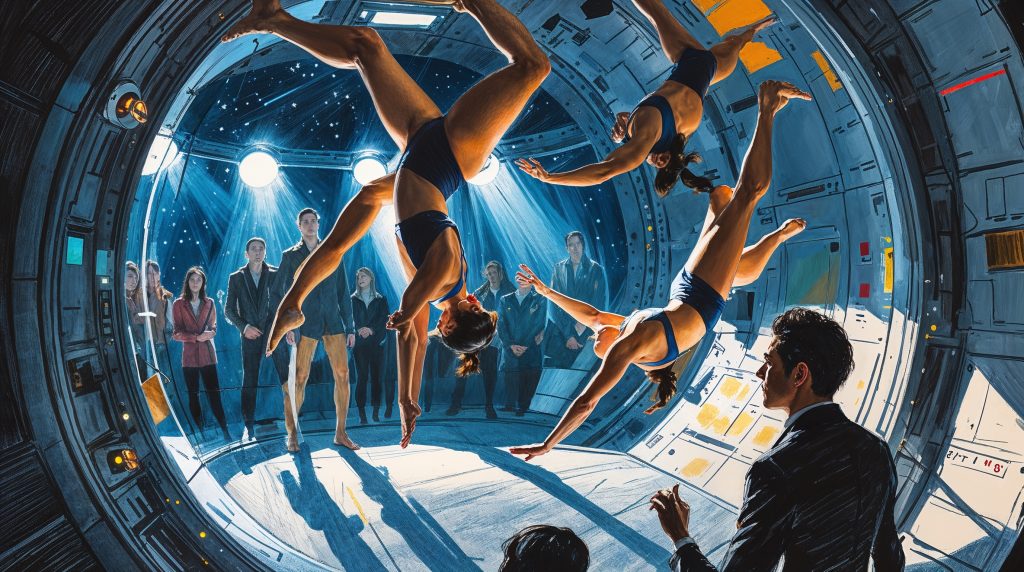
The Zero-Gravity Circus
I watched Cirque du Soleil in Vegas years ago and sat there thinking: what if there was no gravity? Every act would be completely different. The trapeze artist who can’t fall. The tightrope walker with no rope. The strongman whose strength means nothing when a child can lift a thousand pounds. The whole thing became a meditation on what risk means when you remove the thing that makes it dangerous. If the audience knows you can’t get hurt, what are they paying to see? The answer turns out to be beauty, which doesn’t need danger to justify itself but somehow feels less urgent without it.
The Cirque des Étoiles performed its first show in the cargo bay of the orbital station Kepler-7, six hundred kilometers above the Pacific Ocean, on a Wednesday night that nobody on Earth noticed. The audience was fourteen off-duty engineers, a station commander who’d been talked into attending by his wife via video call, and a maintenance robot that had wandered in through an open hatch and couldn’t find its way out.
Milo Petrakis, ringmaster, floated in the center of the bay wearing a top hat Velcroed to his head and a tailcoat that billowed around him like a cape. He was forty-four, a former acrobat from a terrestrial circus in Thessaloniki who’d blown out both knees at thirty-seven and reinvented himself as a showman in the only venue where gravity couldn’t hurt him.
“Ladies, gentlemen, and autonomous maintenance units,” he announced through a wireless microphone that kept drifting away from his mouth. “Welcome to the first circus in space.”
Nobody applauded. In zero gravity, clapping doesn’t work. You push your hands together and the reaction pushes you backward. The engineers had figured this out already. They snapped their fingers instead, which produced a decent approximation of applause and didn’t send anyone spinning into a bulkhead.
The show was a disaster. A magnificent, beautiful, epoch-making disaster.
The trapeze act, reimagined for zero-g, involved three aerialists launching themselves between flexible poles anchored at opposite ends of the cargo bay. In theory, they’d execute triple somersaults, interlocking spirals, and formation dives that would be impossible under gravity. In practice, the first aerialist, a woman named Katya Uvarov who’d trained as a gymnast in Saint Petersburg, overrotated on her launch, clipped the lighting rig, and pinwheeled into the audience. Two engineers caught her. One got a knee to the face.
The juggling act fared slightly better. In zero-g, thrown objects don’t fall. They just keep going. The juggler, a wiry Venezuelan named Paolo Escalante, launched twelve balls into the air and then spent the next three minutes chasing them as they bounced off walls, ceiling, floor, and the maintenance robot, which responded to each impact with an alarmed chirp.
The contortionist, a young woman from Osaka named Reiko Taniguchi, was the only performer who’d trained extensively in zero-g before the show. She’d spent two weeks in the station’s gym module, learning how her body moved without gravity, discovering positions and transitions that were impossible on Earth. Her act was six minutes of silent, flowing movement, her body curling and unfolding in three dimensions, using the cargo bay’s handholds and tether points as anchors while the rest of her body moved with liquid grace.
The engineers stopped snapping their fingers and went still. Even the maintenance robot stopped chirping. Taniguchi moved through the empty air like something dreamed, and for six minutes the cargo bay wasn’t an industrial space inside a tin can orbiting the planet. It was a stage.
When she finished, the silence lasted three beats too long before the snapping started.
Milo floated to the center of the bay, retrieved his hat (it had come unstuck during Katya’s collision and was lodged behind a ventilation panel), and took a bow that sent him slowly tumbling backward.
“Thank you. We’ll be here all week. Literally. The shuttle doesn’t leave until Friday.”
The show was over. It had lasted forty-seven minutes, produced three minor injuries and one cracked light panel, and generated exactly zero revenue. The Cirque des Étoiles had been financed by Milo’s life savings, a crowdfunding campaign that raised forty thousand euros, and a sponsorship deal with a Japanese energy drink company whose logo was printed on everything the performers wore.
It was the beginning of something enormous.
The footage from the show, recorded by the station’s internal cameras and by the engineers’ personal devices, reached Earth the next morning. Within a week, it had been viewed seventy million times. Within a month, every major entertainment company on the planet had contacted Milo about a partnership.
He turned them all down.
“We’re not a brand,” he told his performers in a meeting that took place in the station’s galley module, all five of them floating in a loose circle while they ate reconstituted noodles. “We’re a circus. The moment we let a corporation put their name on us, we stop being art and start being content.”
“We’re eating rehydrated noodles in a tin can,” Paolo said. “Maybe a little corporate money wouldn’t be the worst thing.”
“The worst thing would be doing this for money instead of doing it because it’s never been done. We just performed the first circus in space. Nobody has ever done that. I don’t care if we never make a cent. History doesn’t charge admission.”
He was, of course, being romantic. The practical reality was that the Cirque des Étoiles needed money to survive. Station time cost roughly forty thousand dollars a day. Launch costs were astronomical. The performers needed to eat, and the energy drink company’s sponsorship covered about eight percent of the total budget.
The solution came from an unexpected source. Dr. Amara Osei, the station’s life-sciences officer, had been watching the footage of Taniguchi’s performance on repeat.
“You know what she was doing in there?” Osei said to Milo. “She was demonstrating optimal human movement patterns in microgravity. Every space agency in the world has been studying that for decades. She did it in six minutes, on instinct, better than any of our formal protocols.”
“She’s a contortionist, not a scientist.”
“She’s both, whether she knows it or not. Her body figured out things that our engineers haven’t been able to model. I want to instrument her next performance. Motion capture, biometrics, the works. The data would be worth a fortune to NASA, ESA, CNSA, every program that puts humans in space.”
Milo saw the opening. Not a corporate sponsorship. A research partnership. The Cirque des Étoiles would perform, and space agencies would pay for the privilege of studying how circus performers moved in zero gravity, generating data that would improve space suit design, EVA protocols, and long-duration habitat ergonomics.
It worked. Within six months, the circus had a permanent home on Kepler-7, The negotiation with the space agencies took three months and required Milo to learn a vocabulary he’d never encountered in twenty years of circus work: “biomechanical data acquisition,” “kinematic modeling,” “microgravity locomotion protocols.” He sat in video conferences with engineers from four continents, wearing his top hat (it had become his brand, and brands, he’d learned, were useful even when you claimed to reject them), and argued for the circus’s artistic independence with the ferocity of a man defending sacred ground.
The agencies wanted control. They wanted to dictate routines, specify movements, turn the performers into test subjects executing prescribed sequences. Milo refused. “You can measure what we do,” he told a NASA representative who’d proposed a structured movement protocol. “You can film it, analyze it, feed it into your models. But you don’t get to choreograph it. The whole point is that these performers are discovering movement that your engineers haven’t imagined. If you tell them what to do, you get data on what you already know. If you let them create, you get data on what nobody knows.”
The argument worked because it was true, and because the preliminary data from Taniguchi’s performance had already proven the point. Her instinctive movement patterns in zero-g were more efficient than anything the agencies’ models had predicted. Her body had solved problems that their computers were still trying to formulate.
a dedicated performance module built with funding from a consortium of space agencies. The performers trained daily, developing an entirely new vocabulary of movement that had no terrestrial equivalent.
Katya Uvarov mastered the art of zero-g flight, launching herself across the module at speeds that would be suicidal on Earth, executing mid-air corrections using nothing but core strength and spatial awareness. Paolo Escalante developed a juggling technique that used the module’s air currents to create hovering patterns of objects that orbited each other like tiny solar systems. Taniguchi went deeper into her contortion work, discovering that without gravity’s compression, the human spine could achieve positions that no chiropractor would believe.
And Milo, who couldn’t perform anymore because his destroyed knees made him a liability in zero-g, became the director. He designed shows that used every dimension of the module, performers moving in three-dimensional choreography that made traditional stage direction look flat.
The shows were broadcast live to Earth. Fifty million viewers for the second performance. A hundred million for the third. By the fifth show, the Cirque des Étoiles was the most-watched live entertainment event in human history.
The critics tried to categorize it. Dance? Acrobatics? Performance art? It defied classification, because the medium itself was new. Zero gravity wasn’t just a novelty. It was a new canvas, and the performers were painting on it with their bodies in ways that nobody had imagined.
The breakthrough came during the seventh performance, when Taniguchi and Katya performed a duet. They’d rehearsed for weeks, developing a routine that used each other’s momentum, passing energy between their bodies through contact and release. The piece started with them at opposite ends of the module, floating still. Then Taniguchi launched herself toward Katya, and the two women met in the center and began to move.
What followed was twelve minutes of the most extraordinary physical performance ever recorded. They spiraled around each other, connected and separate, using each other’s bodies as fulcrums and launching pads. They moved with a synchronicity that suggested telepathy, anticipating each other’s trajectories, catching and releasing with split-second precision.
The audience on Earth saw it on screens. The engineers on Kepler-7, watching from behind the transparent module wall, saw it in person. Both groups had the same reaction: silence, followed by tears.
Milo watched from the director’s booth, a cramped observation bubble attached to the performance module. He was crying too, but not because of the beauty, though it was beautiful. He was crying because he’d spent twenty years in the circus and had always believed that the art form was dying, killed by screens and short attention spans and the simple fact that gravity limited what a human body could do.
He’d been wrong. The circus wasn’t dying. It was evolving. And the stage it needed wasn’t on Earth at all.
After the show, Taniguchi floated into the director’s booth. Her face was flushed, her hair a dark halo around her head.
“How was it?” she asked.
“Twelve minutes. Nobody on Earth has ever produced twelve minutes like that.”
“Three hundred million people watched it live,” Taniguchi said. “The streaming servers crashed twice. The space agencies are already arguing about who gets to claim it in their annual reports.”
“Let them argue. The work doesn’t belong to any agency. It belongs to the space, to the weightlessness, to whatever happens when a human body is freed from the only force that’s been limiting it since we crawled out of the ocean.”
“We’re not on Earth.”
“No. We’re not.”
She pushed off the wall and drifted to the observation window. Below them, the Pacific Ocean curved blue and vast, and the sunlight turned the station’s solar panels into wings of gold.
“Do you think they’ll let us keep doing this?” she asked.
“The agencies? They’ll keep funding us as long as the research data is valuable.”
“I don’t mean the agencies. I mean the universe. Do you think it’ll let us keep reaching for things we can’t explain?”
Milo adjusted his hat, still Velcroed, still slightly askew, and looked out at the blue planet turning slowly beneath them.
“I think the universe invented circus for exactly that reason.”
The maintenance robot chirped from the corner, where it had been stuck since the first show. Nobody had figured out how to get it out.
Some problems, Milo reflected, didn’t need solving. They just needed an audience.
And the audience, three hundred million strong and growing, was watching.