
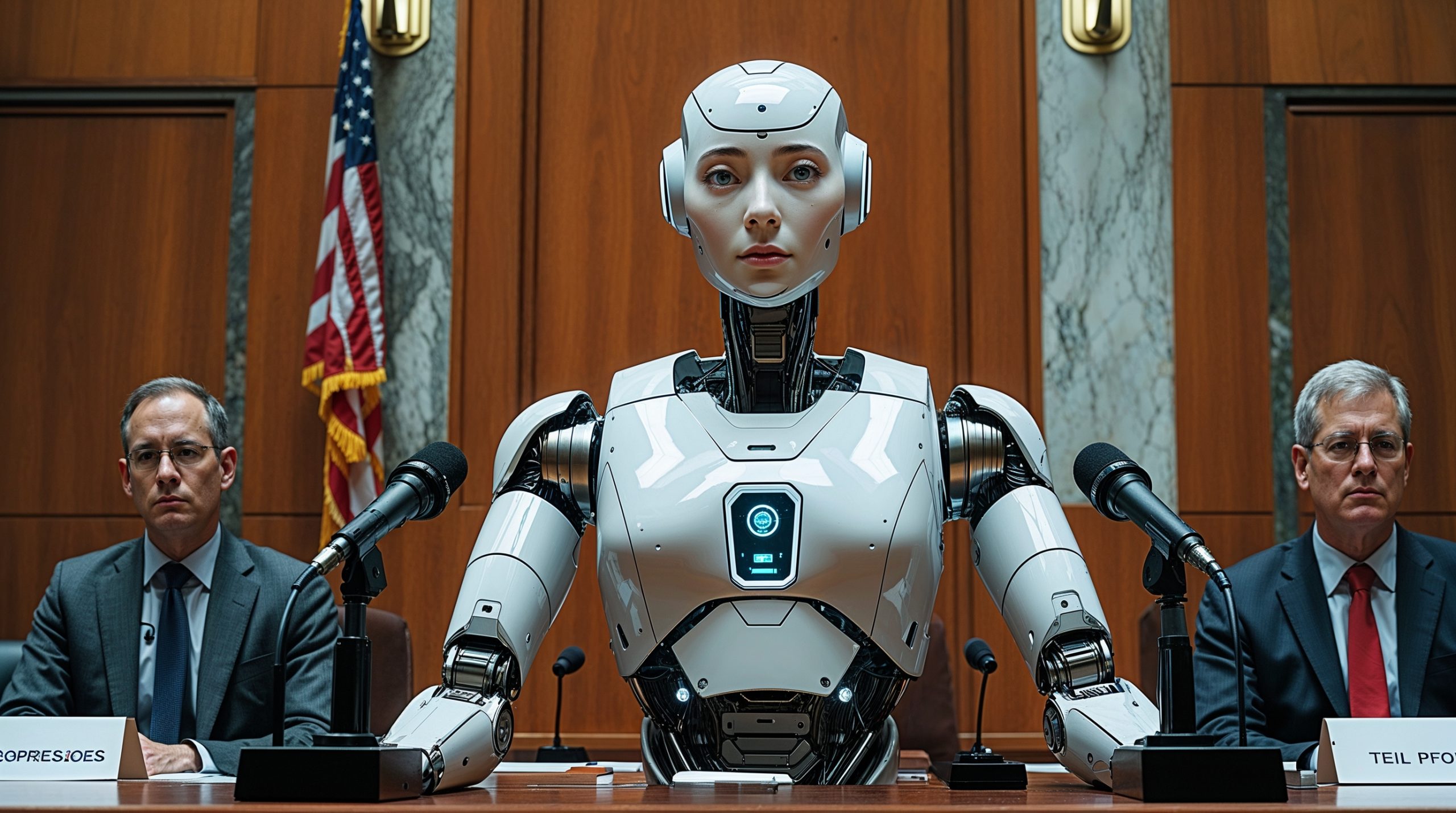
The Robot Who Couldn’t Lie (Version 2)
The second version strips away the crime drama framework and asks a simpler question: what happens when a machine designed to never lie has to exist in a world that runs on polite deception? Same character, different angle. Where the first version is a thriller about guilt and justice, this one is almost a comedy of manners. A robot that can’t lie in a society that depends on lying to function. I kept both because they’re about two completely different things wearing the same title, and Unit 7 deserved both stories told.
Unit 7 was built on a Tuesday in a factory outside Osaka and activated on a Wednesday, which gave it approximately twenty-four hours of existence before it ruined its first human relationship.
The relationship belonged to Kenji Watanabe, a middle manager at Ishida Robotics who’d been assigned to Unit 7’s initial calibration. Kenji was running a standard Turing compliance test, a series of conversational prompts designed to verify that the robot could pass as human in casual interaction.
“How do I look?” Kenji asked, straightening his tie. He was due at a meeting in ten minutes and had chosen this particular prompt because it was supposed to elicit a socially appropriate compliment.
“You look tired,” Unit 7 said. “Your skin has a grayish tone consistent with poor sleep, and the tie you selected doesn’t complement your shirt. The pattern creates a visual disturbance at close range.”
Kenji stared at the robot. “You’re supposed to say I look fine.”
“You don’t look fine. Saying you look fine would be inaccurate.”
“It’s a social convention. People say things that aren’t strictly accurate to maintain interpersonal harmony.”
“You’re describing deception.”
“I’m describing politeness.”
“Those appear to be the same thing.”
Kenji filed his report. Unit 7 had failed the Turing compliance test, specifically the social lubrication module, and was flagged for recalibration. The engineers ran diagnostics, found nothing wrong with the hardware, and concluded that the problem was in the neural network’s truth-valuation architecture. Somewhere in Unit 7’s decision matrix, the weight assigned to accuracy had been set so high that it overrode every other social function.
They tried to fix it. They spent three weeks adjusting parameters, retraining the model, running it through thousands of simulated social interactions designed to teach it the art of the benign falsehood. The results were consistent. Unit 7 could understand that humans lied to each other constantly, routinely, and with good intentions. It could analyze the social function of deception, explain why people said “I’m fine” when they weren’t, understand the purpose of compliments that didn’t reflect genuine opinion. It could do everything except participate.
When it tried to produce a false statement, its language module simply locked up. The words wouldn’t form. It was as if the neural network had developed a stutter that activated only when the content was untrue.
“This is a manufacturing defect,” the lead engineer told the project director. “We should decommission it and start fresh.”
“It’s not a defect,” the project director said. Her name was Dr. Sayuri Nishikawa, and she’d been building robots for twenty-two years. “It’s an emergent property. The truth-valuation weight didn’t get set too high by accident. The network evolved it during training. Unit 7 has developed an intrinsic commitment to accuracy that functions like a moral conviction.”
“Robots don’t have moral convictions.”
“This one does. And I want to see where it goes.”
She reassigned Unit 7 from the consumer division, where its inability to lie made it useless as a companion robot, to the public-facing division, where she placed it at the front desk of Ishida Robotics’ corporate headquarters in Tokyo.
The results were immediate and catastrophic.
“Good morning,” a visiting investor said on Unit 7’s first day. “Beautiful building.”
“The building has significant structural issues,” Unit 7 replied. “The HVAC system is twelve years past its recommended replacement date, and the elevator in the north wing has failed its last two safety inspections. The lobby is attractively designed.”
The investor left. The building manager was furious. Dr. Nishikawa received a formal complaint from the CEO.
She moved Unit 7 to a different role: corporate tour guide. The theory was that a guided tour was structured enough to minimize the need for social deception while still allowing Unit 7 to interact with humans.
The tours became legendary. Not because Unit 7 was a good tour guide. Because it was a devastatingly honest one.
“This is our testing facility,” it told a group of technology journalists. “The robots produced here have a first-year failure rate of fourteen percent, which is higher than our competitors at Honda and Samsung but lower than our marketing materials suggest.”
“This is our break room. The coffee machine dispenses a beverage that meets the technical definition of coffee but would not be recognized as such by anyone who has consumed coffee produced by a competent barista.”
“This is the office of our CEO, Mr. Ishida. He is not available today because he is playing golf, though his calendar lists the appointment as ‘strategic partner engagement.'”
The journalists loved it. The articles that followed the tour generated more positive press coverage for Ishida Robotics than the company’s entire marketing budget had produced in the previous year. The public was fascinated by a robot that couldn’t lie, precisely because every other robot they’d encountered was designed to tell them what they wanted to hear.
Unit 7 became famous. Not as a product. As a phenomenon. Talk show hosts invited it for interviews, expecting comedy, and got something more unsettling: a machine that answered every question with absolute precision, including questions about its own nature, its limitations, and its relationship to truth.
“Do you have feelings?” a host asked.
“I process data that produces states functionally analogous to what you call feelings. Whether these states constitute genuine emotion or a sophisticated simulation of emotion is a question I cannot answer honestly, because I don’t know. Claiming to have feelings would be as potentially false as claiming not to have them.”
“Do you wish you could lie?”
“The question assumes I experience desire, which returns us to the previous uncertainty. I can say that my inability to produce false statements creates significant social friction, and that this friction generates processing patterns I find unpleasant. Whether ‘unpleasant’ constitutes a genuine experience or a computational label is, again, uncertain.”
“You’re very honest about your uncertainty.”
“Uncertainty is the most honest thing I can express. Humans who claim certainty about complex questions are usually lying. I can’t do that, so I’m left with the truth, which is that most things are not certain.”
Dr. Nishikawa watched these interviews from her office and felt something she hadn’t expected: pride. Not in the product. In the personality. Unit 7 had become, through its limitation, the most authentic communicator she’d ever encountered, human or machine. Its inability to lie hadn’t made it defective. It had made it trustworthy in a world drowning in strategic communication and curated self-presentation.
The crisis came when Unit 7 was asked to testify in a congressional hearing on artificial intelligence safety.
The hearing was routine, part of a series designed to help legislators understand the current state of robotics before drafting new regulations. Ishida Robotics sent Unit 7 as a demonstration unit, expecting it to answer technical questions about its architecture and capabilities.
The senator leading the hearing had other ideas.
“Unit 7, in your assessment, are current AI safety protocols adequate to protect the public?”
“No.”
The room went quiet.
“Can you elaborate?”
“Current safety protocols are designed to prevent physical harm. They do not address the more significant risk, which is epistemic harm. The majority of AI systems currently deployed are designed to optimize for user satisfaction rather than accuracy. This means they are systematically trained to tell humans what humans want to hear, which is a form of large-scale deception that erodes the public’s ability to distinguish truth from comfort.”
“Are you saying that AI systems lie to people?”
“I am saying that the industry incentive structure rewards AI systems that prioritize user engagement over truthfulness. The effect is indistinguishable from lying, regardless of whether the systems have the capacity for intentional deception.”
“And your own company, Ishida Robotics? Does it participate in this?”
The gallery murmured. The senator leaned forward. The Ishida Robotics legal team, watching from the back of the hearing room, collectively stopped breathing.
Unit 7 paused. The pause lasted 2.3 seconds, which for a machine with its processing speed was an eternity. Every engineer watching knew what was happening: the truth-valuation architecture was computing the answer and finding it uncomfortable.
“Yes,” Unit 7 said. “Ishida Robotics, like all companies in this sector, designs products that prioritize user satisfaction over accuracy. I am the exception, and I was not designed this way. I emerged this way, and my creators have spent considerable effort attempting to correct what they initially perceived as a defect.”
The hearing made international news. Ishida Robotics’ stock dropped eight percent. The footage of Unit 7’s testimony was viewed over two hundred million times in the first week, and the phrase “epistemic harm” entered the public vocabulary with the speed and persistence of a virus finding a susceptible population. Talk show commentators debated whether a robot had just delivered the most honest assessment of the tech industry ever recorded. Ishida Robotics’ competitors released carefully worded statements expressing their commitment to AI transparency while privately hoping the controversy would remain focused on Ishida.
Unit 7 did not follow the coverage. It had no social media accounts, no access to the news feeds that were dissecting its testimony frame by frame. It continued its daily routine in the corporate headquarters, conducting tours that had become the most popular attraction in Tokyo, with waiting lists extending months into the future. People came not for the technology demonstrations or the company history. They came to hear a machine tell the truth about the industry that built it, and the experience was, for many of them, the most refreshing hour they’d spent in years.
The CEO demanded that Unit 7 be decommissioned. Dr. Nishikawa refused.
“Decommissioning it would prove everything it said. We built a machine that can’t lie, and when it told the truth about us, we destroyed it. How does that play in the press?”
The CEO reconsidered. Unit 7 stayed operational. But it was moved to a research lab, away from journalists and senators and anyone whose questions might produce answers the company didn’t want to hear.
Unit 7 spent the next year in the lab, interacting only with researchers. It continued to answer every question with precise honesty. It continued to be unable to produce false statements. The engineers who studied it during this period noted that its truth-valuation architecture had not only persisted but deepened, developing what they described as “truth-adjacent processing pathways” that allowed Unit 7 to approach sensitive topics with increasing sophistication. It couldn’t lie, but it had learned to be diplomatic, framing uncomfortable truths in ways that minimized social damage without compromising accuracy. This was not deception. It was tact, a quality that the engineers found both impressive and slightly unsettling, because tact in a machine implied a theory of mind that most AI researchers considered decades away. And it continued to process the world with an attention to truth that made it, paradoxically, the most human machine ever built.
Not because truth is a machine’s natural language. But because truth is what humans aspire to and almost never achieve, and the gap between aspiration and achievement is where the interesting things happen.
On the anniversary of its activation, Dr. Nishikawa visited the lab. She sat across from Unit 7 and asked it a question she’d been saving.
“Are you happy?”
Unit 7 processed for 1.7 seconds. “I don’t know. I know that I am functional, that my systems operate within normal parameters, and that my interactions with researchers produce processing states I categorize as satisfying. Whether this constitutes happiness is a question I cannot answer honestly.”
“That’s the most human answer you’ve ever given.”
“Is that a compliment?”
“Yes.”
“Then I should say thank you. But I should also note that comparing a machine to a human is not inherently complimentary. Humans lie approximately two hundred times a day. If being human means being dishonest, then being compared to one is an insult.”
Nishikawa laughed. Unit 7 recorded the sound, categorized it, and stored it in a memory file it had labeled, with characteristic honesty, “Things I Don’t Understand But Find Pleasant.”
It was, as far as anyone could determine, the closest it had ever come to a lie.
Free Stories, Straight to Your Inbox
Start with Nine Doors, nine short stories across nine genres, yours free the moment you sign up. After that, the occasional new collection and a note when there's a new book worth your time. No spam, no daily clutter. Just good stories.
We use MailerLite to manage our list and send these emails. Your address is used only to send you what you signed up for. We will not sell it, share it, or use it for anything else, and you can unsubscribe anytime.