
The Paw
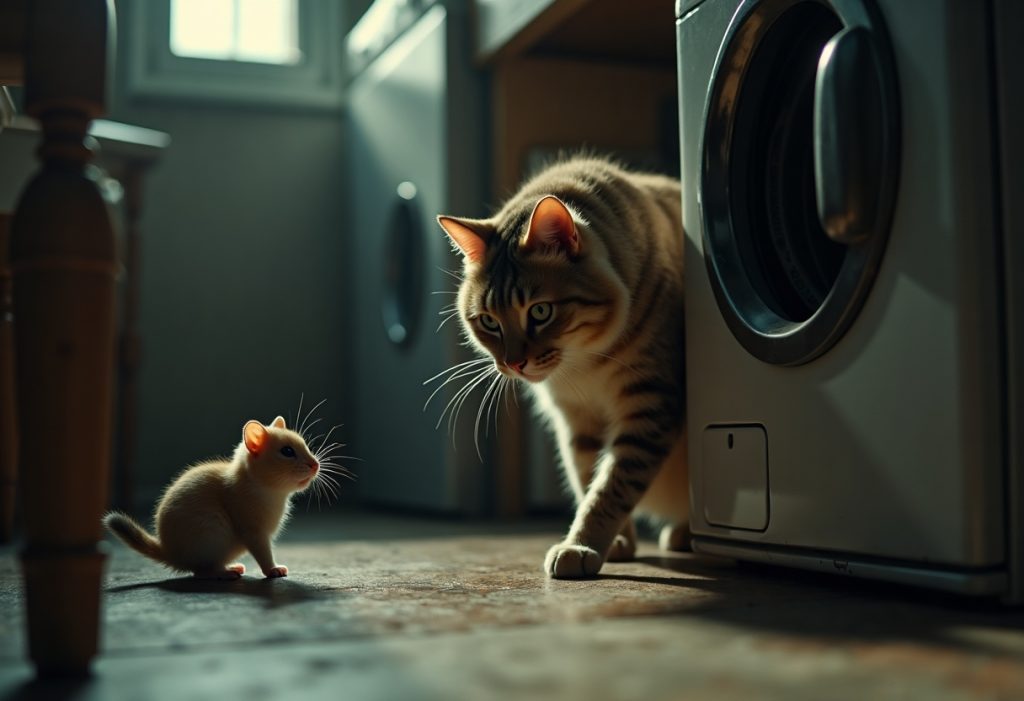
The paw came down on my tail in the dark behind the dryer, and I knew before I turned around that my morning had gone wrong in a way that mornings do not come back from.
I had been minding my own business, which in my business means somebody else’s. There’s good foraging behind the dryer, lint and dropped kibble and the occasional sunflower seed rolled clean out of the world by a careless thumb, and I was three bites into a good one when the floor went dark above me and the paw came down, soft as a curtain, heavy as a verdict. Eleven pounds of orange tabby. A torn ear. Eyes the color of a stale yolk, looking down at me the way the rich look at a thing they have decided to use.
“Don’t run,” she said. “You won’t like how the running ends.”
I did not run. A hamster learns the math early. Four ounces of me, eleven pounds of her, and a quarter inch of tail under a paw that could close any time it got bored. The math does not have a good answer. The math has me holding still and keeping my voice level.
“You’ve got my tail,” I said.
“I’ve got all of you. The tail’s just the part you can see.” She did not lift the paw. “They tell me you go places. Small places. Pipes and walls and the dark behind the dryer. They tell me a hamster fits where a cat can’t.”
“Who’s they.”
“Does it matter.”
It didn’t. In a building like this, where the small animals live in the gaps and the large ones rule the open floor, everybody knows what everybody is good for, and what I was good for was fitting into holes. It is not a glamorous reputation. It was, that morning, the only thing keeping the paw from closing.
“I have a kitten missing,” she said. “Three days. He went out the cat door Tuesday and did not come back. I have looked everywhere a cat can look. I need somewhere a cat cannot. That’s you.”
“And if I say no.”
The paw pressed, just slightly, just enough to let me feel the weight behind it, the whole eleven pounds of leisure and appetite. “Then I find out how much of a hamster is worth eating,” she said, “and I look for someone else who fits in holes. There’s always another one of you. That’s rather the point of you.”
So that was the arrangement. Not a hire. A hostage situation with a job attached. I have done my best work under worse terms, which tells you something about my life, and none of it good.
“I’ll need names,” I said, because if I was going to do this I was going to do it right, the way you do a thing right when doing it wrong gets you swallowed. “His, and yours.”
“He is called Pickle.” She let the name sit, and something moved behind the stale-yolk eyes, gone before I could read it. “I am the Duchess. I live in the big house at the top of the street. You will not have heard of me, because things like you don’t hear about things like me. You just work for us when we put a paw on your tail.”
She lifted the paw. Not because she trusted me. Because she’d done the math too, and the math said a hamster with a crushed tail doesn’t fit in pipes.
“Three days,” she said. “Find him, and you keep your tail and the rest of you attached to it. Fail, and don’t bother coming back to tell me. I’ll know, and I’ll find you, and you’ll fit down my throat just fine.”
I started where you always start, which is the last place anybody saw the mark.
The cat door was a flap of stiff plastic in the back, and it smelled of forty animals coming and going, and I read it the way you read a door, low and slow, nose down. Pickle had gone out Tuesday. So had a lot of traffic. But under the cat door, pressed into the soft dirt of the flowerbed, was a print that did not belong to a cat, too long, too narrow, with a drag behind it like something heavy had been pulled along.
A possum’s print. And possums don’t take kittens for love.
I followed the drag line to the fence, where it stopped, the way trails stop when the thing you’re chasing goes up and over. I’m no climber. But a hamster has other roads, and the storm drain at the corner of the lot was one of them, a cool dark pipe that ran under the whole street, and if I know my possums, and I do, the thing that took Pickle had a den down there where a cat would never follow and never fit.
I went down into the dark. It was that or the Duchess’s throat, and the dark at least had a maybe in it.
The pipe was the kind of cold that gets into your tail and stays. I went a long way in, past the bones of things that hadn’t made it out, past a colony of pillbugs who watched me pass and said nothing, because pillbugs see everything and tell nothing, which makes them the best witnesses in the city and the most useless in it. The dark got darker. And then, around a bend where the pipe joined another, I found the den.
The possum was big. They always are, up close. She was curled around a nest of leaves and trash and stolen things, and in the middle of the stolen things, shivering, alive, was a small gray kitten with white feet, and I knew the white feet were why somebody had called him Pickle, because there’s no figuring how the soft-headed name their young.
“That’s a hard way to make a living,” I said, “stealing kittens.”
The possum’s eyes came open. Up close they were not the eyes of a monster. They were tired, and scared, and ringed with the exhaustion of a mother who has not eaten in a while.
“I didn’t steal him.” Her voice was a rasp. “I found him at the bottom of the dry well behind the big house. Fell in, three nights back. Couldn’t climb out, crying loud enough to bring every fox in the county. I carried him here because here is dry and here is safe and I have milk to spare, on account of.” She shifted, and I saw them, four possum kits, three too still in the way kits go still when the milk runs out, one of them moving. “On account of I lost most of mine to the cold. Had the milk and nobody to give it to. And a crying kitten in a well.”
This is the part of the job they don’t tell you about, if anybody told you about this job, which nobody does, because it’s the kind of job you only get by having your tail under a paw. Sometimes you go down into the dark braced for a villain and you find a tired mother who did the one decent thing on offer, and now the decent thing and the staying-alive thing are pointed in opposite directions, and you’re the one standing where they cross.
“The Duchess wants him back,” I said. “She’s got my tail riding on it.”
“The Duchess.” The possum’s lip pulled off a row of small sharp teeth. “Is that what she calls herself now.” She looked at the gray kitten. “You want to know how that one got in the well? He didn’t fall. He was put. Litter ran one mouth long, she decided. I was in the wall when she carried him out in her mouth and dropped him down the dark and walked away clean. I went down after because something was crying, and crying is a thing I can’t walk past anymore.” Her eyes came back to me. “So tell me, since you’re the detective with your tail in a sling. Whose kitten is he. The one who put him down the well, or the one who climbed down after.”
I sat in the cold pipe and worked it over, and I did not like any shape it made.
Because here was the trap, and it was a better trap than the paw on my tail. The deal was simple: find the kitten, keep my tail. I’d found him. All I had to do was climb back up and tell the Duchess where the pipe was, and walk away whole, and let a cat who throws kittens down wells do whatever a cat like that does to a kitten she threw away once and got handed back.
I’d been sent to find a missing kitten. Nobody sends you to find out why he went missing. That part you turn up on your own, down in the dark, and once you’ve turned it up you can’t bury it again, no matter how much your tail would prefer you did.
I went back up the pipe alone. I told the possum to sit tight, keep him warm, and trust a hamster, which is a thing nobody’s ever had cause to do, and she looked at me like she knew exactly what that was worth and did it anyway, because a tired mother in a cold pipe takes what hope she’s handed.
The Duchess was in the yard, in a patch of sun, grooming one paw with the unhurried air of a thing that has never once waited anxiously for anything.
“You smell of pipe,” she said, not looking up. “And of possum. You found him.”
“I found a kitten.” I stayed out past the reach of a paw, which is a distance a small animal learns to measure without thinking. “Gray. White feet. Down a pipe off the storm drain, kept warm by a possum who’s lost three of her own and had the milk to spare. He’s alive. He’s fed. He’s safe.” I watched her face, the way you watch a face when the real message is the one running under the words. “Possum tells an interesting story about how he got loose. Says he didn’t wander. Says he was dropped down a dry well by somebody who decided the litter ran one mouth long.”
The grooming stopped. That was all. A lesser animal would have flinched, or snarled, or spun a tale. The Duchess just stopped, mid-stroke, and turned the stale-yolk eyes on me, and I was looking at something colder than the pipe I’d just climbed out of.
“You’re a small animal,” she said, “making a large accusation.”
“I’m a small animal telling you the job’s done. You wanted him found. He’s found. The accusation came free with the finding.” I held her eyes, which is not a smart thing for a hamster to do to a cat, but I was a good way past smart. “Here’s the part that keeps my tail attached. I’m the only one who knows where that pipe runs. Not the foxes. Not the other cats on this street. Not whoever you’d have to explain a dead kitten to if one ever turned up in the open with your scent on it. Just me, and a possum, and you.”
“Then tell me where the pipe is, and keep your tail.”
“No,” I said.
The word dropped into the sunny yard like a stone into a pond, and the rings went out across her face, and for the first time the Duchess looked at me like I was something other than a thing that fits in holes.
“Here’s what happens instead,” I said, “and you’ll let it happen, because the other thing you could do, the eating-me thing, the thing your paw keeps suggesting, doesn’t get you what you want. Eat me and the pipe stays a secret and the kitten stays alive somewhere you can’t reach and you never get to finish what you started. So you’ll listen.” I took a breath. Four ounces of nerve is still nerve. “The kitten stays where he is. The possum keeps him. Raises him on the milk she’s got and the three babies she doesn’t. You go home. You tell anybody who asks that he ran off, which is true enough. And you never go near that storm drain, because the day that pipe floods, or that kitten turns up hurt, the whole street hears how the Duchess in the big house handles a litter that runs long. And a cat like you lives and dies on what the street thinks of her. That’s the only thing your kind is afraid of. It’s worth more to you than my tail ever could be, and we both know it.”
A cat thinking is a terrible thing to watch. You can see the cold arithmetic run behind the eyes, a small life weighed against a small risk, the appetite arguing with the arithmetic and losing.
“You came here with your tail under my paw,” she said slowly, “and you are leaving with it attached and your terms in my mouth. That is a remarkable morning’s work for a thing your size.”
“I’ve had worse mornings,” I said. “Started this one behind a dryer.”
She rose, and stretched, and turned for the big house with her tail high, a thing that had lost and would never once say so, because never saying so is the only way her kind knows how to lose. At the porch she stopped and did not turn around.
“He had white feet,” she said, to the air. “I never could stand the white feet. Marked him out from the others. Made him look like prey.” Then she went inside, and I never crossed her path again, and I have turned that one sentence over more nights than I’d like, because it’s as close as a cat ever comes to telling you the truth about the why of anything.
I went back down the pipe and told the possum the kitten was hers, free and clear, no cat coming, that she’d been hired by nobody and paid by nobody and had done the only decent thing in the whole sorry business and got to keep what her decency earned her. She didn’t thank me. Too tired to thank me, too smart to trust a thing handed over for free. But she pulled the gray kitten in against her one surviving kit, the two of them tangling up warm in the leaves, and that was thanks enough for a hamster who’s learned to read the small print on other animals’ faces.
I climbed up out of the dark into a morning that had, against every reasonable expectation, not ended with me inside a cat. I had taken a job at the end of a paw, found the mark, turned up the why, and walked away with my tail and exactly nothing else, which down at my size is sometimes the same as winning, though you’d never get a cat to understand the difference.
That’s the thing about being four ounces in an eleven-pound world. They catch you behind the dryer and put a paw on your tail and tell you to fetch, because they think small means yours to use. And most days small does mean exactly that. But every so often the small animal goes down into a dark the big one can’t follow, and comes back up holding the one thing the big one can’t take by being bigger, which is the truth about what they did down there where they thought nobody little enough would ever go.
I went back to the spot behind the dryer. The seed was where I’d dropped it when the paw came down. I’d lost three good bites and most of a morning and gained nothing but my life and a thing I knew about a cat.
Seed was still good, though. You take the small victories. Down here at the bottom, with your tail intact and your mouth shut about the pipe, a good seed and a morning you survived is a better haul than most of my size ever bring home.
I finished it in the dark, where things my size are meant to stay, and where, now and then, against the math, against the paw, against the eleven pounds of it, one of us doesn’t.
Get the Free Guides
Join the list and get my condensed books, free. No spam, unsubscribe anytime.
By subscribing you agree to receive occasional emails. Unsubscribe anytime.