
The Corpse Collector’s Son
In some cultures, handling the dead is a hereditary profession. The son inherits the father’s work whether he wants it or not. Nobody chooses it. Nobody celebrates it. The neighbors keep their distance and the children at school find reasons not to come over. I was interested in what happens when the thing you’re born into is the thing everyone else finds repulsive. There’s dignity in that work, real dignity, that most people refuse to see because seeing it would mean acknowledging that someone has to do it. The son in this story didn’t choose his life. He chose to find meaning in it anyway.
My father collected the dead for a living, and the dead, on occasion, collected him.
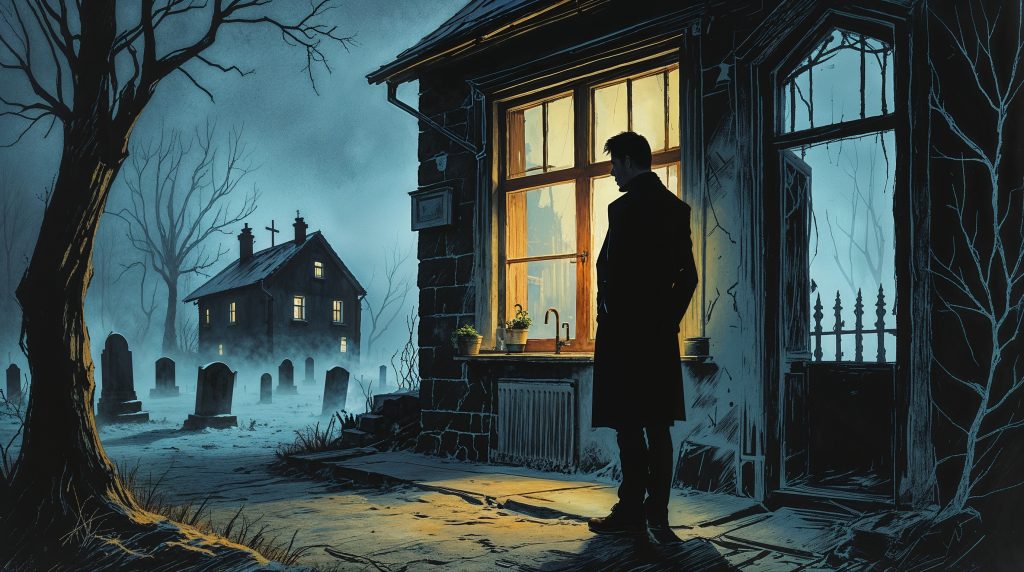
We lived in a narrow house on the outskirts of Bucharest, in a neighborhood that smelled of coal smoke and wet earth, near enough to the cemetery that the morning fog carried the scent of turned soil through our windows. My father, Andrei Costin, was a mortuary transport driver, which meant he drove a van to hospitals, nursing homes, and private residences and collected the bodies of people who’d died and needed to be moved to the morgue or funeral home. It was not a profession that attracted socialites. It was a profession that attracted my father, who was quiet, methodical, and entirely comfortable in the presence of the dead.
I was twelve when I first noticed something wrong with him.
He’d been on a late call, a pickup from a village two hours east of Bucharest, and came home after midnight. I was awake, reading by flashlight in my room, and I heard the van pull into the drive, heard his boots on the porch, heard the front door open and close. Then I heard him talking.
Not on the phone. Not to my mother, who was asleep. He was standing in the kitchen, talking to the empty room in a low, conversational tone, as if he were having a discussion with someone who was answering in a voice too quiet for me to hear.
“No, I understand,” my father was saying. “But the cold makes it harder. The muscles stiffen faster. You should tell them that.”
A pause. Then: “I know. I know you didn’t have a choice.”
Another pause. “The boy? He’s fine. He’s sleeping. He doesn’t know.”
I crept to the top of the stairs and listened until he stopped talking and the kitchen light clicked off. In the morning, I checked his phone. It was in his coat pocket, turned off. It had been off all night.
The conversations became regular. Every few weeks, after a particularly late or difficult collection, my father would stand in the kitchen or the living room and talk to someone who wasn’t there. The conversations were always one-sided from my perspective, his voice low and patient, asking questions, responding to answers I couldn’t hear. He never seemed frightened. He never seemed distressed. He spoke to the invisible presence the way you’d speak to a colleague, with professional courtesy and the occasional flash of dark humor.
“Well, you shouldn’t have been on that road at three in the morning,” he said once, and laughed softly at whatever the silence told him in reply.
I asked my mother about it. She was a practical woman, a nurse at a children’s hospital, and her response was characteristically direct.
“Your father talks to the dead,” she said, stirring a pot of ciorba on the stove. “He always has. Since before I met him.”
“Like a medium?”
“Like a man who drives a van full of corpses and is too polite not to make conversation.”
“That’s insane.”
“Many things are insane. Your father is not one of them. He’s the sanest person I know. He just has unusual colleagues.”
I was not reassured. But I was twelve, and twelve-year-olds have limited options for addressing their parents’ supernatural habits, so I did what children do: I adapted. I accepted my father’s conversations with the dead the way I accepted his early mornings, his calloused hands, and his habit of humming Romanian folk songs while he drove, as features of a landscape I didn’t choose but couldn’t change.
The dead, for their part, seemed to appreciate him. I don’t know how else to describe it. The houses he visited for collections were places people avoided. Friends and neighbors would stand at the curb, unwilling to enter a room where someone had died. My father walked in without hesitation, loaded the body onto his gurney with a gentleness that went beyond professional obligation, and drove to the morgue as if he were giving someone a ride home. He treated each body with a respect that bordered on tenderness, adjusting blankets, closing eyes, murmuring things I couldn’t hear as he worked. The other drivers at the mortuary thought he was eccentric. His clients, the dead ones, apparently thought otherwise.
The problems started when the dead began to linger.
I noticed the cold first. Our house, which had always been warm (my mother kept the radiators running at full capacity from October to April, a holdover from her childhood in a drafty village near Sibiu), developed cold spots. Specific areas where the temperature dropped ten or fifteen degrees, patches of frigid air that you’d walk through and feel the chill settle into your bones like a bad memory.
The cold spots moved. Monday, the hallway. Tuesday, the kitchen. Wednesday, my bedroom, which sent me sprinting to my parents’ room at 2 a.m. with my blanket, claiming a nightmare but knowing it wasn’t a dream. You can’t dream something that makes your breath visible.
Then the sounds. Not voices, not the clear conversations my father had in the kitchen. Sounds without source: a chair scraping on the floor in an empty room. Water running in a sink that was turned off. A slow, rhythmic creaking from the attic that sounded like footsteps but couldn’t be, because the attic was sealed and had been since before I was born. The creaking had a patience to it, a steadiness, as if whatever was making the sound had all the time in the world and intended to use it.
My father noticed. He walked through the house one evening, pausing at each cold spot, tilting his head as if listening. I watched from the stairway landing, hugging my knees, trying to make myself small enough to be invisible.
“There are too many of you,” he said to the living room. “You can’t all stay here.”
A pause. The cold intensified. I saw my breath from twenty feet away.
“I understand. But this is my home. My family lives here. You need to move on.”
Something shifted. The temperature in the hallway normalized. The creaking in the attic stopped. Two of the cold spots dissipated, dissolving like fog in sunlight. But the one in the kitchen remained, stubborn and freezing, a pocket of winter in the middle of our house.
“That one was a child,” my father told my mother afterward, sitting at the kitchen table, his hands wrapped around a cup of tea that steamed in the cold air. “A girl. Six or seven. She’s scared. She doesn’t want to go.”
“Go where?”
“I don’t know. They never tell me where they’re going. They tell me where they’ve been. Where they’re going is their business.”
My mother’s mouth tightened. She was not a woman who believed in ghosts, but she believed in her husband, and the cold in the kitchen was hard to argue with when you could see your own breath in June.
The child’s cold spot stayed for three months. My mother, who was either the bravest woman in Bucharest or the most stubborn, refused to alter her cooking schedule. She stood in the freezing kitchen and made ciorba and sarmale and mici, her breath clouding, her fingers going numb on the wooden spoon handle, treating the dead child’s presence with the same unflinching normalcy she applied to everything else.
“Talk to her,” she told me one evening, handing me a bowl of soup. “Your father says she’s lonely.”
“I’m not talking to a ghost.”
“She’s not a ghost. She’s a child who died and hasn’t figured out what comes next. Talk to her the way you’d talk to any kid who’s scared.”
I sat at the kitchen table. The cold was intense, sharp enough to make my eyes water, sharp enough to turn the steam from my soup into a visible plume that rose and vanished. I felt something in the air, not a presence exactly, but an attention. A focus. The way a room feels different when someone is watching you from behind a curtain.
“Hey,” I said. I felt stupid. “I’m Mihai. I’m twelve. I live here.”
The cold shifted. It moved closer, concentrating around my end of the table. The hairs on my arms stood straight up.
“My dad collects people when they die. He’s really nice about it. He says you’re scared.”
Nothing happened. The cold persisted. I sat there for fifteen minutes, talking to the freezing air about school, about my friends, about the stray dog I’d been feeding behind the cemetery wall. About the comic books I was reading and the football match I’d lost and the girl in my class who had red hair and laughed too loudly and who I thought about sometimes when I was trying to sleep. I talked until my teeth chattered and my fingers were too stiff to hold the soup spoon.
The next morning, the cold spot was gone. The kitchen was warm. The radiator hummed. The air smelled of coffee and toast, not frost and emptiness.
My mother found me at breakfast. “She left last night,” she said. “Your father felt her go around three a.m.”
“Where did she go?”
“He doesn’t know. But she wasn’t scared anymore.”
I want to say that this experience transformed me, that I developed my father’s gift, that the dead began speaking to me and I became a bridge between worlds. None of that happened. I grew up, went to university in Cluj, became a civil engineer, married a woman named Ana who thought my childhood stories about ghosts in the kitchen were charming but didn’t believe them for a second. We lived in a modern apartment in a new development on the north side of Bucharest, a building made of concrete and glass and central heating, a building where the dead would find no cold spots to inhabit and no patient man to talk to.
What I did take from that house, from those years of cold spots and midnight conversations, was this: my father spent his entire life in the company of the dead, and it made him kinder. Not haunted, not damaged, not the grim figure that people imagine when they think of someone who handles corpses for a living. He was gentle, patient, and profoundly respectful of the boundary between the living and the dead, a boundary he crossed daily and never violated. He treated the dead the way he treated the living: with attention, with care, with the quiet assumption that everyone deserves to be spoken to, even when they can no longer answer in a voice the world can hear.
He died at seventy-one. Heart attack, sudden, in the kitchen of our house, the same kitchen where the dead child had lingered. My mother found him on the floor, already gone, with an expression on his face that she described as “interested,” as if death had presented him with something unexpected and he was curious to see what came next.
I drove down from Bucharest for the funeral. The house was warm. No cold spots. No sounds. The dead, for the first time in my memory, were silent. As if they were giving the house privacy. As if they knew that the man who’d spoken to them for fifty years was now on their side of the conversation, and the living needed a moment to catch up.
Except for one.
The night before the funeral, I was sleeping in my old room, and I heard a voice in the kitchen. Low, conversational, patient. My father’s voice.
I didn’t go downstairs. I lay in bed and listened to him talk, the way I’d listened when I was twelve, catching every third word through the floor. He was talking to someone. Asking questions. Getting answers I couldn’t hear.
Then he said something I caught clearly, something that made me pull the blankets tighter and stare at the ceiling until dawn.
“The boy? He’s fine. He’s sleeping.”
A pause.
“No. He doesn’t know. He doesn’t need to.”
The kitchen went silent. The house went warm. And in the morning, when I came downstairs, there was a cup of coffee on the table, steaming, as if someone had just made it and stepped away.
My mother was still asleep. Nobody else was in the house.
I drank the coffee. It was hot, strong, made exactly the way my father had always made it: too much sugar, not enough milk. The way I’d complained about for years as a teenager and missed every morning since I’d moved away.
I drank it standing in the warm kitchen, in the house on the outskirts of Bucharest, near enough to the cemetery that the morning fog carried the scent of turned soil through the windows, and I said nothing, because my father had taught me that the boundary between the living and the dead was not a wall but a conversation, and some conversations are better left to the people who know how to have them.
Get the Free Guides
Join the list and get my condensed books, free. No spam, unsubscribe anytime.
By subscribing you agree to receive occasional emails. Unsubscribe anytime.