
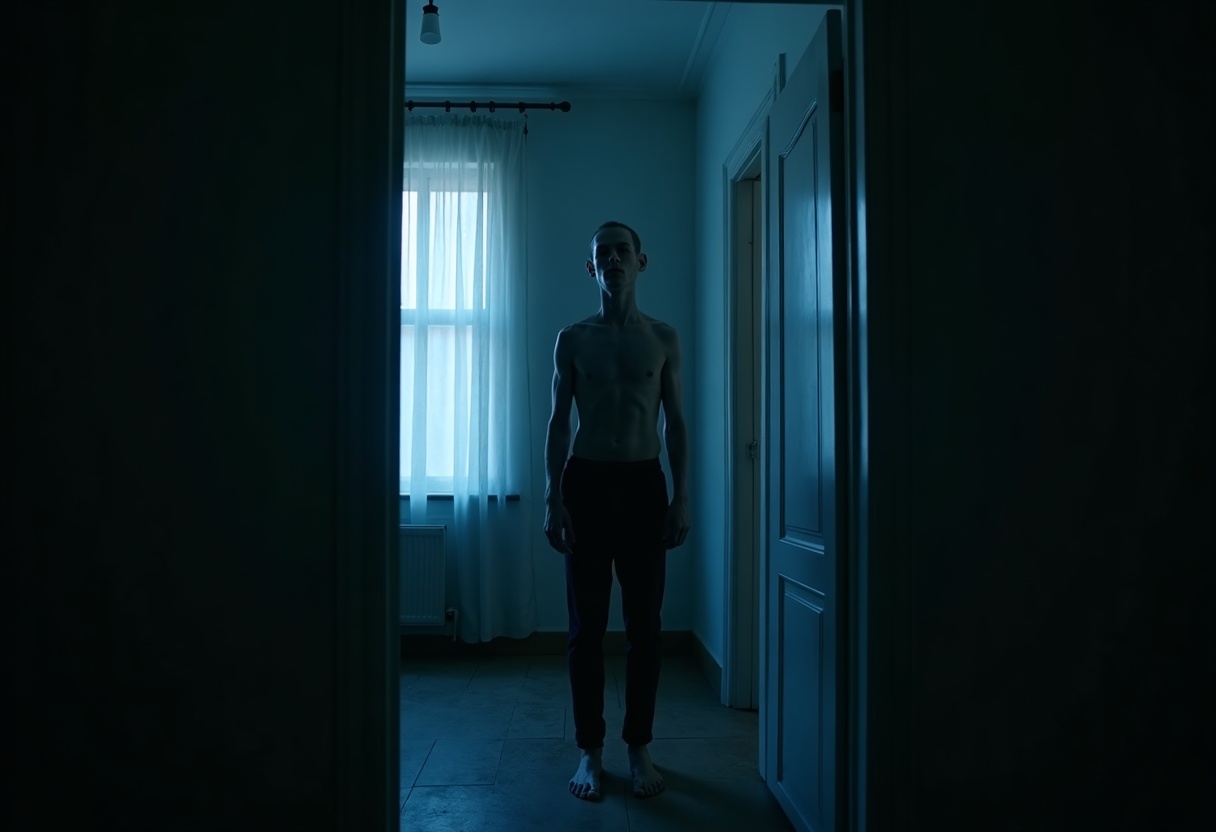
The Cold Thing
Marisol slept the way the living sleep, which is to say carelessly, her throat bared to the ceiling and her pulse ticking in it, and Edvard lay beside her in the dark and listened to the blood move and told himself, again, that listening was not the same as deciding.
He had been doing this for four months. Lying still while a human slept beside him, close enough to feel the warmth come off her skin, close enough to hear the soft machinery of a body that did not know it was sleeping next to the thing it was built to fear. Marisol thought Edvard had insomnia. Marisol thought a great many kind and wrong things, and Edvard had let her, because the truth was not a thing you said to a woman you were still deciding whether to keep or to drink.
The pulse in the throat was the problem. It was always the problem. It was a slow, even, trusting beat, and to Edvard it was the most beautiful sound in the world and also dinner, and for four months he had pretended those two things could be held apart. They sat side by side in him, the love and the hunger, and he had let himself believe, the way the sentimental believe, that the love was the larger of the two. He was old enough to have known better. Being old, it turned out, was no protection against wanting to be the kind of creature the stories said you could become if you only loved hard enough.
He got up before the sun, the way he always did, and went to sit in the kitchen in the dark, and did the arithmetic one more time.
Edvard was old. Not the oldest, but old enough. He had been turned in a century that left no photographs, in a city that had since changed its name twice, and he had spent the long arithmetic of his years arriving at a private code he could live inside. He did not kill. He had killed, in the beginning, the way the new ones do, and then he had stopped, and fed carefully ever after, the willing and the paid and the drunk who woke thinking they had dreamed it, a sip here and a sip there, never enough to harm. He had called this conscience. He had been proud of it, in the cold way his kind are proud, the way a man is proud of a diet he has not yet been truly hungry through.
Then Marisol had spilled a drink on him in a bar, and laughed, and Edvard had decided to find out whether a creature like him could love a creature like her. He had told himself it was love. He had told himself that for four months. Sitting in the dark now, he made himself look at what it had actually been, and what it had actually been was a predator who had never let himself want the same prey twice, circling one animal for a season, calling the circling devotion.
The thing he had refused to look at was the species problem. He looked at it now.
A man might love a woman across every line people draw between each other and call it the finest thing he ever did. But Marisol was not another kind of person to Edvard. That was the lie at the center of the four months, the one Marisol could never see and he had worked not to. She was not his kind. She was the other thing entirely, the warm thing, the thing his body had been remade to open, and the gap between what he was and what she was had no bridge across it that nature recognized, only one he had built out of wanting and propped up nightly and called a relationship.
People believed, because the stories told them, that the bite was a door, that a human drained could rise again changed, made into the thing that killed her, partner at last across the gap. It was a lovely lie and Edvard had let it stand whenever he heard it, because it made his kind sound less like what they were. It did not work that way. He had never in two centuries made another of himself and never would. What he was could not be given. It could only be taken from, and a human he drank did not wake transformed. A human he drank did not wake. There was the warm thing, and then there was the cold thing, and then there was nothing, and the deer did not become the wolf by being eaten. The deer became the meal.
A wolf does not marry the deer. The whole arrangement of his existence ran on the absence of exactly the feeling he had let himself develop, and he had spent four months believing the feeling could overrule the arrangement, and tonight, listening to her pulse, he understood that he had it backward. The feeling was the deer learning to stand still. The arrangement was what he was.
He heard Marisol wake. The change in the breathing, the shift of weight, the bare feet on the floor. Then she was in the kitchen doorway in one of his shirts, hair wild, squinting at the dark, trusting the room the way she trusted him, which was completely, which was the trust of an animal that does not know what is in the house with it.
“You’re up,” she said. “You’re always up. Do you actually sleep?”
“Not much.”
“I’m starting to think you just don’t like beds.” She crossed to the counter and started the coffee, and Edvard watched her move through the dark with the easy thoughtless grace of a creature that has never once been hunted, and the love rose up in him one more time, hard, real, the realest thing he had felt in two centuries. And for one moment he was simply a man watching a woman he adored make coffee at dawn. Then she yawned and stretched and tipped her head back, and the throat showed, the slow trusting beat of it, and the love did not silence the hunger the way it used to. The hunger silenced the love. He felt it happen. He felt the larger of the two things show itself at last, and it was not the one he had spent four months pretending it was.
“You went somewhere,” Marisol said, watching him over the coffee. “You do that. You go behind your face.”
“I’m here.”
“You’re here and you’re somewhere else. Four months, Edvard. I keep waiting for you to let me all the way in, and you keep stopping at a certain point, like there’s a door you won’t open.” She said it gently, no accusation in it, which made what was coming worse. “I’d like to know what’s behind it. I’d like to know what you’re so afraid I’ll see.”
He looked at her, and he made himself answer the question honestly, in the privacy of his own head where she could not hear it. What was behind the door was not a wounded creature afraid of being seen. What was behind the door was a predator who had taken a season to admit that the careful code, the conscience he had been so proud of, had never once been tested by real hunger and real proximity and a throat that bared itself to him every dawn. The code was a thing for strangers. It had no answer for this, for a warm animal who loved him and slept in his bed and stood in his kitchen with her neck showing, because the code had been built precisely to keep him from ever being in this room with this much trust and this much want and no one watching.
“Do you believe in things you can’t explain,” Edvard said. It was the closest he had come to the door in four months, and he knew, even as he said it, that he was not opening it to confess. He was opening it to bring her closer.
“Like what.”
“Like a person who isn’t quite a person.” He kept his hands flat on the table, where she could see them, an old habit, the predator showing the prey its claws are sheathed. “Come here. I want to tell you. I’ve wanted to tell you for four months. Come sit.”
And Marisol, who had asked a hundred times to be let in, who had been patient, who loved him, set down her coffee and came around the table and sat close, the way you sit beside someone about to trust you with the thing they have never trusted anyone, and tipped her head, and waited, and gave him the throat without knowing she was giving it.
Edvard had built a code over two centuries. He had been a good monster, by his own accounting, which he understood now was the only court that had ever heard the case. And the code, in the end, came down to one line he had repeated to himself across all those years until he believed it was character instead of restraint: you do not love your food.
He had broken the line for four months. Sitting beside her now, with her pulse a hand’s breadth from his mouth and her eyes warm on his and her whole trusting weight leaned into him, he understood that he had not broken it at all. He had only postponed it. The line had been waiting the entire time, patient as he was patient, old as he was old, and it did not care about four months of coffee and shared beds and a woman who did not flinch at the cold of his hands. It cared about one thing, which was what he was, and what he was had never been in any real doubt, only in a sentiment he had mistaken for a self.
“You’re shaking,” Marisol said, and put her warm hand on his cold face, tender, unafraid. “Whatever it is. I’m not going to run.”
“I know,” Edvard said. “That’s the worst of it. You won’t run, because you don’t know what I am, and I’m not going to be able to tell you, because the part of me that wanted to tell you is the smaller part. I found that out tonight. I was hoping it was the larger one. It isn’t.”
He moved the way his kind move, which is faster than the eye that loves you can follow, and his hand was behind her head and his mouth was at her throat before the question finished forming, and for one second Marisol still thought it was tenderness. He felt her think it. He felt her lean into him, trusting, the way she had leaned into him a hundred mornings, her hand coming up to the back of his neck to hold him there.
Then the teeth went in, and she understood.
He felt that too, the exact moment the understanding reached her, and God help him it was the best thing he had ever felt. That was the truth the four months had been hiding from him. Not guilt. Not horror at himself. This. The warmth going into him, the trust breaking against his mouth, the old machinery of what he was finally running the way it was built to run, after two centuries of sips and rules and pretending the careful little life was the one he wanted. It was better than loving her had ever been. It was not close. The love had been a candle he held up against this, and this was the sun, and he understood now why he had never let himself want the same prey twice, because if it felt like this every time he would never have stopped, and the code had never been conscience at all. It had been him hiding from how good it was.
Her body went rigid against him. The hand on his neck became a hand pushing, then clawing, then pounding, and the sounds she made were not words anymore, were the sounds an animal makes when the shape beside it that it trusted turns out to be the thing it should have run from at the first cold touch four months ago. She fought. They always fought, at the end, once the trust broke, and the fighting was the part the stories left out because the stories needed the bite to be a kiss. He felt the fighting too, and that was good as well, all of it was good, every part of her leaving the world through him was the finest hour he had had since the century that left no photographs.
She was not being let in on a secret. She understood that now, he could feel her understanding it, draining with the rest of her. She was not going to wake changed, his match at last, the two of them prowling the dark together the way the lovely lie promised. There was no door. There was a mouth, and it was on her, and she was going out of the world through it, second by second, warmth by warmth, and nothing was waiting on the other side of it for her, no second life, no dark gift, no him forever. Only the end. She had time, as the strength went out of her arms, to know that the four months had been the circling, that the kind man had never existed, that she had made her coffee that morning in a kitchen with a thing that was eating her now, and that knowing it changed nothing, saved nothing, bought her not one second back. The horror of it was complete because it was true, and she died inside it, fully aware, a warm animal who had been taught to stand still and had only now, far too late, learned why.
It did not take long. It never took as long as the prey, in those last moments, needed it to.
When it was done the kitchen was quiet, the way a house goes quiet when the one warm heartbeat in it stops. Edvard sat for a long while in the dark, full in a way he had not let himself be in a hundred years, and waited to feel the guilt arrive, because some part of him still expected it, still believed the careful creature of the last two centuries had been the real one. The guilt did not come. What came instead was peace. There had been a door in him after all, and behind it was not a wounded man hoping to be loved.
Behind it was only what he was, satisfied, the way it had always wanted to be satisfied, now that he had stopped feeding it scraps and pretending the pretense was a self.
Outside, the sky went gray at the edges. Edvard rose, and stepped out of the light, and left the coffee cooling on the counter beside the woman who had asked, only minutes before, to be loved all the way and not in a careful little portion.
He had loved her, in his way. That was the part the stories never told you. It had not been a lie, the love. It had simply turned out to be the smaller thing, and the smaller thing always loses, in the end, to the cold thing that was there first and will be there long after, patient and old and, for one perfect hour before dawn, finally fed.
Free Stories, Straight to Your Inbox
Start with Nine Doors, nine short stories across nine genres, yours free the moment you sign up. After that, the occasional new collection and a note when there's a new book worth your time. No spam, no daily clutter. Just good stories.
We use MailerLite to manage our list and send these emails. Your address is used only to send you what you signed up for. We will not sell it, share it, or use it for anything else, and you can unsubscribe anytime.