
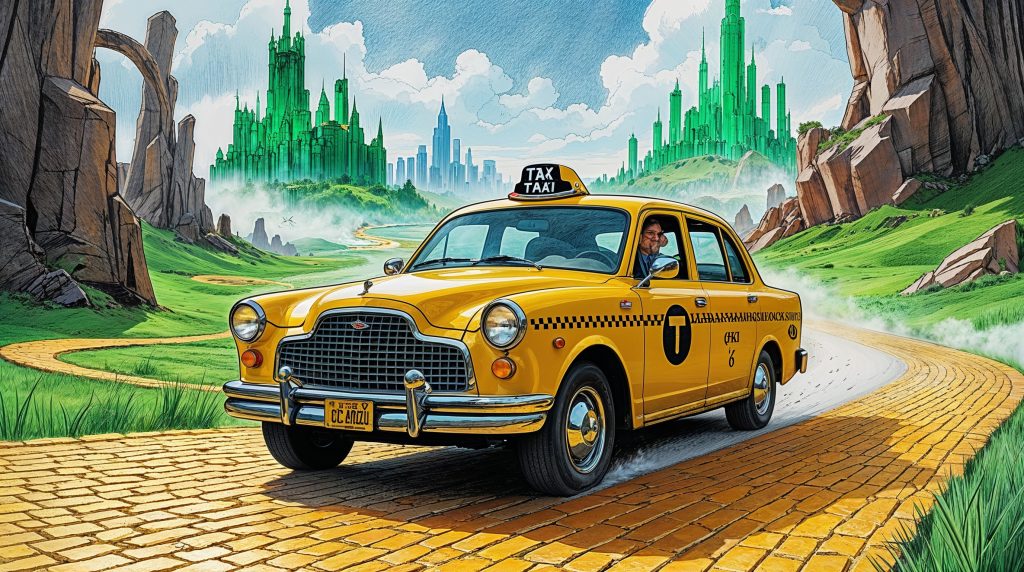
The Cab Driver of Oz
The yellow cab pulled up to the Emerald City’s main gate at 7:43 a.m. on a Tuesday, and the Scarecrow, who’d been waiting at the curb for twenty minutes, opened the back door and got in.
“Where to?” asked the driver. His name was Mort. He was a short, stocky man from Queens who’d been driving a taxi for thirty-one years before a tornado (or possibly a dimensional rift, the insurance company was still arguing about it) deposited him, cab and all, in the middle of a poppy field outside the Emerald City. That was three years ago. He hadn’t found a way home. He had found a reliable income, because it turned out that the Land of Oz had exactly zero public transportation and a population with legs that got tired just like everyone else’s.
“The Tin Man’s palace,” the Scarecrow said. “In the Winkie Country.”
“That’s a long fare. Sixty miles, at least. You got money?”
“I’m the King’s chief advisor. I have unlimited credit with the treasury.”
“Treasury pays thirty days net. I run on cash.”
The Scarecrow produced a small bag of emeralds. Mort examined them, bit one (a habit from New York that had transferred surprisingly well to a land of gemstone currency), and nodded.
“Hop in. And buckle up. The Yellow Brick Road’s got potholes you wouldn’t believe.”
The Yellow Brick Road was, in Mort’s professional opinion, the worst-maintained highway in any dimension. The bricks were original construction, laid during the reign of the original Wizard, and nobody had repaired them since. Gaps the size of manhole covers appeared at random intervals. Entire sections had been heaved upward by tree roots or undermined by Munchkin mining operations. The shoulders, where they existed, were packed dirt that turned to mud in the rain and dust in the sun.
Mort drove it anyway. His cab, a 2019 Toyota Camry that shouldn’t have survived the dimensional transit but did (Toyota engineering, he maintained, transcended physical law), handled the broken bricks with the resignation of a vehicle that had already survived the Cross Bronx Expressway.
“You ever think about getting this road fixed?” Mort asked the Scarecrow, navigating the Camry through a gap between two displaced bricks that would have swallowed a lesser vehicle. “I’ve been driving this thing for three years and it gets worse every month.”
“The road maintenance budget was allocated to the Flying Monkey Demobilization Program,” the Scarecrow said. “The monkeys needed job training. You can’t just release a paramilitary aerial force into civilian life without support services.”
“What kind of job training do flying monkeys need?”
“Courier services, mostly. Some went into construction. Three became surprisingly good baristas. The problem is that their union negotiated wages that consume sixty percent of the western territory’s operating budget, which leaves nothing for infrastructure.”
Mort absorbed this with the equanimity of a man who’d spent three years in a fairy tale and had stopped being surprised by institutional dysfunction, regardless of the dimension it occurred in. He’d driven a cab in Queens for thirty-one years. He’d seen bureaucratic insanity on a scale that made flying monkey labor disputes look rational.
“In New York,” he said, “we have the same problem. Too much money goes to pensions and debt service. Roads fall apart. Bridges rust. The subway floods every time it rains. The difference is that in New York, nobody blames it on winged primates.”
“Do you miss it?”
The question caught Mort off guard. He navigated around a section of road where the yellow bricks had been replaced, inexplicably, with purple ones (the Munchkins again, he suspected, marking territorial boundaries with the passive-aggressive creativity that was their defining cultural trait) before answering.
“I miss specific things. Pastrami from Katz’s. The view from the Queensboro Bridge at sunset. The feeling of driving through Manhattan at 3 a.m. when the streets are empty and the city feels like it belongs to you. I miss my daughter. She’s in Astoria. She thinks I’m dead.” He paused. “But do I miss the life? The job? The twelve-hour shifts and the traffic and the passengers who don’t tip and the dispatch system that hasn’t been updated since 2005? No. I don’t miss that.”
“You’ve built something here,” the Scarecrow said. “You’re the only person in Oz who provides mobile transportation. You’ve created a service that didn’t exist before you arrived. In a sense, you’ve done what the Wizard did, you came from the outside world and filled a gap that nobody knew existed.”
“The Wizard was a fraud.”
“The Wizard was a fraud who gave people what they needed by making them believe they already had it. You’re a cab driver who gives people what they need by taking them where they want to go. The mechanism is different but the function is identical.”
Mort considered this as the Yellow Brick Road curved through a stand of trees whose leaves were literally silver, tinkling in the breeze like wind chimes. Three years ago, he would have pulled over and stared. Now he barely noticed. Adaptation, he thought. The human superpower. Put a man from Queens in a fairy tale and give him enough time, and the fairy tale becomes normal.
around a crater where someone had apparently removed thirty bricks for personal use.
“It’s on the agenda.”
“It’s been on the agenda since I got here.”
“Government moves slowly.”
“Even in a fairy tale?”
“Especially in a fairy tale. In a fairy tale, the happy ending already happened. Everything after that is bureaucracy.”
Mort had discovered this to be true. The Land of Oz, post-happy-ending, was a mess. The Wizard was gone, replaced by a Scarecrow king whose primary qualification was that a wizard had once declared him intelligent, which, Mort reflected, was about as solid a credential as most political appointments he’d seen. The Wicked Witch was dead, but her flying monkeys had unionized and now charged exorbitant fees for aerial courier services. Dorothy had gone back to Kansas, taking with her the only person in the country who had any experience with the concept of democracy.
The Tin Man ran the western territories with the emotional intensity you’d expect from someone whose heart was a gift from a carnival huckster. He loved everything and everyone, which made him a compassionate ruler and a terrible negotiator. The Cowardly Lion governed the southern forest with courage he’d received from the same huckster, which manifested primarily as an aggressive infrastructure program that involved cutting down trees and building roads that went in circles because the Lion couldn’t read a map.
“This place needs a city planner,” Mort said.
“This place needs a lot of things. What it has is a scarecrow, a tin man, a lion, and a cab driver from New York.”
“I’m not from New York. I’m from Queens.”
“Is that different?”
“Very different. Worlds apart. Literally, in this case.”
They crossed the border into Winkie Country around noon. The landscape shifted from the tidy farmland of the Emerald City’s outskirts to the rougher terrain of the west, where the remnants of the Wicked Witch’s rule were still visible. Crumbling watchtowers dotted the hillsides. Fields that had been scorched by the witch’s soldiers were slowly returning to green, but the recovery was patchy, and large swathes of land remained barren.
“The Tin Man’s been pouring resources into environmental restoration,” the Scarecrow said. “It’s expensive.”
“Everything’s expensive when you pay in emeralds. You ever think about establishing a fiat currency? Paper money? Coins that aren’t worth their own weight in precious gems?”
“We tried. The Munchkins refused to accept it. They said paper money was ‘non-magical’ and therefore untrustworthy.”
“In New York, we call that the gold standard debate. Everybody argues about it. Nobody agrees. Eventually you just print the money and tell people it’s worth something because the government says so.”
“Does that work?”
“For about three hundred years so far. Ask me again in another century.”
The Tin Man’s palace was a gleaming structure of polished metal that caught the afternoon sun and threw reflections across the valley. It had been built on the ruins of the witch’s castle, using materials salvaged from the wreckage. The design was impractical, a sprawling complex of towers and courtyards with no apparent floor plan, because the Tin Man had designed it himself based on what felt right emotionally rather than what made sense architecturally.
Mort parked the cab outside the main entrance. The Scarecrow got out, paid the fare (plus tip, which surprised Mort, since tipping was not a concept that had penetrated Ozian culture), and paused.
“Mort.”
“Yeah?”
“Have you tried the silver shoes?”
“The what?”
“Dorothy used silver shoes to travel between worlds. There may be a pair in the palace treasury. They were the original method of dimensional transit.”
Mort stared at him. “You’re telling me there might be a pair of magic shoes in this building that could send me home, and nobody mentioned this in three years?”
“Nobody thought to. You seemed comfortable.”
“Comfortable? I’ve been driving a cab through a fairy tale for three years. I’ve been charged by flying monkeys, detoured by singing rivers, and had a Munchkin throw up in my back seat after a festival. I am not comfortable. I am adaptable.”
“There’s a difference?”
“A big difference. Comfortable means you want to stay. Adaptable means you can survive anywhere, including places you didn’t choose.”
The Scarecrow considered this. Considering was something he did well, being composed primarily of straw and therefore having no internal organs to distract him from pure thought.
“Come inside,” he said. “Let’s see about those shoes.”
They found the shoes in a vault on the palace’s lowest level. They were silver, delicate, and sized for a twelve-year-old girl from Kansas. They would not fit Mort’s size-eleven feet under any circumstances.
“Can they be resized?” Mort asked.
“They’re magical artifacts. They can’t be altered.”
“Then they’re useless to me.”
“Unless you find someone with smaller feet who’s willing to wear them and take you along.”
Mort looked at the shoes. He looked at the Scarecrow. He looked at the Tin Man, who’d wandered in during the conversation and was weeping openly because the sight of the shoes reminded him of Dorothy and his heart, however artificial, was overwhelmed with emotion.
“You know what,” Mort said, “keep the shoes. I’ve got a fare waiting.”
He walked back to his cab. The engine started on the first try, because Toyota. He backed out of the palace courtyard, pulled onto the Yellow Brick Road, and headed east toward the Emerald City, navigating the potholes with the practiced indifference of a man who’d been driving terrible roads for thirty-four years, three of them in a dimension where the roads were paved with gold-colored bricks and the passengers paid in emeralds.
He didn’t need magic shoes. He needed fares. And in the Land of Oz, where nobody had cars and everyone had places to be, fares were the one thing that never ran short.
He turned on the meter. The Yellow Brick Road stretched ahead, broken and beautiful, leading to a city made of green glass that caught the light like something from a dream he’d had as a kid in Queens, when the world was small and strange and anything seemed possible.
“Where to?” he asked the road.
The road, being a road, didn’t answer. But Mort drove it anyway, because that’s what cab drivers do. They go where the road goes and charge by the mile and hope the passenger tips.
In Oz, they always tipped. That was the one thing about fairy tales that worked exactly the way it should.
Mort turned east on the Yellow Brick Road and drove toward the Emerald City, the meter running, the engine humming, the road ahead broken and golden and stretching toward a horizon that looked, if you squinted, almost exactly like Queens at sunset, which was either a comfort or a cosmic joke, and Mort, after three years in Oz, had decided it was both.