
The Ballad of Route 66
I’ve driven stretches of Route 66 several times and every abandoned gas station and boarded-up motel feels like a ghost story. The road itself is a character, this long scar across America that used to mean freedom and now mostly means decay. There’s a whole chapter about Route 66 and what happened to it in my book The Enshittification of America. The real-life version of the same grief. I wanted to write a story that treated the road as a living thing watching its own death, remembering when it was young and the cars stretched bumper to bumper from Chicago to Santa Monica and every mile meant something.
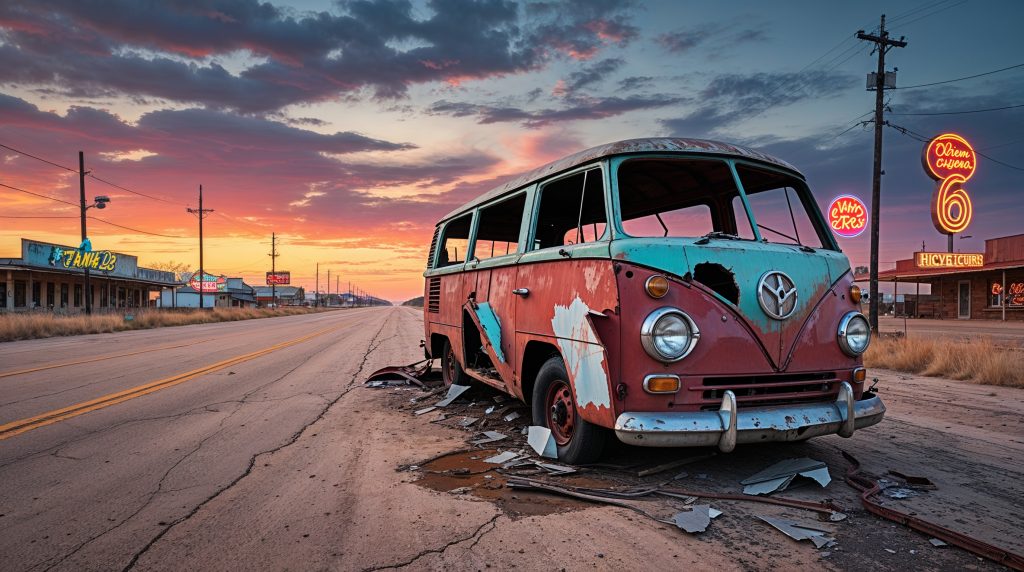
The last stretch of original Route 66 in Oklahoma ran through a town called Delmore that the highway department had bypassed in 1962 and the rest of the world had forgotten by 1970. Population peaked at eight hundred in the fifties. By the time Clementine Fosse arrived in 2019, driving a Volkswagen van with a failing clutch and no particular plan, the sign at the town limits read “Pop. 43” and even that felt optimistic.
She pulled into the gas station on Main Street because the van was overheating and the temperature gauge had entered the red zone somewhere around Tulsa. The station was a relic, a single pump under a rusted canopy with a Coca-Cola sign from the Eisenhower era. The attendant was a woman in her seventies with a sun-cured face and hands that looked like they’d been carved from mesquite.
“Radiator’s shot,” the woman said after popping the van’s hood and peering inside. “You’re not going anywhere today.”
“Is there a mechanic in town?”
“You’re looking at her.”
The woman’s name was Opal Beaumont. She’d run the gas station for forty years, since her husband died of a heart attack while changing a tire on a Pontiac Firebird. She was also the town’s mayor, fire chief, and sole proprietor of the only restaurant within thirty miles, a diner called Opal’s attached to the gas station by a covered walkway.
Clementine had dinner at Opal’s while the radiator repair waited for a part that would have to be ordered from Oklahoma City. The diner was empty except for a man at the counter eating a chicken-fried steak the size of a hubcap. He was maybe fifty, lean and quiet, with a face that suggested he’d been handsome once and hadn’t noticed when it stopped mattering.
“That’s Walt Greer,” Opal said, setting down a plate of meatloaf in front of Clementine. “He owns the motel next door. Both rooms.”
“There’s a motel?”
“The Route 66 Motor Lodge. It’s been closed for six years, but Walt keeps the rooms clean in case someone shows up.”
“Has anyone showed up?”
“You’re the first.”
Clementine was twenty-eight. She’d left Savannah, Georgia, three weeks earlier with twelve hundred dollars, a duffel bag of clothes, and the kind of aimlessness that comes from having done everything you were supposed to and finding it all hollow. She’d graduated from college, worked in marketing for a beverage company, gotten engaged, gotten unengaged, and woken up one morning realizing she couldn’t name a single thing she was looking forward to. So she’d bought the van from a guy on Craigslist and pointed it west.
She’d planned to follow Route 66 because it seemed like the kind of romantic, unoriginal thing a person in crisis does, and she was self-aware enough to know that her crisis was not unique. The Mother Road. The Main Street of America. She’d read Steinbeck in college and remembered enough to know that the road was supposed to represent possibility, the western horizon, the perpetual American promise that somewhere ahead was better than where you’d been.
Delmore didn’t look like possibility. It looked like the end of something. Half the buildings on Main Street were boarded up. The old movie theater had a marquee that still read “NOW SHOWING” but the letters below were blank. The school had closed in 2004. The post office held hours three days a week.
But the meatloaf was phenomenal.
“You make this from scratch?” Clementine asked.
“Every day. Even when nobody comes in.”
“Why?”
Opal wiped the counter with a rag that had seen decades of use. “Because if I stop making meatloaf, I’m admitting the town is dead. And I’m not ready to do that.”
The radiator part took four days to arrive. During those four days, Clementine met all forty-three residents of Delmore. She met Frank Jessup, who ran the feed store that hadn’t sold feed in five years but served as the town’s unofficial gathering place. She met Bettie and Cora Langston, sisters in their eighties who lived in the house their father had built during the Dust Bowl and who hadn’t spoken to each other since a dispute over a pie recipe in 1987 but occupied separate floors of the same building with elaborate systems for avoiding contact.
She met Hector Olvera, the youngest person in town at forty-one, who’d come back to Delmore after twenty years in Dallas to care for his mother and found that he couldn’t leave. Not wouldn’t. Couldn’t. Something about the town held him, a gravity he couldn’t articulate.
“It’s not nostalgia,” he told Clementine over coffee at Opal’s. “I didn’t have a happy childhood here. My old man was a drunk, and the other kids were cruel. But this place has a weight to it. A substance. Everything in Dallas felt like it was made of paper. Here, things are made of stone and dirt and time.”
She started writing about them. Not for any publication, not for a blog or a social media account. She wrote in a spiral notebook she’d bought at the feed store, longhand, because the van’s radiator was broken and she had nothing else to do. She wrote about Opal’s meatloaf and Walt’s empty motel and the Langston sisters’ architectural cold war. She wrote about the way the light hit Main Street at sunset, turning the abandoned buildings gold, making them look not decrepit but patient, like they were waiting for something.
When the radiator was fixed, she didn’t leave.
She told herself it was because the van still sounded rough. Then because she wanted to finish writing about the Langston sisters. Then because Opal offered her the second room above the diner for fifty dollars a month and she’d spent enough time on the road to know when the road was pointing her at something.
She stayed through the summer. She helped Opal in the diner, learning to make the meatloaf and the chicken-fried steak and the coconut cream pie that was Opal’s masterpiece. She helped Walt patch the motel’s roof. She sat with Frank at the feed store and listened to stories about Delmore in its heyday, when Route 66 brought a river of travelers through town and every business on Main Street hummed with commerce.
“We had three gas stations,” Frank said. “Two motels. A barbershop, a dress shop, a hardware store. The movie theater showed double features on Saturday nights and the whole town turned out. You couldn’t find a parking space on Main Street from April to October.”
“What happened?”
“Same thing that happened to every Route 66 town. The interstate came through. Traffic went from here to there.” He pointed east, toward the distant ribbon of I-44. “We didn’t die overnight. We bled out. Slow. Took about fifteen years.”
Clementine read her notebooks. She had over a hundred pages of notes, descriptions, conversations, character sketches of everyone in town. The material was raw but vivid, and she could feel a shape forming in it, not a news story or a feature article but something longer. A book, maybe.
She drove to Oklahoma City in September and bought a used laptop at a pawn shop. The laptop was a five-year-old ThinkPad with a cracked hinge and a battery that lasted forty-five minutes, which meant she was always tethered to the outlet behind the counter at Opal’s, the power cord snaking across the floor like a lifeline connecting her to the work.
The writing came hard at first. She’d been a marketing copywriter, trained to produce clean, efficient prose that sold things. Fiction required something different, a willingness to sit with uncertainty, to follow sentences into territory that didn’t have a conversion rate or a call to action. The first fifty pages were terrible. She knew they were terrible while she was writing them, which didn’t stop her from writing them, because Opal had told her once that the only way to make good meatloaf was to make bad meatloaf first and pay attention to what went wrong.
By November, something shifted. The prose loosened. The characters stopped being descriptions and started being people. Clementine found herself writing scenes that surprised her, conversations she hadn’t planned, moments of tenderness and stubbornness and dark humor that came from the people she’d met rather than from any outline or intention. Walt, who rarely spoke, gave her a passage of dialogue so perfect that she wrote it down on a napkin and carried it in her pocket for a week before typing it in.
She set up at a table in Opal’s diner and started writing for real. Eight hours a day, six days a week. Opal kept her coffee cup full without being asked and never once looked over her shoulder at the screen.
The book took seven months. She wrote about Delmore the way you’d write about a person, with affection and honesty and without flinching from the parts that were ugly or sad. She wrote about the town’s decline without sentimentality. She wrote about the people who’d stayed without turning them into folk heroes. They were stubborn, flawed, sometimes petty, sometimes generous. They were human, which was enough.
She sent the manuscript to a literary agent in New York who’d been recommended by a college friend. The agent called her two days later.
“Where have you been hiding this?”
“In a diner in Oklahoma.”
The book published the following spring. It was called “The Last Mile,” and it told the story of Delmore and its forty-three residents with the clear-eyed warmth of someone who’d lived among them long enough to see past the picturesque decay.
It sold modestly at first. Then a reviewer at the Times called it “the best piece of American nonfiction since ‘Let Us Now Praise Famous Men.'” Then it sold less modestly.
The attention came. Journalists drove to Delmore. Photographers. A documentary crew from Netflix. The town’s population, which had dropped to forty-one after Frank Jessup’s heart surgery, briefly swelled to several hundred before the crews left.
Opal handled the attention with the same matter-of-fact competence she applied to everything. She served the journalists meatloaf, charged them full price, and answered their questions without performing.
“Are you proud of the book?” a CNN correspondent asked her.
“I’m proud of the meatloaf. Clementine’s proud of the book.”
Clementine stayed. The book money allowed her to buy Walt’s motel and renovate it, turning the two rooms into six, adding a small event space where she hosted monthly readings and concerts that drew people from Tulsa and Oklahoma City. The feed store became a bookshop. Hector opened a coffee roastery in the old hardware store.
Delmore didn’t boom. It didn’t become a tourist destination or a gentrified artistic colony. It just stopped dying. The population stabilized, crept upward, reached sixty-seven by the following year. Young people trickled in, drawn by the book or by the cheap rent or by the same gravity that had held Hector.
On the anniversary of her arrival, Clementine sat at the counter at Opal’s and ate a piece of coconut cream pie.
“You know what Route 66 was really about?” Opal said, refilling her coffee.
“Going west.”
“Going somewhere. Didn’t matter which direction. Just the going. The feeling that tomorrow’s a place you haven’t been yet.”
Clementine looked out the window at Main Street. The sunset was doing its thing, turning the old buildings gold. A couple she didn’t recognize was walking past the movie theater, reading the blank marquee like it might tell them something.
“I think I found my somewhere,” she said.
Opal smiled. “Eat your pie.”
Some nights, when the bar was empty and the street was quiet and the old buildings settled into themselves with the familiar creak of structures that had survived everything the twentieth century threw at them, Clementine would sit on the porch of the motel and listen to the silence. It was a different silence from the city. It had texture. Depth. The sound of wind across empty plains and the distant rumble of trucks on the interstate, four miles south, carrying cargo and passengers to places that were faster and newer and nowhere near as interesting. The old road hummed beneath it all, a low vibration that you felt more than heard, the residual energy of a million journeys absorbed into asphalt and concrete and the memory of a nation that had once believed the best thing you could do was get in a car and drive until you found something worth stopping for.