

The Arena
I wrote this story in May of 1978, especially for a magazine called The Space Gamer. This magazine was published by a gaming company called Metagaming to help promote their own products. At the time, I was heavily involved in the world of fantasy gaming, and considered Metagaming to be among the best companies involved in the field.
The Space Gamer was a very amateurish publication, which was a major part of its charm. For the last year I had dreamed of getting an article or story published in that magazine, and I finally decided to make the attempt.
I wrote and rewrote a fictional account of a magical battle between two mighty wizards. The fight was based upon a game called Wizard, which was also published by Metagaming.
I based several characters upon people that I know. I borrowed the name of the ambitious son (Justin) from my father’s brother, who was killed in a motorcycle accident. The character of Daniel Melimnod was based upon my friend Dan Milam.
After I had rewritten the article for the fourth time, I put it into a large envelope and mailed it off to Metagaming. Six weeks later, I received my first rejection slip.
METAGAMING
Dear Richard,
I am sorry, but at this time I am not buying any fiction. I have material on hand for several issues to come and will not be buying anymore right now.
As usual, I am short of articles, and would like to see anything along those lines.
Sincerely,
Ben Ostrander, editor/TSG
None of this would have happened if Justin had chosen a private moment for his ultimatum.
Instead he delivered it in the Great Hall, surrounded by council members and apprentices, his voice carrying the particular cruelty of a man who knows exactly what he is doing. “Make me a member of the Wizard’s Council, Father, or I will inform the emperor of your recent activities. The treasonous ones.”
The argument that followed was inevitable. The duel that followed the argument was not — that had been Ezra’s own failure of temper, his wounded pride asserting itself at the worst possible moment. Justin had smiled when he accepted the challenge, and that smile told Ezra everything he needed to know about how badly he had miscalculated.
A soft cough interrupted his thoughts. He turned to find Daniel Melimnod in the doorway — a young apprentice of uncommon talent, the kind of young man who reminded Ezra of what he himself had been before decades of politics ground away his edges.
“Your son is ready, most honored one,” Daniel said. The excitement in his voice was barely concealed, the way it always was with young men who had not yet seen what magical combat actually costs.
“First time watching a duel in the Arena?” Ezra asked.
Daniel nodded.
“I remember my first time. I was terrified — not of the fight itself, but of the moment I realized that someday it would be me down there.” Ezra rose from his chair. “The fear never entirely leaves. You just learn to carry it differently.”
“Justin is waiting,” Daniel said.
“Young men are always waiting to get somewhere faster.” Ezra moved toward the door. “Lead the way.”
The walk through the halls gave him too much time to think.
No man should be asked to kill his own son. The thought circled without resolution. If he killed Justin he would carry that weight until he died. If he didn’t, Justin would finish the job for him. He had raised a son more capable than he ever intended, and now that capability had turned on him like a blade in his own hand.
They reached the portal. Ezra felt the Keeper before he saw it — that ancient presence, older than the Council, older than the city above, placed there by wizards whose names had been forgotten before his grandfather was born. He emptied his mind and stood still while the cold thing moved through him, searching his purpose with something that was not intelligence but was not less than it either.
His legs buckled. He stayed upright.
Then it was done, and he walked into the Arena.
Daniel Melimnod had not expected to fight today.
He had come to watch — to take his place among the apprentices on the Arena wall and witness history. Instead he was standing on the hex-marked floor opposite a wizard named Crael who had called him a coward in front of a hundred witnesses and then smiled, confident the smile would go unanswered.
It had not gone unanswered.
Crael was older, thicker through the chest, and moved with the ease of a man who had done this many times. Daniel had done it twice in practice and once in a dream he preferred to forget.
He started with an Image — a wolf, cheap and fast, not meant to damage Crael but to read him.
Crael disbelieved it without blinking. The wolf dissolved before it took a single step.
High IQ. He saw through it instantly.
Real, then. Daniel summoned a real wolf and felt the drain hit immediately — something drawn out of his chest, reserves he would need later, spent now. The wolf lunged. Crael sidestepped with lazy precision and put a force bolt into it that cracked ribs. The wolf skidded sideways, still up but hurting.
Then Crael summoned a bear.
Daniel tested it and felt nothing give. Real. Expensive. Crael expected to end this quickly.
Daniel retreated. A scared wizard burns spells fast. Be stingy.
He cast Dazzle on the bear. The creature shook its head, confused, unable to track movement. Crael’s expression cracked for the first time, and in that moment Daniel summoned a second wolf to flank, forcing Crael to split his attention while his bear stumbled uselessly.
Crael put the first wolf to sleep. Clean and efficient.
They stood breathing hard, both men aware of what they had already spent. Daniel cast a simple image of himself standing six feet to his left — just standing, doing nothing — and stepped right. Crael’s eyes followed the image. His next bolt went wide.
Daniel hit him with everything he had left. The Lightning came out of him like something torn free and it dropped Crael flat on the Arena stones, and it left Daniel on his knees with shaking hands and nothing left in reserve.
He had won.
The crowd made noise. Daniel barely heard it. He was focused entirely on convincing his legs to work again, still kneeling on the Arena floor when the main event began.
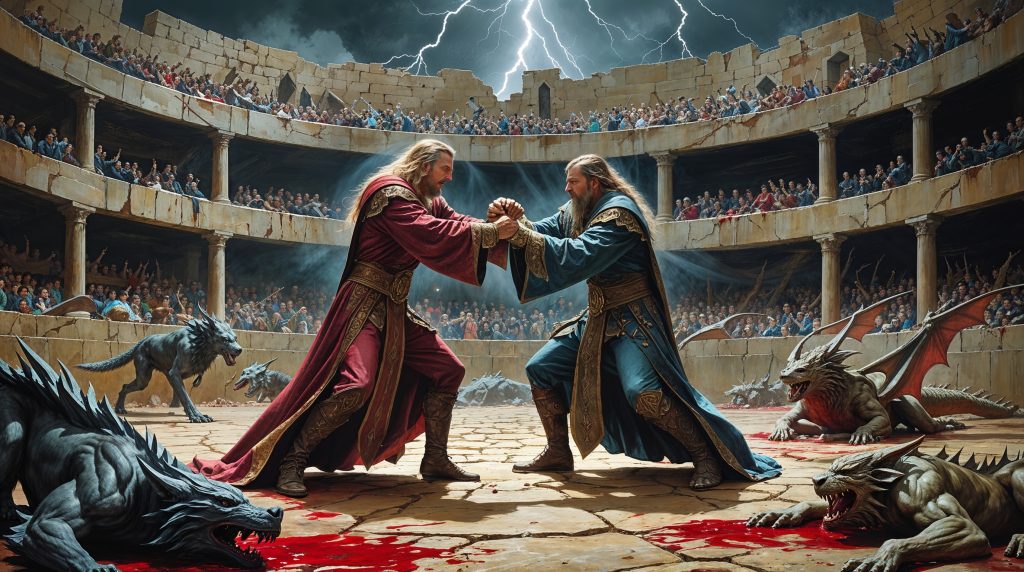
Justin had summoned a gargoyle.
Ezra watched it take form — grotesque, half-human and entirely wrong, as though something had begun building a person and abandoned the project halfway. It stretched its wings with the confusion of a creature freshly yanked from wherever such things waited between summonings, peering around the Arena with stupid eyes.
Ezra hit his son with a telekinetic blow before the gargoyle fully oriented itself. Justin staggered, caught himself, looked up with fury.
Good. Angry opponents make mistakes.
He summoned a wolf.
It lunged at the gargoyle — all forward momentum, all hunger. Its teeth found flesh and bit down hard.
The wolf yelped and slunk away, tail between its legs.
Iron Flesh. Justin had cast Iron Flesh — a spell requiring years of training beyond what Justin should have. Either his son had been hiding his abilities for a long time, or he had found a teacher Ezra didn’t know about. Neither possibility was comfortable.
He summoned his own gargoyle.
The two creatures found each other immediately and the Arena filled with the sound of their collision — stone-hard flesh on stone-hard flesh, wings beating for leverage, both too durable to damage quickly and too stupid to stop trying. Ezra used the noise as cover, crossing the floor at an angle, closing distance while Justin’s attention split between managing his gargoyle and tracking his father.
Justin tracked it anyway. He turned at exactly the right moment and met Ezra’s force bolt with a ward that deflected it into the Arena wall, leaving a scorch mark the size of a man’s head.
Then Justin came forward.
That was the first surprise. Young wizards stayed back and threw spells. Justin closed the distance with his Iron Flesh active and hit Ezra with a fist that caught him across the jaw and rocked him back three steps. Ezra tasted blood. His son had been trained in Melee as well. The book on Justin he had been reading from was badly out of date.
He dropped low and swept Justin’s legs.
Justin went down but rolled immediately, came up with a Dazzle hex that caught Ezra square in the face. The Arena doubled, tripled, the floor uncertain under his feet. Ezra shut his eyes and fought on memory and instinct, moving laterally the way he had trained himself to when visibility was gone, refusing to stop because a stationary target is a gift.
He cast Sleep toward Justin’s gargoyle and felt it land. One problem gone.
His own gargoyle was losing — he could hear it in the increasingly desperate wing beats, the higher-pitched shrieks — and he abandoned it rather than spend more of himself on a losing fight. It dissolved. Justin’s gargoyle turned toward Ezra.
The Dazzle faded. Ezra blinked the Arena back into focus and saw the gargoyle coming and Justin circling wide to his left, separating him from two directions at once. A coordinated maneuver that took most wizards a decade to develop.
He learned that from me.
Ezra summoned a dragon.
It was expensive — more than he wanted at this stage — but a dragon changed the geometry of everything, and he needed the geometry changed. The creature appeared above the Arena center with a sound like a thunderclap and settled the gargoyle question in four exchanges.
Justin dropped his Iron Flesh deliberately — calculating that the Strength cost of maintaining it was now worth more spent elsewhere — and cast three spells in quick succession: a Blur, a ward against fire, and something Ezra didn’t immediately recognize that settled over the Arena floor like heat shimmer.
Ezra tested it with one careful step and felt his boot stick.
Sticky ground. An old spell, dug out of somewhere obscure and prepared specifically for this fight.
He moved off it and reassessed. Justin was blurred and warded and recovering Strength while the dragon occupied his father’s attention. It was exactly what Ezra would have done. It was, in fact, what Ezra had done in a documented fight fourteen years ago that had apparently been studied carefully by someone with access to Council records.
He dismissed the dragon.
The silence that followed was the loudest thing in the Arena.
They stood thirty feet apart, both breathing hard, stripped of their creatures. For a moment they were simply a father and son standing in a room together, and Ezra felt the full weight of everything that had brought them here.
Then Justin summoned a Myrmidon and the moment was over.
The Myrmidon was fast and disciplined — no fear, no hesitation, nothing but training. Ezra disbelieved it on instinct and felt it hold. Real. He sidestepped its first strike and took its second on his forearm. He caught its sword arm on the third strike, redirected it, and drove an elbow into the back of its neck with the efficiency of a man who had spent twenty years learning exactly where to hit things.
The Myrmidon went down.
Justin had not expected that. He had expected his father to counter-summon, to keep the fight at spell range where reserves were what won or lost it. Instead Ezra was inside the engagement, too close for most spells, and Justin had a fraction of a second to decide.
He made the same decision Ezra had just made. He came forward.
They met in the center of the Arena and fought with their hands and everything twenty years of Melee training had put into their bodies, and for a time there were no spells at all — just the sound of the fight and the crowd above gone completely silent and Daniel Melimnod gripping the stone rail hard enough to whiten his knuckles.
Ezra was stronger. Justin was faster. They canceled each other out.
They separated by exhaustion, both bleeding, both starting over from nothing.
Justin summoned a second dragon.
Ezra understood then what his son had been doing. Through all of it — the gargoyle, the Iron Flesh, the Myrmidon, the close fighting — Justin had managed his reserves more carefully than Ezra had managed his own. The student had outplanned the teacher in the one way that counted.
He summoned his own dragon because there was nothing else to do.
The two creatures found each other above the Arena center, and the fight entered its final phase.
They fought for hours.
Not in spells or creatures or any precise sequence that could be reconstructed afterward, but in the slow destruction of two men who refused to quit. The dragons gave way to smaller things as their reserves fell. Myrmidons replaced gargoyles. The creatures grew cheaper and then cheaper still, and sweat soaked through both men’s robes, and the Arena floor disappeared under the wreckage of everything they had thrown at each other.
From the wall Daniel watched and understood for the first time what the master had meant. It wasn’t the fear of the fight. It was the moment you realized the man across from you had been built from the same materials as you, trained in the same school, carrying the same knowledge — and was not going to stop.
In the lower city, people heard sounds they couldn’t name and went to their cellars.
When the magic was gone they fought with their bodies. When their bodies gave out they fought with their hands. When their hands stopped working they used what was left, which was almost nothing, and it still wasn’t enough for either of them to stop.
They died at the same moment, reaching for each other across the Arena floor, eyes open.
The judges called it a draw.
Daniel stood at the wall a long time after, not moving, while the witnesses drifted away around him in ones and twos. Eventually the Arena was quiet and empty except for the bodies and the wreckage of the afternoon.
He had come to watch history. He had not understood until now what that meant.
It is said by some that the fight never truly ended. That somewhere, in whatever place holds the souls of wizards who refused to yield, a father and his son are still at it — still searching for the weakness that will settle the question neither of them ever thought to ask while they were alive. Those who tell this story add that the fight will last until time itself runs out, which strikes most listeners as both entirely plausible and exactly what those two would have wanted.
Free Stories, Straight to Your Inbox
Start with Nine Doors, nine short stories across nine genres, yours free the moment you sign up. After that, the occasional new collection and a note when there's a new book worth your time. No spam, no daily clutter. Just good stories.
We use MailerLite to manage our list and send these emails. Your address is used only to send you what you signed up for. We will not sell it, share it, or use it for anything else, and you can unsubscribe anytime.