
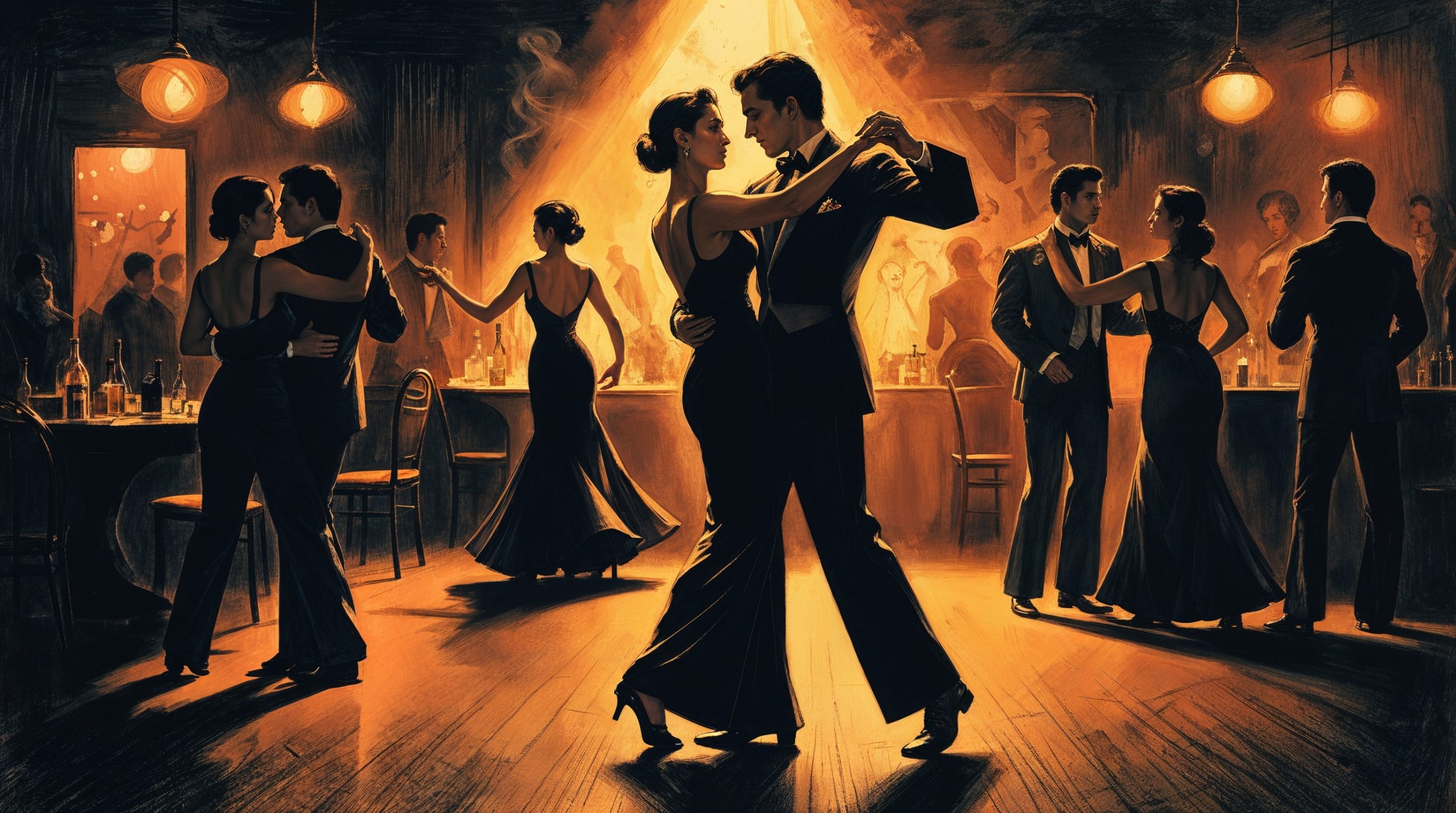
Tango in a War Zone
I read about a couple who kept dancing through a siege. Not as protest. Not as performance. Not to make a statement or go viral or prove a point. Just because it was the one thing that still felt normal. Two people holding each other and moving to music while the world fell apart outside the window. That image, just that single image, was the whole story. Everything else I wrote was just context for two people dancing in a room where the windows had been blown out and the music came from a phone with twelve percent battery.
The checkpoint at Avenida Libertador had been manned by the same three soldiers for eleven days, and they’d stopped checking papers on day four. By day eleven, they were playing cards on an overturned oil drum, their rifles leaning against the sandbags like forgotten umbrellas, and the woman who walked past them at 9 p.m. didn’t warrant more than a glance.
Her name was Valentina Segura. She was thirty-three, dark-haired, with the kind of angular beauty that people in Buenos Aires described as “interesting” when they meant something more dangerous. She wore a black dress cut high on the thigh and low in the back, and heels that clicked on the pavement with the precision of a metronome. She was carrying nothing except a clutch purse the size of a paperback novel and a tube of lipstick that was not, strictly speaking, a tube of lipstick.
The city was under martial law. The junta had declared a state of emergency six weeks earlier, following a series of bombings attributed to the resistance, and the streets after dark were supposed to be empty. Supposed to be. But the milongas kept running. They always kept running. The military could shut down newspapers, arrest professors, disappear dissidents. They couldn’t kill the tango. They’d tried. It kept coming back, like a heartbeat that refused to flatline.
The milonga was in a basement on Calle Defensa, in San Telmo, accessed through a door that looked like it led to a storage room. Valentina descended the stairs and entered a space dense with smoke, sweat, and the sound of Piazzolla coming from speakers older than she was. Forty people were dancing. In the corner, a bartender poured measures of Fernet with the methodical care of a pharmacist.
She scanned the room. The man she was looking for was at a table near the back wall, drinking red wine and watching the dancers with the focused stillness of someone who was either very patient or very dangerous.
Rafael Muro. Forty-one. Former army intelligence, now freelance, which in Buenos Aires in this particular year meant he sold information to whoever paid the most and trusted no one. He had a face that photographs lied about, too severe in still images, too alive in person. His hands were large, scarred across the knuckles, and they held the wine glass with surprising delicacy.
Valentina sat down across from him without invitation.
“You’re late,” he said.
“Your checkpoint soldiers were playing cards. I had to walk around them so they wouldn’t remember me.”
“They wouldn’t remember you anyway. They’ve been on that post for eleven days. They can barely remember their own names.”
“I remember everything. It’s a problem.”
He looked at her. The look lasted a beat too long, the kind of assessment that in a different context would be a compliment and in this context was a threat evaluation.
“Do you dance?” he asked.
“Is that a professional question?”
“It’s a personal question in a professional setting.”
“Then yes. I dance.”
He stood and offered his hand. She took it. The contact was electric, the way contact always is when both people know the other is lying about something and the truth is the most dangerous thing in the room.
They stepped onto the floor. The music was a tango from the forties, slow and aching, the kind of piece that demands close embrace and doesn’t forgive hesitation. Rafael’s hand found the small of her back, his fingers pressing against the bare skin above the dress’s low cut. His palm was warm and rough, and Valentina felt every callus.
She was not here to dance. She was here because Rafael Muro had access to a list. A specific list: the names of the junta’s next targets, the people scheduled to be “disappeared” in the coming week. The resistance needed that list. Valentina was the courier.
But the tango is a negotiation, and some negotiations happen with bodies instead of words.
They moved. The close embrace of Argentine tango puts bodies in contact from chest to thigh, and the lead-follow dynamic requires a sensitivity to the other person’s weight, balance, and intention that borders on the telepathic. Rafael led with authority, his torso communicating direction through pressure and release, and Valentina followed with the fluid responsiveness of someone who’d been dancing since childhood.
Her mother had taught her. In the kitchen of their apartment in Palermo, when Valentina was six years old and the world outside was still safe enough that a mother could teach her daughter to dance without wondering whether the soldiers would come that night. Those kitchen lessons continued for years, through adolescence, through the early days of the junta, through the disappearances that hollowed out their neighborhood one family at a time.
Her mother was taken in 1978. A Thursday. The soldiers came at dinner. They ate the food on the table before they put her in the car. Valentina was nineteen. She joined the resistance the following week, not out of ideology but out of the simple, animal fury of a daughter whose mother had been stolen between courses.
She learned the tango the way her mother had taught it. with the radio playing, her mother had shown her the walk, the pivot, the ocho, the gancho. “The tango is a conversation,” her mother had said. “The man speaks. The woman answers. But the woman decides how much to say.”
Valentina decided to say a great deal.
She pressed closer than the music required, letting the heat of her body communicate urgency. Her thigh brushed his with each step, deliberate, a signal wrapped in a social convention. When the music turned, she executed a boleo that arced her leg behind her, the movement precise and suggestive, and felt his breath catch against her neck.
“You’re very good,” he murmured.
“I’m very motivated.”
“The list.”
“The list.”
The song ended. They stayed in the embrace for three beats of silence before the next piece started. In the tango world, this was an intimacy greater than a kiss, the shared pause between songs, the decision to continue dancing together instead of returning to separate tables.
“I have conditions,” Rafael said.
“Name them.”
“The list is current as of yesterday. Seven names. Three are people I’ve worked with. If the resistance moves on this information, I need assurance that my involvement stays buried.”
“You have it.”
“Your word.”
“My word and the word of the people I work for.”
“Your people’s word is worth nothing. They’ll burn me if it suits their strategy. Everyone burns everyone in this city. That’s the only constant.”
“Then why give us the list?”
He pulled back enough to look at her face. The milonga’s dim light made his features sharp, all angles and shadow. “Because seven people are going to die this week if someone doesn’t warn them. And I’ve reached the point where my conscience weighs more than my survival instinct.”
“That’s a dangerous point to reach.”
“Everything about tonight is dangerous.”
The second tango was faster, more aggressive, a Pugliese arrangement that demanded quick footwork and dramatic pauses. They danced it with a ferocity that drew glances from the other couples. Valentina matched his intensity step for step, her body a weapon of persuasion, every movement calibrated to close the distance between them in ways that had nothing to do with choreography.
She was good at this. Not just the dancing. The negotiation. The seduction of information from men who held it like a grenade with the pin half-pulled. She’d done it before, in other milongas, with other men, and the calculus was always the same: give enough of yourself to make them trust you, keep enough in reserve to survive if they don’t.
Rafael was different. He didn’t trust easily, and the tango, which would have softened most men, seemed to sharpen him. Every movement she made, he countered. Every invitation she extended, he accepted with reservation. They were two people dancing at the edge of something, and the edge was equally likely to be intimacy or violence.
The music stopped. The DJ announced a break. Couples drifted to the bar, to the tables, to the dark corners where conversations happened in whispers.
Rafael led her to his table. Poured a second glass of wine. Placed a folded piece of paper between them on the table.
“Seven names,” he said. “Addresses. Scheduled dates.”
Valentina didn’t touch the paper. “What do you want in return?”
“I already told you. Anonymity.”
“You want something else.”
He drank his wine. Set the glass down. “I want to keep dancing.”
“We can dance.”
“Not tonight. Tomorrow. And the night after. I want to come to this milonga and dance with someone who knows what I’ve done and doesn’t look at me like I’m either a hero or a traitor.”
“What would I look at you like?”
“Like a partner. That’s all anyone wants in the tango. Someone who moves with you instead of against you.”
Valentina picked up the paper. It was warm from his hand. She slipped it into the clutch purse, next to the tube of lipstick that was not a tube of lipstick but a miniature radio transmitter.
“Tomorrow,” she said. “Nine o’clock. I’ll be late.”
“You’ll walk past the checkpoint.”
“The soldiers will be playing cards.”
She left the milonga and climbed the stairs into the night. The streets were empty. The checkpoint soldiers were, as predicted, playing cards. She walked the twelve blocks to her safe house on Calle Humberto I, transmitted the seven names over the encrypted frequency, and sat in the dark kitchen listening to the confirmation come back: all seven warned, all seven moving to safe locations before dawn.
Seven people who would wake up tomorrow instead of vanishing.
She looked at her hands. They were still warm from the dancing. From Rafael’s grip. From the paper folded against her palm.
She went back the next night. And the night after. And every night that the milonga was open and the city was burning and the tango was the only honest thing left.
They danced. They talked. They built something in the spaces between songs that had no name and no future and mattered more than either of them could afford to admit.
The junta fell three years later. The milonga on Calle Defensa was still open the night the generals resigned. Valentina and Rafael were on the floor, dancing a slow vals, when the news came through on the radio behind the bar. The bartender stopped pouring. The DJ stopped the music. Someone began to cry.
Rafael pulled back and looked at Valentina. Three years of nights. Three years of lists and secrets and the dangerous intimacy of the close embrace.
“What happens now?” he asked.
“We keep dancing.”
The DJ put on another record. They stayed on the floor. The city above them erupted in celebration, car horns and fireworks and the sound of a nation exhaling after years of holding its breath. In the basement, forty people danced, and two of them held each other with the particular tenderness of people who’d survived something together and weren’t sure they’d survive what came next.
The tango doesn’t promise happy endings. It promises honesty. Two bodies in conversation, telling truths that words can’t carry, in a language older than the wars that tried to kill it.
They kept dancing.
The music didn’t stop. It never stopped, not through the junta, not through the trials that followed, not through the decades of reckoning when a nation tried to account for what it had done to itself. The tango survived because the tango was the truth that the regime couldn’t suppress, the conversation between bodies that said what mouths were forbidden to say.
Valentina and Rafael danced for eleven more years, until his heart gave out on a Tuesday night in 1994, mid-tanda, in the same milonga on Calle Defensa where they’d met. He died in her arms, on the dance floor, which was, she told the paramedics through her tears, exactly how he would have wanted it. The milonga closed for one night. It reopened the following evening. Someone had to lead.
Free Stories, Straight to Your Inbox
Start with Nine Doors, nine short stories across nine genres, yours free the moment you sign up. After that, the occasional new collection and a note when there's a new book worth your time. No spam, no daily clutter. Just good stories.
We use MailerLite to manage our list and send these emails. Your address is used only to send you what you signed up for. We will not sell it, share it, or use it for anything else, and you can unsubscribe anytime.