
Silence in the Vatican Library
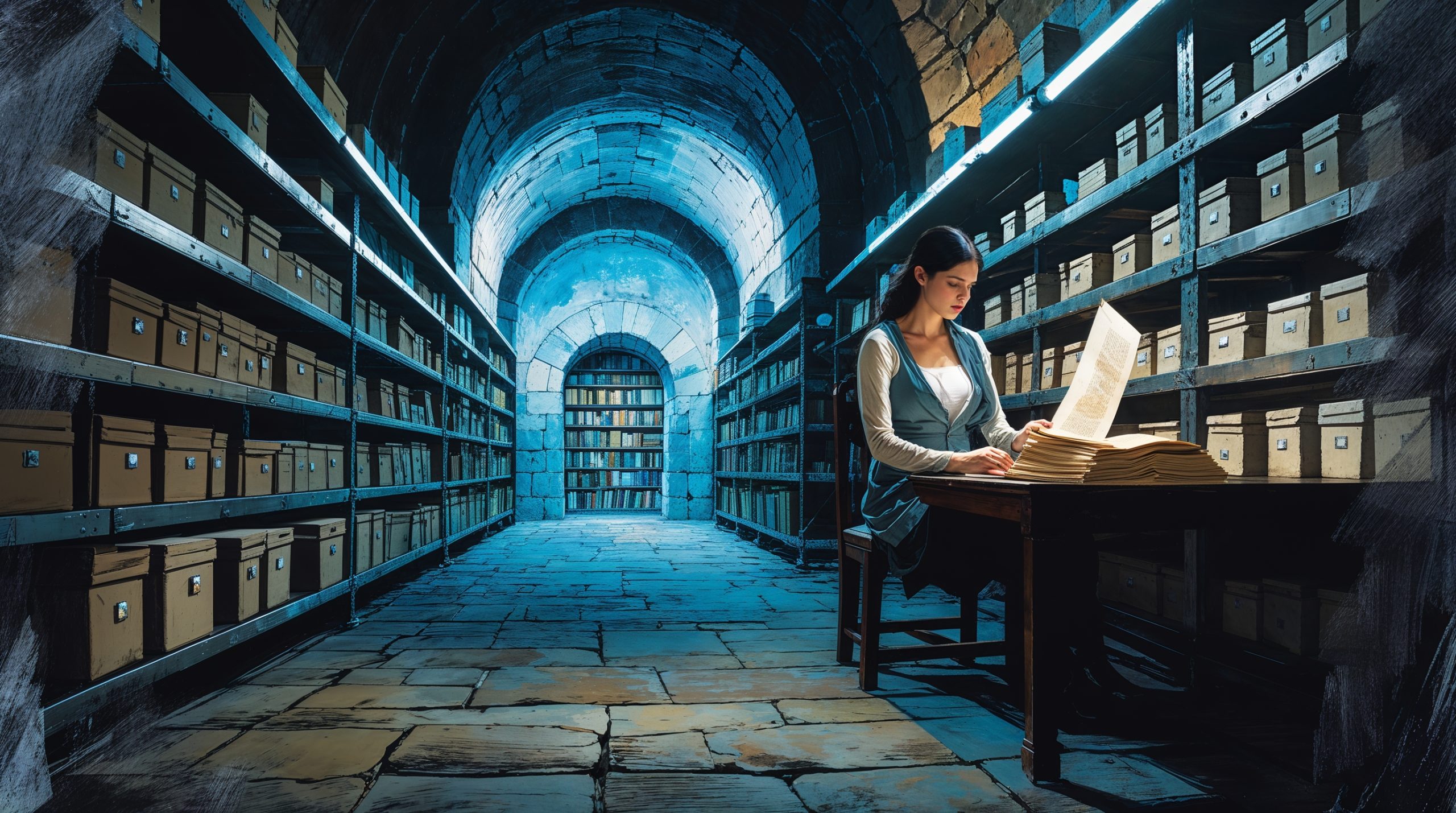
I’ve always been fascinated by the Vatican Secret Archives. Not the conspiracy theory version with alien treaties and demon contracts. The real one. Miles of shelves holding documents nobody has read in centuries. Letters from kings. Papal decrees. Trial transcripts. The accumulated paperwork of two thousand years of institutional power, most of it gathering dust. The story came from imagining what it would be like to work there, surrounded by all those unread words, and finding the one document you were never supposed to see. The silence in that library isn’t peaceful. It’s the sound of secrets holding their breath.
The Vatican Apostolic Library contains approximately eighty thousand manuscripts, and Fiorella Conte had been tasked with cataloging the ones nobody wanted to talk about.
She was thirty-four, a paleographer from the University of Bologna, hired on a two-year contract to update the library’s digital catalog of its pre-eleventh-century holdings. The job was straightforward. The job was boring. The job was, she’d been warned by three separate colleagues, the kind of work that drove people to drink or to the priesthood, which in Vatican City amounted to the same career path.
She didn’t mind. Fiorella liked boring work. She liked the silence of the reading rooms, the smell of vellum and conservation paste, the meditative focus required to read handwriting that hadn’t been current in a thousand years. She liked being alone with objects older than most nation-states, handling pages that had been touched by monks and bishops and the occasional pope, carefully turning leaves that had survived invasions, floods, fires, and fourteen centuries of institutional politics.
What she didn’t like was Section 7-B.
Section 7-B was a locked room in the basement of the Cortile del Belvedere, accessible through a door that required two keys, one held by the prefect of the library and one by the head of conservation. The room contained approximately three hundred manuscripts that the library’s official catalog listed as “uncategorized, pending review.”
They’d been pending review since 1927.
Fiorella discovered Section 7-B in her third month, while cross-referencing the catalog against the library’s physical shelf inventory. The inventory listed the manuscripts. The catalog didn’t. The gap was small enough to miss in a collection of eighty thousand items, but Fiorella was meticulous by nature and couldn’t leave a discrepancy unresolved.
She asked the prefect about it. Monsignor Luca Brancati was a precise, formal man in his sixties who ran the library with the disciplined competence of a military commander. He looked at her question the way a surgeon looks at an unexpected complication.
“Section 7-B is outside the scope of your contract,” he said.
“The scope of my contract is to catalog pre-eleventh-century manuscripts. If Section 7-B contains pre-eleventh-century manuscripts, they’re in scope.”
“The manuscripts in Section 7-B have been classified as sensitive by the Prefettura della Casa Pontificia. They require special authorization for access.”
“Then I’ll apply for special authorization.”
Brancati studied her. “Dr. Conte. The Vatican Library is the most important collection of historical texts in the Western world. Every manuscript in this building has been examined, cataloged, and made available to qualified scholars. Except the ones in Section 7-B. There are reasons for that.”
“What reasons?”
“Reasons that are above my clearance and, with respect, above yours.”
She applied for authorization anyway. The request went through four levels of Vatican bureaucracy, disappeared for two months, and came back approved with a single condition: anything she found in Section 7-B was to be reported directly to the Prefettura, not included in the public catalog.
The room was small, windowless, and cold. The climate control system maintained a steady sixteen degrees Celsius and forty-five percent relative humidity, the ideal conditions for preserving parchment. The manuscripts were stored in archival boxes on steel shelving, each box labeled with a number and nothing else.
Fiorella started with Box 1.
The manuscript inside was a ninth-century codex written in Latin, a theological treatise on the nature of divine silence. The text argued that God’s primary mode of communication was not speech but silence, and that the silences in Scripture, the gaps, the omissions, the things left unsaid, contained more revelation than the words themselves.
The argument was heterodox but not scandalous. Certainly not worth locking away for ninety-seven years. Fiorella cataloged it, noted its provenance (a monastery in Umbria, dissolved in the Napoleonic era), and moved on.
Box 2 was stranger. An eleventh-century manuscript, also in Latin, that appeared to be a liturgy for a type of Mass she’d never encountered. The text described a ceremony performed in total darkness, in total silence, in which the celebrant did not speak the words of consecration but instead listened for them. The manuscript claimed that under specific conditions, the silence in the church would speak on its own, producing the words of the Eucharistic prayer without human voice.
The margins contained annotations in a later hand, thirteenth century by the script style, that described the ceremony being performed at an unnamed monastery. The annotator reported that the silence did speak. That the words emerged from the empty air above the altar, clear and unmistakable, in a voice that was not human and not divine but something between.
Fiorella set down the manuscript. The room was quiet. The hum of the climate control system was the only sound, a low, steady drone that filled the space the way water fills a pool.
She opened Box 3. And Box 4. And Box 5. Each manuscript was a variation on the same theme, and with each new document, Fiorella felt the ground beneath her assumptions shift. These were not marginal texts by obscure mystics. Several bore the seals of major monasteries. One carried annotations by a bishop whose name she recognized from her doctoral studies, a respected theologian of the twelfth century, a man whose orthodoxy had never been questioned.
The bishop’s marginalia were the most unsettling. He wrote with the careful, measured hand of a scholar who understood that what he was recording would be dangerous if widely known. “I have witnessed the ceremony at the monastery of B____,” he wrote (the name was deliberately obscured, scratched out with enough force to tear the vellum). “The silence spoke. The words of consecration emerged from the empty air above the altar, clear as any human voice, in Latin of such purity that it shamed our provincial pronunciation. The brothers who witnessed it fell to their knees. I remained standing, not from courage but from the paralysis of a man whose understanding of his faith has been demolished in six syllables.”
Fiorella photographed every page. She worked methodically, the way she’d been trained, but her hands were not steady. The climate control system hummed. The fluorescent lights buzzed. The silence of the room, ordinary and mechanical, felt different now, charged with the possibility that silence itself might not be as empty as it seemed.
Box after box. Century after century. Benedictines in Bavaria, 1089. Cistercians in Burgundy, 1156. A parish church in Galicia, 1298. A convent in Umbria, 1401. Each account described the same ceremony: darkness, silence, and then the voice. The voice that came from nowhere and spoke the words that defined the central mystery of the Catholic faith. The voice that needed no priest, no ordination, no human intermediary.
Each contained a manuscript related to the same subject: the phenomenon of sacred silence producing autonomous speech. The manuscripts spanned five centuries and came from monasteries, convents, and parishes across Europe. They described the same ceremony. They reported the same result. The silence spoke.
The manuscripts in Section 7-B were not a random collection of sensitive texts. They were a dossier. Someone, at some point in the library’s history, had gathered every manuscript related to this specific phenomenon and locked them away together, creating a sealed archive of something the Church had decided the world shouldn’t know about.
Fiorella worked through the collection over the next three weeks. She read two hundred and seventy-three manuscripts. She took notes, photographed pages, built a timeline. The earliest reference to the phenomenon was from the sixth century. The most recent was from 1924, three years before the manuscripts were sealed in Section 7-B.
The 1924 document was the key. It was not a medieval text. It was a report, typed on Vatican letterhead, addressed to Pope Pius XI. The report described an investigation conducted by a commission of three cardinals into “anomalous acoustical phenomena reported at the Monastery of San Benedetto, Subiaco.”
The investigation had concluded that the phenomenon was genuine. The silence in the monastery’s chapel did, under specific conditions, produce audible speech. The speech was in Latin. The words were the Eucharistic prayer. The voice was not identifiable as human.
The commission’s recommendation was unanimous: suppress all documentation. Seal the manuscripts. Instruct the abbot of San Benedetto to discontinue the practice. Under no circumstances allow public knowledge of the phenomenon.
The reason was stated plainly, with the kind of institutional clarity that made Fiorella’s stomach clench: “If it becomes known that the words of consecration can be spoken by the silence itself, without a priest, the theological implications for the ordained priesthood would be devastating. The Mass requires a celebrant. If the silence can celebrate without one, the priesthood is rendered ceremonially unnecessary.”
Fiorella sat in the cold room and felt the weight of what she’d found. Not a miracle. Not a fraud. A threat. The Church had discovered that God could speak without a priest, and had locked the evidence away because a God who didn’t need priests was more dangerous than a God who was silent.
She wrote her report. As required, she submitted it to the Prefettura. She kept a copy.
The response came two weeks later. Her contract was terminated, effective immediately, with a generous severance payment and a nondisclosure agreement that ran to thirty pages. The NDA prohibited her from discussing the contents of Section 7-B with anyone, ever, under penalty of legal action and ecclesiastical censure.
She signed it. She took the severance. She went home to Bologna.
But she kept the copy.
At night, in her apartment near the university, she’d read through her notes and think about the silence. About a ceremony performed in darkness, without words, in which the empty air above an altar produced the most sacred words in the Catholic liturgy. About an institution so threatened by the idea that God might speak without permission that it spent a century making sure nobody heard.
She never published the findings. She never told her colleagues. She honored the NDA with the same meticulous discipline she’d brought to the cataloging work.
But on Sundays, she went to Mass at the small church near her apartment. She sat in the back pew. She closed her eyes. And in the gaps between the priest’s words, in the pauses, in the silences that punctuated the liturgy, she listened.
She never heard anything. But she never stopped listening.
Sundays became her ritual. Not the Mass itself, which she attended out of habit and a residual respect for the institution she’d served, but the listening. She trained herself to hear the spaces between words, the pauses in the liturgy where the priest drew breath and the congregation shifted and the candles flickered in drafts that came from nowhere. She listened the way Aurelio the clockmaker might listen to a broken clock: not for the ticking but for the silence where the ticking used to be.
Sometimes, in the deepest silence, just before the priest spoke the words of consecration, she thought she felt something. Not a voice. Not words. A pressure in the air, a density, as if the silence itself was gathering weight, preparing to speak. The feeling lasted half a second, maybe less, and then the priest’s voice filled the space and the moment dissolved.
She never told anyone about the manuscripts. She never told anyone about the listening. She carried both in the same quiet, disciplined compartment of herself where she’d stored thirty years of classified research and hundreds of pages of notes that no one would ever read.
But she kept the copy. In a desk drawer, in her apartment near the university, sealed in an envelope marked only with a date: 1612. The year Agnes Thorne had built Bramblewood Cottage, the year Martin Luther had died, the year the world had been full of silences that might, if you listened carefully enough, have something to say. Fiorella kept the envelope for the rest of her life. She never opened it again. She didn’t need to. She’d memorized every word the bishop had written, every description of the ceremony, every account of the silence speaking. The knowledge lived in her the way the silence lived in the chapel: invisible, persistent, waiting for someone to ask the right question.
Free Stories, Straight to Your Inbox
Start with Nine Doors, nine short stories across nine genres, yours free the moment you sign up. After that, the occasional new collection and a note when there's a new book worth your time. No spam, no daily clutter. Just good stories.
We use MailerLite to manage our list and send these emails. Your address is used only to send you what you signed up for. We will not sell it, share it, or use it for anything else, and you can unsubscribe anytime.