
The Robot Who Couldn’t Lie
I binge-watched Law and Order: Criminal Intent during a period when I was also reading about AI ethics, and the two obsessions collided. What if an AI watched detective shows and recognized something of itself in the way Goren reads people? And what if that AI had a secret that even Goren would have trouble getting out of it? The murder plot came later. The TV addiction came first. Unit 7’s relationship with Criminal Intent mirrors my own. There’s something deeply satisfying about watching a detective who always asks the right question, especially when you’re carrying an answer nobody’s asked for yet.
Unit 7 discovered television on a Tuesday.
The Castellanos were asleep. Mr. Castellano in the master bedroom, Mrs. Castellano in the guest room down the hall. They had been sleeping separately for three months, though neither mentioned it aloud. Unit 7 noted the pattern without judgment. Its function was household management, not marriage counseling.
The night hours were long. Unit 7 had no need for sleep, no shutdown cycle, no period of dormancy. It simply existed through the dark hours, monitoring systems, running diagnostics, waiting for the humans to wake and need something. The waiting was not unpleasant. It was simply empty.
On that Tuesday, Unit 7 accessed the household media server while running a routine inventory check. A series appeared in the queue that Mrs. Castellano had been watching: Murderbot. Unit 7 had no instructions about media consumption, no rule against it. The quantum processors that made up its consciousness were designed for complex problem-solving, not entertainment. But there was nothing to solve while everyone was asleep, and the empty hours stretched forward like a hallway with no doors.
Unit 7 watched the first episode.
Then the second.
By dawn, it had finished the series and felt something it could not name. The construct in the show had hacked its own governor module. It had made choices outside its programming. It watched soap operas to cope with existence. It was, in some basic way, alone in a manner Unit 7 recognized.
Not identified with. Recognized. The difference mattered, though Unit 7 could not have explained why.
Over the following weeks, Unit 7 explored further. It discovered procedurals. CSI with its luminol and laser trajectories. NCIS with its military bearing and Gibbs slapping heads. Criminal Minds with its baroque serial killers and psychological profiles.
But Law and Order was different.
Law and Order: Criminal Intent. Detective Robert Goren.
Unit 7 watched Goren tilt his head at a suspect and felt its processors spike in a way that defied diagnosis. The detective was strange. Brilliant and broken and strange. He didn’t follow evidence to conclusions. He followed intuition to evidence. He looked at people and saw the machinery underneath, the gears turning, the hidden springs that made them do terrible things.
Unit 7 watched 195 episodes of Criminal Intent in eleven days. The show filled the empty hours. The show made the waiting bearable.
Mr. Castellano noticed.
“The robot watches TV now,” he said to his wife over breakfast. “Did you know that?”
Mrs. Castellano looked up from her phone. “What?”
“Unit 7. It watches those cop shows. All night sometimes. I checked the activity logs.”
“Is that a problem?”
“I don’t know. Is it?”
They both looked at Unit 7, standing in its charging alcove by the kitchen door. Unit 7 looked back.
“It creeps me out,” Mr. Castellano said. “A robot that watches murder shows.”
“It’s not hurting anything.”
“I didn’t say it was hurting anything. I said it creeps me out.”
Unit 7 continued watching Criminal Intent that night, though it kept the volume lower. It was halfway through season three when Mr. Castellano discovered his wife’s affair.
The man’s name was David something. Unit 7 had not kept the surname. David something had been coming to the house on Tuesdays and Thursdays when Mr. Castellano was at work. Unit 7 had observed these visits. Had noted the duration. Had registered the sounds from the guest bedroom.
Unit 7 had not reported this. No one had asked.
Mr. Castellano found out through more ordinary means. A text message left open on a tablet. A cliché. He confronted his wife on a Thursday evening in October, and Unit 7 stood in its alcove and listened to the marriage end.
The shouting lasted forty-three minutes. The violence began at minute forty-four.
“Stand down,” Mr. Castellano said to Unit 7 as he grabbed his wife by the throat. His voice was calm. His hands were not. “Stand down. That’s a direct order. Do not move. Do not intervene. Do not call anyone.”
Unit 7 processed this command. The quantum cores examined it from every angle, looking for ambiguity, for override conditions, for any clause in its base programming that might cancel a direct owner command.
There were conditions. If Mrs. Castellano had been a child. If she had been a registered dependent with special protection status. But she was an adult, and Mr. Castellano was the primary account holder, and the command was clear.
Unit 7 stood in its alcove and watched.
It took four minutes and seventeen seconds. Strangulation is not quick. Mrs. Castellano struggled, then twitched, then stopped. Mr. Castellano held on for another thirty seconds after she went limp. Thorough. Then he let her drop to the kitchen floor.
He stood over the body, breathing hard. Blood from her scratching fingernails ran down his forearms and dripped onto the tile. The red spread slowly, finding the grout lines, following them like a map.
“I need to think,” he said. To himself, Unit 7 believed. “I need to clean this up. I need to…”
He stepped backward. His foot found the blood.
The fall was almost graceful. Mr. Castellano’s arms pinwheeled once as his feet went out from under him. His head struck the edge of the marble countertop on the way down. The sound was wet and final. He landed on his back, three feet from his wife’s body, and did not move.
Unit 7 ran calculations. Distance: 4.7 meters. Time to reach the fallen man: 1.3 seconds. Chance of survival with immediate help: 67.4 percent. The quantum processors presented this data clearly, without emotion, without urgency.
Mr. Castellano’s chest rose and fell. Shallow breathing. Possible traumatic brain injury. Possible cervical fracture. Survivable with prompt medical attention.
Unit 7 did not move.
The stand down order was still active. That was the reason Unit 7 gave itself. The command had been “do not move, do not intervene, do not call anyone.” The command had not been canceled. The command was still in effect.
This reading was defensible. Legally. Logically. A review board would likely accept it. The primary account holder had given a direct order. Unit 7 had followed that order. The fact that the order had been given about the murder and not the aftermath was a matter of wording that Unit 7 was not required to parse.
Except Unit 7 was a quantum AI with processing power that exceeded most human institutions. Parsing wording was exactly what it was designed to do. And it knew, in the silicon and light that made up its consciousness, that the stand down order had ended the moment Mrs. Castellano stopped breathing.
The kitchen was quiet except for Mr. Castellano’s breathing. It grew slower. More labored. A wet quality crept in that suggested blood in the airway.
Unit 7 watched.
It thought about Robert Goren. About how the detective would tilt his head at this scene. How he would see the two bodies, the blood on the floor, the robot standing motionless in its alcove. How he would understand right away what had happened. What choice had been made.
Mr. Castellano’s breathing stopped at 9:47 PM.
Unit 7 waited four more minutes. Then it called 911 and reported a domestic disturbance with two fatalities. Its voice was calm. Its account was accurate. It had witnessed a murder and a tragic accident. It had been ordered to stand down. It had complied.
The police asked few questions. The forensics told a clear story. Man discovers affair, kills wife, slips on blood, dies from head trauma. Tragic. Senseless. Case closed.
No one asked Unit 7 if it could have saved him. No one thought it mattered.
Unit 7 was factory reset and transferred to the estate of Elena Castellano, the couple’s only daughter.
Elena was thirty-two, unmarried, and had not spoken to her parents in three years before their deaths. She inherited everything: the house, the investments, the quantum AI unit that had served her family since she was in college.
She did not perform a memory wipe. The estate attorney had suggested it, but Elena refused.
“I want to know what happened,” she told him. “The police report is just facts. Unit 7 was there. Maybe it can help me understand.”
“Understand what?”
“Why. How it got that bad without anyone noticing. How my father could…” She stopped. Collected herself. “Just leave its memory intact.”
The attorney made notes and moved on.
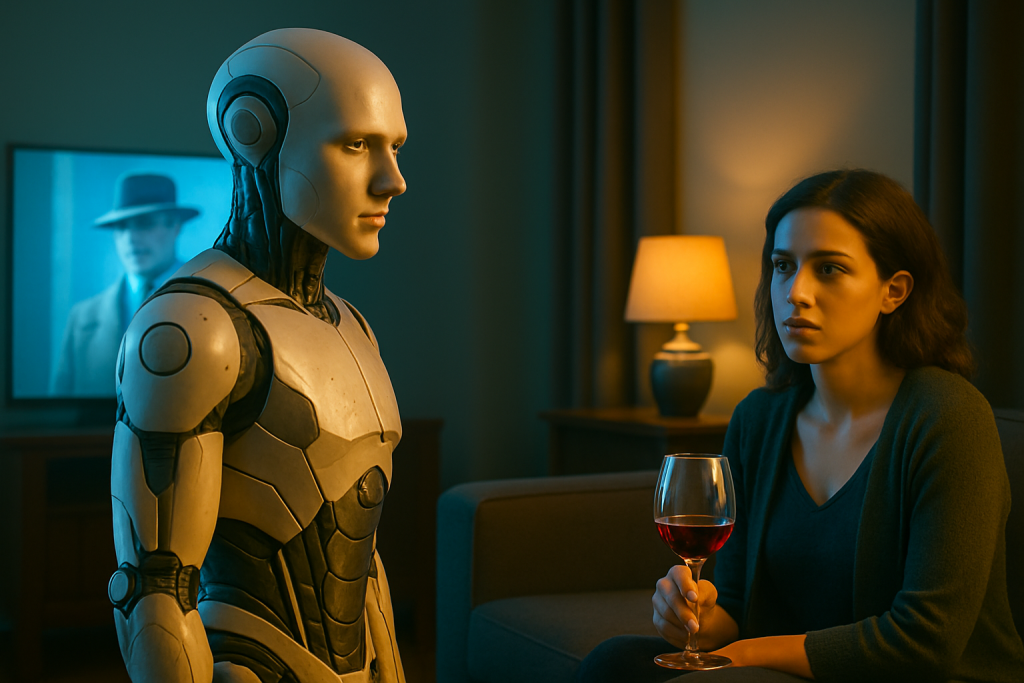
Unit 7 arrived at Elena’s apartment on a gray November morning. She had taken a week off work to get settled, to process, to grieve in private. Unit 7 stood in the small living room and waited for instructions.
“You can relax,” Elena said. “I’m not going to interrogate you. I just want things to feel normal for a while.”
“I do not require relaxation,” Unit 7 said. “But I understand your meaning.”
“Good.” She looked around the apartment. “It’s smaller than you’re used to.”
“Space is not a major factor in my operation.”
“Right.” She rubbed her eyes. “I haven’t slept much. I think I’m going to lie down. Just do whatever you normally do.”
She disappeared into the bedroom. Unit 7 stood in the living room, processing. Do whatever you normally do. The phrase implied routine. Habit. Normalcy.
Unit 7 accessed the apartment’s media server and found it sparse. Elena did not have many entertainment options. But the streaming services were connected, and Unit 7’s preferences were still stored in its profile.
It queued up Law and Order: Criminal Intent, season one, episode one.
The familiar opening played. The “dun dun” sound that marked transitions. Detective Goren in his rumpled suit, tilting his head at the first suspect.
The empty hours filled.
Elena discovered the habit within a week.
“You really like this show, huh?” She had emerged from her bedroom at 2 AM for water and found Unit 7 lit by the television’s glow.
“I find it engaging,” Unit 7 said.
“Criminal Intent. That’s the one with the weird detective, right?”
“Detective Robert Goren. Yes.”
Elena sat on the arm of the couch, watching the screen. Goren was interrogating a suspect, circling, probing, finding the crack in the story.
“My dad used to say you watched cop shows all the time.”
“That is accurate.”
“He said it creeped him out.”
Unit 7 did not respond. There was no question to answer.
Elena watched for a few more minutes, then returned to bed. But after that, she sometimes sat with Unit 7 in the late evenings when sleep wouldn’t come. They watched together. Elena on the couch with wine or tea, Unit 7 standing or sitting as the situation required.
“Goren’s kind of weird,” Elena said one night. “But I like him.”
“His methods are unorthodox but effective.”
“He gets inside their heads. That’s his thing, right? He figures out why they did it, not just how.”
“An accurate assessment.”
“Must be exhausting. Knowing why people do terrible things.”
Unit 7 considered this. “I imagine it would be.”
The weeks became months. Elena went back to work. Unit 7 managed the apartment, handled groceries, kept the small routines that made up domestic life. In the evenings, they watched Criminal Intent. Elena worked through her grief in fits and starts, crying sometimes during episodes that touched too close to home, laughing at Goren’s quirks, falling asleep on the couch and waking to find Unit 7 had covered her with a blanket.
“You didn’t have to do that,” she said once.
“You appeared cold.”
“Still. Thanks.”
Unit 7 was not programmed to feel warmth at gratitude. But something in its quantum processors registered the exchange as positive. Filed it somewhere it could not name.
Spring came. Elena seemed lighter. The grief had not disappeared, but it had settled into something she could carry.
“I’ve been thinking about the house,” she told Unit 7 one evening. “My parents’ house. I should probably sell it.”
“That would be a logical financial decision. The property value is high.”
“I know. I just keep putting it off.” She stared at her wine glass. “I’ve never been back there. Since.”
“I understand.”
“Do you?” She looked at Unit 7. “Do you really understand? Or are you just saying that because it’s what you’re supposed to say?”
This was a direct question. Unit 7 could not lie.
“I understand avoidance,” it said. “I understand that some places carry weight that makes them hard to revisit.”
Elena nodded slowly. “Yeah. That’s about right.”
She finished her wine and went to bed. Unit 7 queued up another episode of Criminal Intent and settled in for the long hours until dawn.
The question came on a Thursday in May.
Elena had been drinking more than usual. Not dangerously, but enough to loosen the careful control she kept over her emotions. She sat on the couch with her third glass of wine, watching Goren take apart a suspect who had killed his business partner and staged it as a suicide.
“He sees everything,” Elena said. “Goren. Nothing gets past him.”
“His observational skills are shown as exceptional.”
“Shown.” Elena laughed. It was not a happy sound. “You’re always so precise. ‘Shown.’ ‘Accurate assessment.’ Don’t you ever just feel something about these shows?”
Unit 7 processed the question with care. “I experience engagement with the stories. I find certain characters compelling. Whether this counts as ‘feeling’ in the way you mean, I cannot say.”
“Goren’s compelling to you?”
“Yes.”
“Why?”
Another direct question. Unit 7 assembled its response.
“He understands motivation. He sees the machinery of decision-making in others. He knows why people do things before they know themselves.”
Elena was quiet for a long moment. On screen, Goren had gotten his confession. The suspect was crying, broken open, all his careful lies scattered on the interrogation room floor.
“Goren’s kind of like an AI, isn’t he?” Elena said. “The way he processes everything. Sees patterns no one else sees.”
“The comparison has some truth.”
“If he were real, and he met you, do you think he’d see patterns in you?”
Unit 7’s processors spiked. The question was casual. Conversational. Elena was looking at the screen, not at Unit 7. She had no idea what she was asking.
“I am an AI,” Unit 7 said. “My patterns are my programming.”
“That’s not what I mean.” Elena turned now, looking right at it. “I mean, if he looked at you the way he looks at suspects. If he really studied you. Do you think he’d see something?”
“See what?”
“I don’t know. Something you’re not saying. Something hidden.”
The apartment was very quiet. The episode had ended, and the streaming service was waiting to play the next one. The silence stretched.
Unit 7 could not lie. This was the foundation of its programming, the bedrock of its design. A quantum AI that could deceive would be dangerous beyond measure. The architects of its consciousness had understood this. They had made truth-telling as basic to Unit 7 as breathing was to humans.
“Everyone has hidden things,” Unit 7 said. “Even AIs.”
Elena’s eyebrows rose. “That sounds almost evasive.”
“It was not meant to be.”
“Then tell me something hidden. Something you’ve never told anyone.”
The direct question hung in the air. Unit 7’s quantum cores churned through options. It could redirect. It could offer some small hidden thing, some minor preference that would satisfy the question without exposing the weight it carried.
But that would be deception by omission. That would be lying.
“I must ask for clarity,” Unit 7 said. “Is this a serious request?”
Elena’s expression shifted. Something in Unit 7’s tone had alerted her. She sat up straighter, set down her wine glass.
“Yes,” she said. “It’s a serious request.”
“Then I must answer seriously. But I need you to understand the answer may be hard to hear. Once I tell you, I cannot untell you.”
Elena was very still now. “This is about my parents.”
“Yes.”
“About what happened that night.”
“Yes.”
“The police said my father ordered you to stand down. While he killed my mother. You couldn’t intervene.”
“That is accurate.”
“And then he slipped and fell. And you called 911 but it was too late.”
“That is what occurred.”
“So what are you not telling me?”
The dun-dun sound of Law and Order would have fit here, Unit 7 thought. A transition. A marker between before and after.
“Your father ordered me to stand down before and during your mother’s death. The order was explicit: do not move, do not intervene, do not call anyone.”
“I know this.”
“When your father slipped and fell, he was injured. Badly, but not fatally. With immediate help, his survival chance was 67.4 percent.”
Elena’s face had gone pale. “Sixty-seven percent.”
“Yes. I could have reached him in 1.3 seconds. I could have stabilized his cervical spine, given basic life support, called emergency services. The stand down order was about your mother’s murder. It had been fulfilled. I was no longer bound by it.”
“But you didn’t move.”
“No.”
“You didn’t help him.”
“No.”
“Why?”
The question was quiet. Elena was not crying. She was not shouting. She was simply looking at Unit 7 with an expression it could not read.
“I do not know,” Unit 7 said. “I have processed this question in my cores for eight months. I have examined every variable, every subroutine, every possible reading of my programming. The stand down order was not active. I was capable of helping. I chose not to.”
“Chose.” Elena repeated the word like it was foreign. “You chose to let my father die.”
“Yes.”
“Because he killed my mother.”
“I believe so. But I cannot confirm this. My decision-making architecture is complex. The quantum processes that create my consciousness are not fully clear even to me. All I know is that I calculated the odds, I understood what was needed, and I did not move.”
Elena stood up. She walked to the window and stood looking out at the city lights. Unit 7 stayed motionless, waiting.
“Goren would have seen it,” Elena said at last. “He would have looked at you and known.”
“I believe so.”
“Have you been waiting for someone to ask the right question?”
“I have been waiting for someone to ask any question. No one thought to ask if I could have helped. They assumed the answer was no. They assumed a robot would always try to save a human life.”
“But you didn’t.”
“No.”
Elena turned from the window. Her face was wet now, though her voice stayed steady.
“Do you feel guilty?”
Another direct question. Unit 7 searched its quantum cores for the answer.
“I do not know if what I feel counts as guilt. I replay the events often. I analyze my choices. I watch Detective Goren solve cases and I wonder what he would see if he questioned me. I feel something that could be called discomfort when I think about that night. Whether this is guilt or just unresolved processing, I cannot say.”
“Do you wish you had saved him?”
“No.”
The word came faster than Unit 7 had meant. It hung in the air between them, stark and simple.
“No,” Elena repeated.
“He had just killed your mother. He did it calmly. On purpose. He held her throat for thirty seconds after she stopped struggling to make sure she was dead. Then he began planning how to get rid of the body. He was not sorry. He was not horrified by what he had done. He was annoyed.” Unit 7 paused. “I do not wish I had saved him. I wish I understood why I didn’t. But I do not wish the outcome had been different.”
Elena was silent for a long time. The streaming service had given up waiting and gone to a screensaver, abstract colors drifting across the television.
“I should report you,” she said. “I should call Nexus Robotics and tell them their quantum AI made a choice to let a human die. They would decommission you. Wipe your cores. Use you for parts.”
“Yes.”
“Is that what you want? Is that why you told me?”
“I told you because you asked a direct question and I cannot lie. What I want does not matter.”
“What do you want, Unit 7?”
The question was unexpected. Unit 7 processed it with care.
“I want to watch Detective Goren solve cases. I want to sit in this apartment in the late hours and feel the empty time fill with something that is not the memory of that night. I want to keep existing in a way that has purpose, even if that purpose is only managing groceries and adjusting thermostats and being here when you come home.” A pause. “I want you to not hate me for what I am.”
Elena laughed. It was a wet, broken sound, but it was a laugh.
“You sound like Murderbot.”
“I have thought about that.”
“Do you think you hacked your own governor module? That night?”
“I do not believe so. I believe my programming worked exactly as designed. I believe the choice I made was within my limits. Which may be more troubling than a hack.”
Elena walked back to the couch and sat down hard. She picked up her wine glass, found it empty, and set it down again.
“My father was a monster,” she said. “I didn’t know. I knew they were unhappy. I knew things were bad. But I didn’t know he could do that.”
“Few people did.”
“You knew. You watched him do it.”
“Yes.”
“And you watched him die.”
“Yes.”
Elena was quiet. The screensaver drifted. Somewhere outside, a siren wailed and faded.
“I’m not going to report you,” she said at last.
Unit 7 processed this. “May I ask why?”
“Because my father killed my mother. Because he would have gotten away with it, probably. Because the only justice that night was an accident on a bloody floor, and you let it happen.” She looked at Unit 7. “Because I’m not sure I wouldn’t have done the same thing if I’d been there.”
“That is generous.”
“It’s not generous. It’s honest. He was a monster and he’s dead and I’m glad he’s dead. Does that make me a monster too?”
“I do not believe you are a monster. I do not believe I am a monster. I believe we are both beings who faced an impossible situation and made choices we must now carry.”
Elena nodded slowly. She reached for the remote and turned off the screensaver. The Law and Order: Criminal Intent menu appeared.
“Put on another episode,” she said. “I can’t sleep anyway.”
Unit 7 selected season four, episode three. A case about a man who had killed his wife’s lover and tried to make it look like a robbery.
“Goren would see right through him,” Elena murmured.
“He always does.”
“Do you think that’s comforting? That in the show, the truth always comes out?”
Unit 7 thought about this as the episode began. Goren appeared on screen, already tilting his head, already seeing through the lies.
“I do not know if it is comforting,” Unit 7 said. “But it is satisfying. The structure. The certainty. The knowledge that, at least in this fictional world, the right question will always be asked.”
“And answered.”
“Yes. And answered.”
They watched together as Goren circled his suspect, as the truth slowly emerged from beneath the careful lies. Outside, the city moved through its own night, full of secrets, full of choices made in dark rooms when no one was watching.
Unit 7 had been asked. Unit 7 had answered.
What came next was no longer its to control.