
Quantum Widow
A friend of mine lost her husband and told me she kept finding his things in places she was sure she’d already cleaned out. His reading glasses on the nightstand. His coffee mug in the dish rack. She said it felt like the universe couldn’t quite let go of him either. That conversation haunted me for months. I started reading about quantum mechanics, about observation and probability and the idea that things exist in multiple states until someone looks at them, and I thought: what if grief works the same way? What if the dead aren’t fully gone until we stop expecting to find them?
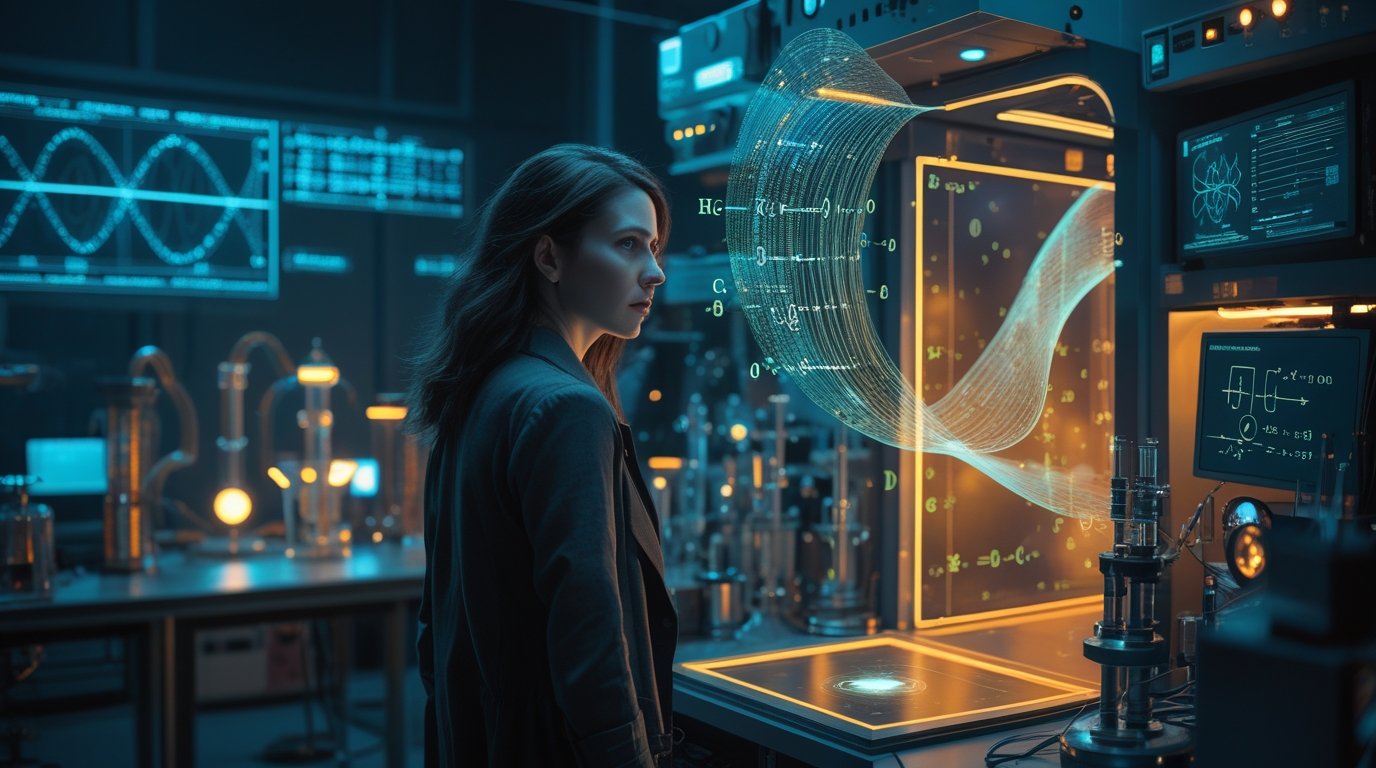
Elena found the pattern at 4:28 AM, six months after Marcus’s funeral.
She’d been living on coffee and stubbornness, analyzing data from the equipment failure that supposedly killed her husband. The university called it a tragic accident. The insurance investigators blamed faulty wiring. Elena’s grief counselor suggested she was manufacturing meaning from chaos because accepting Marcus’s death was too painful.
But there in the quantum noise, hidden like a message in the language of probability waves, was something that made her hands shake.
The data should have shown chaos, random particle scatter from exploding lab equipment. Instead, the signature was elegant. Controlled. Mathematical poetry where there should have been destruction.
“You didn’t die,” Elena whispered to the empty laboratory where they’d spent three years redefining the possible. “You beautiful, reckless bastard. You jumped.”

Dr. Marcus Reeves had spent those three years mapping dimensional barriers, chasing theories about consciousness existing across parallel realities. Elena had watched him grow obsessed, working sixteen-hour days, muttering equations in his sleep. When the university cut his funding, calling his work “too speculative for serious consideration,” she’d supported him publicly while privately worrying he was losing his grip on reality.
The night before he died, Marcus had been agitated, talking about breakthroughs he couldn’t share yet. “Promise me something,” he’d said, gripping her hands with unusual intensity. “If something happens to me, don’t let them destroy my work. Everything you need is in our files, but you’ll have to be clever about finding it.”
She’d assumed he meant academic politics. She’d been catastrophically wrong.
The mathematics proved Marcus had fragmented his awareness across parallel realities in the seconds before his lab equipment destroyed itself. But the equations also showed something else: he’d been preparing this experiment for months, building components in secret, testing theories she’d never suspected existed.
Elena spent the next month trying to understand what Marcus had built. The encrypted notes weren’t blueprints. They were breadcrumbs leading through three years of theoretical development she’d never paid attention to. Marcus hadn’t left her instructions. He’d left her an education.
She started with his earliest dimensional theory papers, working forward through increasingly complex mathematics. The equations made her head ache. Half the theoretical framework relied on principles that mainstream physics considered impossible. But Marcus had been testing those principles, building proof-of-concept devices in the university’s machine shop after hours.
Elena found the components hidden throughout their shared laboratory space. A quantum field generator disguised as a spectrometer calibration device. Crystalline processing arrays Marcus claimed were for “data storage experiments.” Neural interface hardware he’d told her was for measuring brainwave patterns during complex calculations.
Three weeks to understand how the pieces fit together. Another week to assemble them according to Marcus’s scattered specifications. The result looked nothing like the sleek dimensional bridge she’d imagined. More like a jury-rigged contraption that belonged in a garage.
Elena stared at the completed device, her hands trembling. She had no idea if it would work. Marcus’s notes suggested a sixty-percent chance of successful dimensional transfer. A thirty-percent chance of catastrophic equipment failure. A ten-percent chance of something he’d labeled simply as “consciousness dissolution.”
The neighbors complained about the electrical interference. The power company sent two technicians to investigate mysterious fluctuations in the local grid. Elena ignored them both, driven by a certainty that bordered on obsession: Marcus was alive somewhere in the spaces between worlds.
The dimensional scanner came online on a Tuesday morning, its readings painting impossible pictures across holographic displays. Elena calibrated the system according to Marcus’s specifications, her fingers moving through sequences he’d programmed for her neural patterns.
She found him immediately.
A strong consciousness signature three quantum layers from baseline reality. Close enough that the entanglement held. Far enough that reaching him would require everything she’d learned about dimensional physics and luck she probably didn’t have.
Elena stared at the readout for twenty minutes, afraid that looking away might make it disappear. After six months of grief, the proof of Marcus’s survival felt too fragile to trust.
But the signal stayed steady. Coherent. Human awareness, Marcus’s neural patterns, alive in some form that went beyond death as most people understood it.
Elena strapped on the neural interface Marcus had designed for her, noting how perfectly it fit, how warm it felt against her temples. He’d built this for her. Whatever plan he’d been developing had always included her.
The device was heavier than she’d expected, filled with crystalline structures that hummed with contained energy. When she closed her eyes, she could feel it interfacing with her nervous system, preparing her consciousness for translation across dimensional boundaries that shouldn’t be crossable.
She thought about leaving a note. Some explanation for why Dr. Elena Vasquez had vanished from her laboratory, her classes, her carefully constructed life. But what could she write that wouldn’t sound like the ravings of a woman broken by grief? Either she’d succeed and explanations wouldn’t matter, or she’d fail and be beyond caring.
“I’m coming,” she said to the empty room, and activated the dimensional bridge.
Reality dissolved like sugar in infinite water.
The transition felt like being unmade and remade at once, consciousness reduced to component equations before reassembling according to different physical laws. Elena’s sense of identity flickered between existence and void, tethered only by quantum entanglement to the woman she’d been moments before.
When her vision cleared, Elena stood in a laboratory almost identical to hers, but wrong in ways that made her skin crawl.
The equipment was arranged more efficiently. The lighting was warmer, suggesting someone who valued comfort over optimal working conditions. The walls bore photographs she’d never seen. Marcus receiving awards from institutions she didn’t recognize. Marcus laughing with colleagues whose faces meant nothing to her. Marcus living a life that had unfolded according to different choices.
And there, sitting at a workstation analyzing holographic displays that showed quantum field equations of staggering elegance, was Marcus himself.
“Marcus?”
He turned, and Elena’s chest tightened. Same dark hair that fell across his forehead when he concentrated. Same thoughtful brown eyes behind wire-rimmed glasses that were always slightly crooked. Same small scar above his left eyebrow from a childhood chemistry experiment gone wrong.
When he smiled, it was the same crooked expression that had made her fall in love during graduate school seminars where they’d competed to ask the sharpest questions.
But his expression held only polite confusion. He looked at her the way he might examine an interesting research problem. Intellectual attention without personal recognition.
“I’m sorry, do I know you?”
Ice water flooded her nervous system. Her carefully prepared explanations dissolved, leaving her with only raw truth in a voice she barely recognized as her own. “I’m Dr. Elena Vasquez. I was… I am your wife.”
“Vasquez.” Marcus adjusted his glasses in the gesture she knew meant he was processing new information. “I know your work on dimensional consciousness theory. Brilliant stuff. Answers questions I didn’t know I was asking. But we’ve never met.”
Elena felt the ground shift. This Marcus had never married her. Never loved her. He lived a different life where Dr. Elena Vasquez was simply another researcher whose papers he’d read and admired from a distance.
They worked together that first day, and she fell in love with him all over again. His excitement when discussing equations that pushed the boundaries of accepted physics. The way he drummed his fingers against his workbench when chasing a stubborn theoretical framework. His terrible physics puns that stayed endearing across dimensional boundaries.
“This is extraordinary,” Marcus said as they collaborated on calculations describing consciousness as a multidimensional phenomenon. “Your framework suggests awareness exists independently of individual neural architecture. We could map consciousness across parallel realities, study how identity persists through different physical manifestations.”
Elena found herself finishing his sentences, anticipating his logic, building on his ideas with the fluency of minds perfectly matched even across the barriers between worlds. But every moment of intellectual closeness was shadowed by the weight of recognition unreturned. Love offered to someone who couldn’t give back what he’d never experienced.
“Strange,” Marcus said as evening painted the laboratory walls with golden light. “Working with you feels familiar. Like remembering instead of learning.”
Her pulse quickened. “What if I told you that in another reality, another universe, we were married?”
Marcus considered this with the same precision he applied to complex physics problems. When he spoke, his voice was soft. “I’d say that somewhere in the quantum foam, there’s a version of me that’s probably the luckiest man alive.”

Elena stayed two more days in that reality, watching this Marcus fall in love with the theoretical possibility of her while she loved him completely and hopelessly. But there was someone else. Dr. Rebecca Torres, a biochemist with kind eyes and a laugh that carried across rooms, who clearly adored this version of Marcus.
Elena saw them together in the faculty lounge. The easy affection between two people building something real without interference from parallel dimensions or the complicated mathematics of interdimensional love. Rebecca’s face lit up when Marcus entered the room. Marcus leaned toward Rebecca when she spoke without seeming to notice he was doing it. They had inside jokes, shared references, the comfortable shorthand of two people learning each other’s rhythms.
“He talks about you constantly,” Rebecca told her over coffee in the campus cafe, her hands wrapped around a mug that read “World’s Okayest Scientist” in faded letters. “This research collaboration you two have going, I’ve never seen him this excited. You’re brilliant, by the way. I tried reading your dimensional theory paper three times and still only understand half of it.”
Elena stared into her coffee, watching cream swirl in patterns that reminded her of quantum field equations. “He’s remarkable. You’re very lucky.”
“We’re lucky to have each other,” Rebecca said, then hesitated. “Though sometimes I think he’s more in love with physics than he could ever be with any actual person. The way he talks about parallel universes and quantum possibilities… like he’s searching for something that doesn’t exist in our reality.”
When Elena prepared to activate the return sequence, Marcus stood watching from the laboratory doorway, his expression unreadable.
“Will I see you again?” he asked, echoing words Elena remembered from another life, another version of this conversation.
“I don’t know,” she said, meaning it.
The return transition felt like coming home to a house emptied while she was away. Her own laboratory looked exactly as she’d left it. Messier than the parallel version, older equipment, everything touched with the quiet sadness of solitary work and the absence of someone who would never return.
Elena sat in Marcus’s empty chair for an hour, breathing traces of his cologne still clinging to the fabric after six months. The dimensional scanner showed dozens of other consciousness signatures scattered across the spectrum. Each one a different version of the man she’d lost. Each one a different possibility for love, loss, and the tangled mathematics of human connection across infinite realities.
She could keep jumping. The technology worked, the pathways were mapped, and somewhere in the spaces between worlds was probably a version of Marcus who would recognize her face and remember their life together. Maybe dozens. Maybe hundreds.
But she’d seen something in that other reality that changed how she understood love stretched across dimensional boundaries. Marcus building a different life with different choices. Rebecca’s face when he walked into a room. Two people writing their own story with patience and mutual discovery.
Maybe some forms of love were too selfish to deserve the name.
Elena powered down the dimensional bridge and encrypted the research files. Tomorrow she would write a paper on theoretical consciousness mapping, crediting Dr. Marcus Reeves as co-author. She would apply for grants, build a career that honored what they’d discovered without trying to recreate what they’d lost.
The quantum signature stayed in the data. Proof that consciousness could outlast death. Marcus existed across parallel realities, living different lives, loving different people.
She climbed the stairs to make dinner for one. Some equations had no solutions. Some losses couldn’t be solved, only carried.
But love itself? That mathematics stayed beautiful, even when it led nowhere she could follow.
Free Stories, Straight to Your Inbox
Start with Nine Doors, nine short stories across nine genres, yours free the moment you sign up. After that, the occasional new collection and a note when there's a new book worth your time. No spam, no daily clutter. Just good stories.
We use MailerLite to manage our list and send these emails. Your address is used only to send you what you signed up for. We will not sell it, share it, or use it for anything else, and you can unsubscribe anytime.