
Lot Fourteen
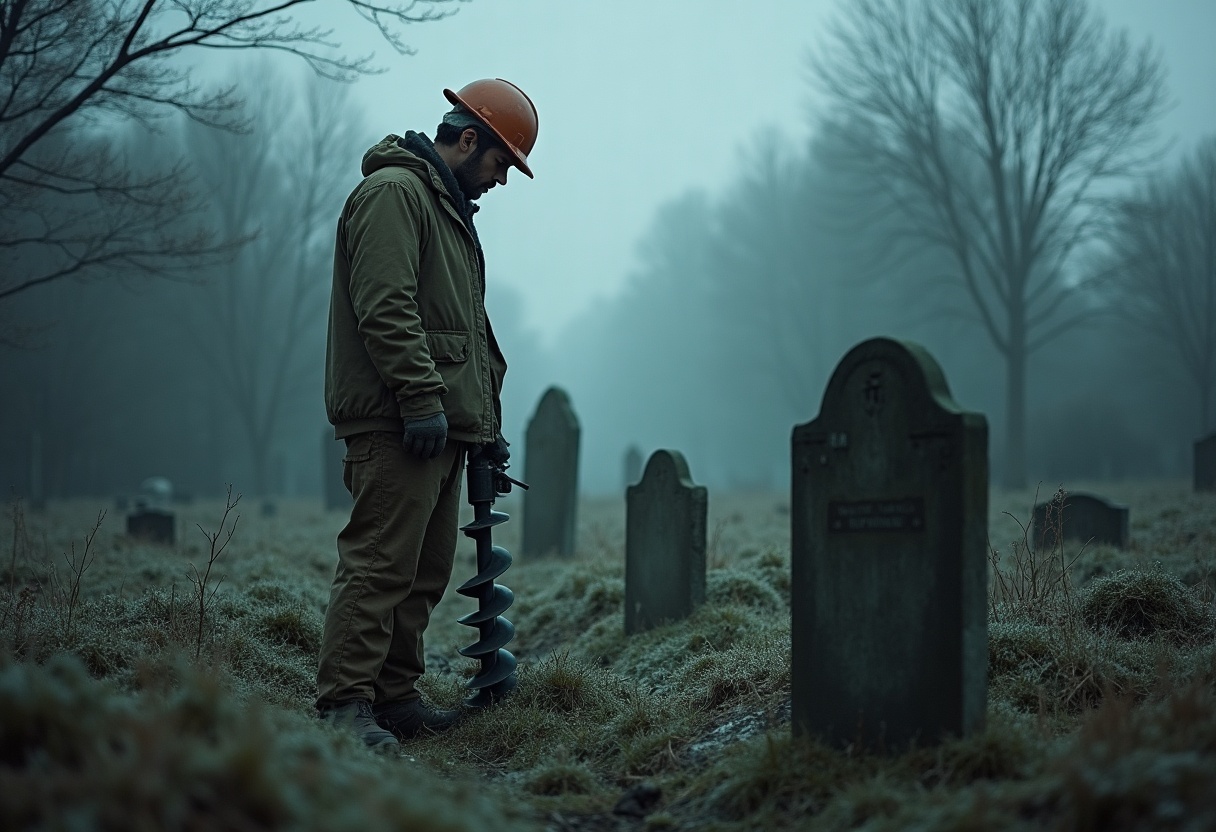
The auger hit the first box at four feet, and Dale Ferro knew the sound of wood under a drill bit the way he knew his own truck starting, so he killed the motor before he thought about why.
He was setting the last of the deck footings. Twelve holes, eleven of them clean through the clay, and this one stopped soft at four feet with a sound that was not a rock and was not a root. Dale backed the auger out and crouched at the lip of the hole and looked down at what the bit had chewed: pale splinters, old wood, and the curve of something that had been planed and joined by a person.
A coffin lid. He had grown up two doors from a man who built them, and he knew the shape.
Dale was forty-six and had been pouring foundations and framing houses for twenty-eight years, and in that time he had dug up a great many things that did not belong where he found them. Buried oil tanks. A Volkswagen. Once a safe, empty, which had ruined a week of his life with hope. He had a process for the unexpected, and the process was to stop, document, and call the people whose job it was. He took out his phone and photographed the hole.
The cold came up out of it before the voice did.
It rolled over the lip of the hole like water out of a freezer, a cold that had nothing to do with the morning, and it climbed his arms and settled in his teeth, and the light on the graded pad went thin and gray though there was no cloud. Dale’s breath smoked. In July. The hair on his neck stood the way it does when a thing in the dark has already seen you and is deciding.
“You put that drill down,” the voice said, “or I will put it down for you, and your hand with it.”
Dale did not move. He looked around the lot, the stacked lumber, the silent street of the half-built subdivision, and there was no one, and it was seven in the morning, and he was the first one out the way he was always the first one out, which meant there was no one to find him for an hour.
“Down here,” the voice said.
He looked down the hole.
There was a man in the coffin, or the idea of one, gray and wrong, folded into the box the auger had opened. He was looking up at Dale, and his eyes were the part Dale would not be able to forget, because they were not a ghost’s eyes from a story. They were the eyes of something that had been in the dark a very long time and had stopped being patient about it. One hand lifted, slow, and pointed at the auger, and where it pointed the steel bit went white with frost and the hydraulic line stiffened and cracked.
“Third hole this month,” the dead man said. “Third roof. I have come up to say something each time, and each time the man with the machine runs, and brings more men, and more machines. You are not going to run. We have decided.”
“We,” Dale said. His voice came out steadier than he was. A man who has talked down inspectors and a Teamster and his ex-wife’s lawyer learns to keep his voice flat while his stomach drops.
“There are forty of us.” The cold pulsed when he said it, forty small drops in temperature, a thing Dale felt in his fillings. “This was ground in 1851. The church burned in 1909 and took the only record. The county calls it raw land. We call it ours, and we are very tired of being drilled.”
Dale made himself crouch, slow, and sit on the edge of the hole, because his knees were going and a man about to negotiate for his life should not do it from a crouch. He set the dead bit aside. He kept his hands where the thing in the box could see them.
“What’s your name,” Dale said.
The dead man considered whether to give it, the way you consider whether to give a stranger anything at all. “Ambrose Webb. Attorney. I speak for the others because I argued for a living and am already damned, so the work suits me.” The cold eased a half-degree, a concession. “And you are the one building the house.”
“Dale Ferro. Foundation sub. The house belongs to a developer named Castellano I’ve never met, who answers to a bank that answers to nobody.” He wet his lips. “Mr. Webb, I’m going to be straight, because I think a lawyer respects it more than begging. I’ve got a contract and a pour Thursday and eleven good footings and one through your roof. If I run and tell people there’s a graveyard here, nothing happens for a year. Then it happens anyway, slower, with backhoes, and they move every one of you to a county shelf.”
The temperature dropped so hard the puddle of hydraulic fluid skinned over with ice, and a second voice came up out of the ground, not from Ambrose’s box but from the left, lower, wetter, a voice like a man talking through soil.
“Moved.” It said the one word and the tarp Dale had not yet thrown began to lift at its corner with no wind. “They moved me. Nineteen fifty-three. For a road. Took me up in a county truck in pieces and set me down wrong, and I have not slept since, and I will not be moved again, and I will not let him be the one who does it.”
“That’s Hollis,” Ambrose said, and for the first time there was something careful in the lawyer’s voice, the tone of a man stepping around a colleague who has come unhinged. “He is not wrong to be angry. He is only past listening. Mr. Hollis, this one has not moved anyone yet.”
“They all say yet.” The cold reached Dale’s chest now, a hand spreading flat over his lungs, and he understood, with the clean certainty of a man feeling a structure begin to fail, that Hollis was going to stop his heart in the next minute and call it justice, and that Ambrose might not choose to prevent it.
Dale had been afraid on job sites before. Trench cave-ins. A crane swing that missed him by a foot. But fear on a site was fast and then over. This was slow, and it was reasoning with him, and it had forty votes and one of them wanted him dead.
He did the only thing he knew how to do, which was solve the problem in front of him faster than it could kill him.
“I’m not going to move you.” He said it to Hollis, not Ambrose, because Hollis was the danger and you address the danger. “Listen to me. Moving you is the developer’s answer and the county’s answer, and I’m telling you it’s a stupid answer, and I can stop it, but not if I’m dead in this hole, because then Petey finds me at eight, the site shuts down, and the next outfit through here doesn’t talk to you. They just dig. You kill me and you guarantee the exact thing you’re afraid of.”
The hand on his chest did not lift. But it did not press, either. It waited.
“Go on,” Ambrose said softly. “Quickly.”
Dale’s mind ran the way it ran when a pour was going bad and he had ninety seconds to save it. “The footings are the problem. Every hole is a drill through a roof. But a footing is just how you hold a structure up, and there’s other ways. A floating slab. Grade beams. A thing that sits on top of the ground and spreads the load instead of punching down into it. Nothing goes deeper than a foot. Nobody ever drills you again. The house sits on you like a lid, not a stake.”
“Words.” Hollis. The cold tightened. “He is buying his minute with words. The road man had words.”
“It’s not words, it’s a method, and I can prove it.” Dale was talking fast now and did not let himself stop, because the talking was the only thing between him and the floor of the hole. “I redesign the footprint today. I sell Castellano on bad soil, expansive clay, future lawsuits, and he does what I say because developers do what you say when you scare them with money. Nothing goes in the ground. And the hole I already made, I patch this afternoon. New cedar lid, sealed, backfilled soft. Better than it was.”
The pressure on his chest eased by a degree, and Dale thought he had it, and that was when he made the mistake.
“And I’ll pay,” he said. “Out of my own pocket. Whatever it costs to make this right, I’ll cover it, I’ll put money into the ground, into the church record, a marker, a fund, whatever you want.”
The cold came back all at once, worse, and the lumber stack thirty feet away went over with a crash, and Dale knew before Ambrose spoke that he had said exactly the wrong thing.
“Money.” Ambrose’s voice had gone flat and cold as Hollis’s now. “Every man who has stood where you stand has offered money. The developer in 1953 offered money. The county offered money. Money is what you offer a thing you intend to leave behind. You have just told forty of us that you are the same as all of them, and Mr. Hollis is no longer the only one who wants you in the ground.”
The hand pressed. Dale’s vision went to pinholes. He had one breath left and he spent it on the truth, because the truth was all he had not yet tried.
“Then I’ll stay.” The words came out of him before he understood them, the way the right answer on a failing pour comes from the hands before the head. “Not money. Me. You don’t want to be paid, you want somebody who won’t leave. Somebody who comes back. I’ll be the one. I’ll keep your record. I’ll keep the ground. I’ll come back every year I’m alive and check every roof, and I’ll find the man who takes the trade after me and put it on him, and when I die I’ll know where I’m going to be, which is here, with you, in the ground I kept, because a man who keeps a graveyard belongs in it. That’s not money. That’s a debt with my name on it that doesn’t end when I drive off the lot.”
The hole went silent. The cold hung where it was, neither pressing nor leaving, forty souls weighing a thing they had not been offered in a hundred and seventy years, which was not payment but a person.
“He means it,” Ambrose said at last, and there was something in his voice that had not been there before, something like grief. “God help him, Mr. Hollis. He means it. I have heard ten thousand men lie under oath and this one is not lying.”
The pressure left Dale’s chest. He fell back onto his hands on the dirt and pulled cold July air into his lungs in long whoops, alive, shaking, forty-six years old and crying a little and not caring that he was.
“We have terms,” Ambrose said. “You will keep the ground unpierced and the roofs in repair. You will keep our record so the next machine knows we are here. You will return while you live, and you will name a keeper after you, and the keeping does not end. In exchange we keep the quiet, and we let the family live, and we do not trouble what you build. And when your time comes, you come here.” A pause. “It is not a kindness we offer you, Mr. Ferro. It is a sentence. You should know the difference before you agree, because we did not, any of us, and look where we are.”
Dale looked at the hole, at the gray man and the dark to his left where Hollis lay, and he understood that he was being offered the thing he had asked for and that it was going to cost him every year he had left and the rest after that, and that this was the deal, and that there was no version where he walked away clean, because he had drilled the hole and seen the eyes and there was no unseeing them.
“I agree,” Dale said.
A gray hand came up out of the hole. Dale spat in his palm, the way his grandfather taught him to close a deal that mattered, and reached down and took it, and it was cold the way deep water is cold, and it held his hand longer than a handshake, long enough that he felt the others in it, all forty, the weight of every one settling onto him through the grip of a lawyer dead since 1851.
“Pleasure,” Dale said, because his grandfather had also taught him you finish a deal the same whether you won it or lost it.
“No,” Ambrose said. “It isn’t. But you’ll do it well. That’s worse, and it’s why we chose you.”
He patched the roof that afternoon, alone, after he sent Petey for a bit that did not need replacing. New cedar over the splinters, sealed, backfilled soft, his hands as careful as they had ever been on any custom job, because the client was watching and the client had forty witnesses and one of them had nearly killed him. He moved the deck to a floating slab. He sold Castellano on bad soil in a ten-minute call, and the man thanked him for saving him from a lawsuit.
The house went up. A young family bought it, a baby and a dog, and the dog slept every night on the floor over the spot Dale had drilled, in the warmest place in the house, and the family stopped trying to explain it.
Dale Ferro kept his word. He went back every year. He fixed the roofs that needed it, on his own dime, on his own time, and he kept the church record in a fireproof box in his truck and updated the county nothing, because the county was the enemy. He found a young framer named Reyes in his last year in the trade and told him the whole thing over two beers, and watched the kid decide he was crazy, and watched the kid go out to lot fourteen alone at seven in the morning to prove it, and watched him come back gray and quiet, and that was how the keeping passed.
It cost him. The years of driving out. The thing he could never tell his ex-wife, who thought he was seeing someone and never guessed it was forty someones. The knowledge, carried every day, of exactly where he was going to lie, which is a thing most men are merciful enough not to know.
He never called it a gift. Ambrose had been honest with him, the one honest party he ever dealt with, and Ambrose had called it a sentence, and Dale, who had spent his life building things for people who would live with what he left behind, served it.
He is out there now, in the ground he kept, in the quiet under lot fourteen, the warmest spot in the subdivision, where the dogs like to sleep. Forty-one boxes. The newest one tended, the way he tended all the others, by a framer named Reyes who drills his first footing slow, and listens, and is ready, if the bit ever goes soft at four feet, to sit down on the edge and pay what the dead actually charge.
Which was never money. Dale could have told you that. It took him one hole to learn it and the rest of his life to pay it.
Free Stories, Straight to Your Inbox
Start with Nine Doors, nine short stories across nine genres, yours free the moment you sign up. After that, the occasional new collection and a note when there's a new book worth your time. No spam, no daily clutter. Just good stories.
We use MailerLite to manage our list and send these emails. Your address is used only to send you what you signed up for. We will not sell it, share it, or use it for anything else, and you can unsubscribe anytime.