
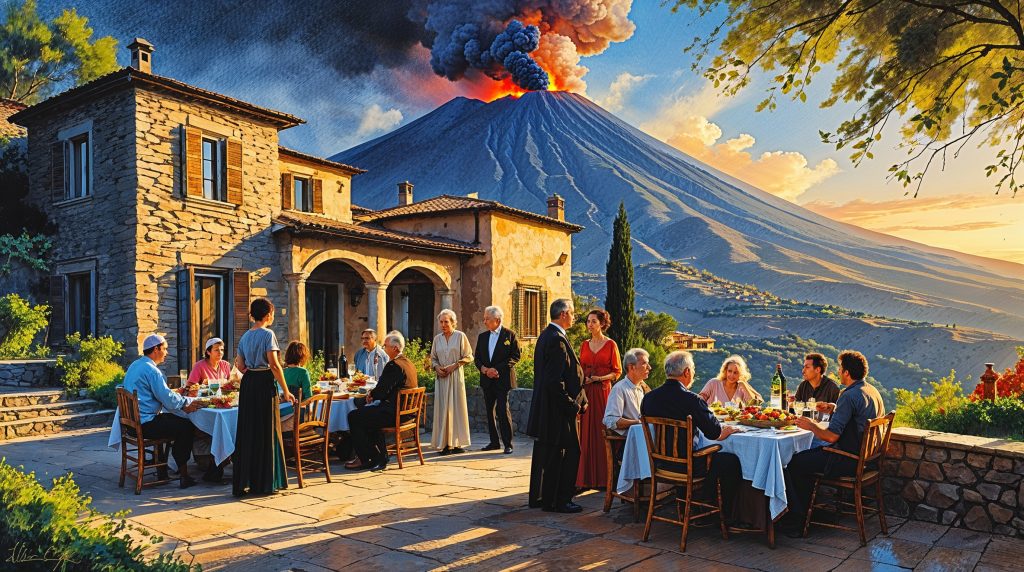
Children Under the Volcano
I read about the children of Pompeii, the ones whose plaster casts you can still see in the ruins, frozen in the positions they died in nearly two thousand years ago. I couldn’t stop thinking about the hours before the eruption. Not the disaster. The normal day that preceded it. Kids playing in the street. Parents arguing about dinner. A dog sleeping in a doorway. All of it about to be frozen forever, and none of them knew. The horror isn’t the volcano. The horror is the ordinary afternoon that came right before it.
The house sat on the slope of Mount Etna like a barnacle on the hull of a ship, clinging to the volcanic rock with the stubbornness of a family that refused to acknowledge that they’d built their lives on top of something that could kill them at any moment.
The Ferrante family had lived on the mountain for six generations. The original house, built in 1847 by Giacomo Ferrante, a winemaker who believed that volcanic soil produced the finest grapes on earth, had been destroyed by lava flows three times and rebuilt three times, each iteration a few meters higher, a few meters farther from the crater, as if the family was playing a slow-motion game of retreat that neither side intended to finish.
Lucia Ferrante was the current matriarch, though nobody called her that. They called her Nonna, even the people who weren’t her grandchildren, because at seventy-eight she’d achieved the gravitational pull that extended beyond bloodline into the neighborhood, the village, and arguably the mountain itself. Lucia’s relationship with Etna was personal. She spoke to the volcano the way other people spoke to their dogs: with affection, exasperation, and the firm belief that it could hear her.
“Behave,” she said every morning, standing on the terrace with her coffee, looking up at the smoking summit. It was a ritual. The mountain had not behaved in recorded history, but Lucia kept asking, and the mountain kept not listening, and the standoff continued with the comfortable persistence of a marriage that had outlasted passion and settled into routine.
The family gathered at the house every August, a ritual Lucia enforced with quiet authority. Her three children, seven grandchildren, and various attached spouses and partners descended on the house for two weeks of meals, arguments, wine, and the particular torture of extended family proximity in a building with six bedrooms and one functioning bathroom.
Marco, the eldest, arrived from Milan with his wife Paola and their two teenage daughters, Sofia and Greta. Marco was fifty-two, a corporate attorney who’d spent thirty years building a career he secretly despised and a marriage he publicly maintained with contractual precision. He wore expensive suits the way a soldier wears armor, and he spoke to his wife in the clipped, efficient sentences of a man drafting a memo rather than having a conversation. Paola was a museum curator who’d married Marco because he was stable and had spent twenty-three years discovering that stability and happiness were not synonymous. She drank more than she used to. Nobody mentioned it.
Teresa, the middle child, came from Rome with her partner Daniela and their son Matteo, who was nine and had the intense, watchful eyes of a child who understood more than adults wanted him to. Teresa was a documentary filmmaker who specialized in environmental disasters, a career choice that Lucia considered ironic given the family’s residential arrangement. Daniela was a pediatrician with a quiet intensity that could fill a room or empty it, depending on her mood. Their relationship operated at a pitch that exhausted everyone who witnessed it, all sharp edges and fierce repair, the emotional equivalent of living on a fault line.
Roberto, the youngest, arrived last, alone, in a rental car that smelled of cigarettes and airport cologne. He was forty-six, twice divorced, professionally unclassifiable (he described himself as a “consultant,” a word the Ferrante family understood to mean “unemployed”), and the only one of Lucia’s children she still worried about. He had their father’s face, their father’s charm, and their father’s relationship with alcohol, which was less a relationship than a hostage situation.
“You look terrible,” Lucia told him at the door.
“I look like my father.”
“Your father looked terrible too. It runs in the family.”
Roberto kissed her cheek and carried his single bag to the smallest bedroom, the one he’d had as a boy, the one that still smelled faintly of the model airplane glue he’d used obsessively at fourteen.
The first week passed in the familiar pattern. Meals that lasted three hours, built around Lucia’s cooking, which was aggressive in its generosity. Platters of pasta alla Norma, caponata, arancini, grilled swordfish, and the blood-orange granita that she made every afternoon and that tasted like August distilled into a spoon. Arguments about politics that started at the dinner table and continued on the terrace until the wine ran out. Sofia and Greta hiding in their room, communicating with the outside world through their phones like hostages sending coded messages. Matteo exploring the volcanic rock formations around the house with the fearless curiosity of a child who didn’t understand that the ground beneath him was, in geological terms, a loaded weapon.
The tension was under the surface, like the magma. Marco and Paola conducted their marriage with the choreographed distance of people who’d agreed, without discussing it, to be civil in public and silent in private. At dinner, they passed plates without touching. In conversation, they referred to “the house” and “the children” as if discussing a joint venture rather than a shared life. Teresa and Daniela had the opposite problem: too much discussion, too much processing, every minor friction analyzed and deconstructed until the analysis became its own friction. They’d been in couples therapy for a year, and the vocabulary of that therapy had invaded their daily speech. “I feel unheard” and “that triggers my abandonment schema” were phrases that Lucia endured with the patience of a woman who’d survived actual hardship and had limited tolerance for therapeutic jargon.
Roberto drank. Not dramatically, not conspicuously, but with the steady, experienced consumption of someone who’d been managing pain with alcohol long enough that the management had become invisible. A glass of wine at lunch. Two at dinner. A grappa on the terrace after the others went to bed. Then another. Lucia noticed. She always noticed. She said nothing, because saying something to Roberto had never once in forty-six years produced a useful result.
The eruption started on a Thursday morning.
Not the volcanic kind. Etna grumbled and smoked as usual, a thin plume rising from the summit like the mountain’s version of morning breath. The real eruption was at breakfast, when Sofia, who was sixteen and had been silent for most of the week, looked at her father across the table and said, “Are you and Mom getting divorced?”
The silence that followed was absolute. Lucia’s hand stopped mid-pour over Marco’s coffee cup. Teresa’s fork hung in the air. Matteo, who had been methodically dismantling a cornetto, looked up with the alert stillness of a prey animal sensing danger. Even the mountain seemed to hold its breath.
Marco set down his coffee cup with exaggerated care. “That’s not an appropriate question.”
“It’s the most appropriate question anyone’s asked all week. You don’t talk to each other. You sleep in separate rooms. Mom’s been crying at night. I can hear her through the wall.”
Paola’s face went white. Greta, who was fourteen and generally wanted to be invisible, slid her chair back from the table as if proximity to the conversation might be contagious. Roberto laughed, a short, bitter sound that carried the weight of a man who recognized a fellow truth-teller. Teresa reached for Daniela’s hand under the table, an unconscious gesture of solidarity in the presence of someone else’s crisis.
Lucia stood up. She was small, barely five feet, and she stood with the deliberate precision of someone who intended to be the tallest person in the room regardless of physics.
“Everyone on the terrace. Now.”
They went. The full family, all twelve of them, crowding onto the stone terrace that overlooked the vineyard and the slope and, beyond that, the smoking summit of Etna. The morning light was golden. The air smelled of sulfur and rosemary, two scents that had no business coexisting but that defined this place as completely as the black volcanic soil and the twisted grape vines.
“Sit,” Lucia said. They sat. On chairs, on the wall, on the ground. Matteo perched on a lava rock with his legs crossed, watching with the gravity of a nine-year-old judge.
“Every August,” Lucia said, “you come to this house. You eat my food. You drink my wine. You smile at each other and pretend that everything is fine, and then you go back to your cities and spend eleven months avoiding each other until August comes again and you have to pretend some more.”
“Nonna,” Marco started.
“I’m not finished. I’ve been watching this family fall apart for twenty years. Slowly, the way the mountain works. A little more distance every year. A little more silence. A little more pretending. You think I don’t know? I’m old, not blind.”
She pointed at the summit. The plume of smoke was thicker today, darker, pushed sideways by the upper-altitude winds.
“That mountain has destroyed this house three times. Three times, my family rebuilt it. Not because we’re brave. Because we’re stubborn. We know the mountain will erupt again. We know the lava will come. We know that everything we build here might be buried under rock and ash. We stay anyway. Because the soil is good. Because the wine is good. Because this is where we belong, and the risk of losing it is the price of having it.”
She looked at Marco and Paola. “If your marriage is over, let it be over. Don’t let it rot in the dark like something you’re ashamed of. If it’s not over, then fix it. But stop pretending, because pretending is the coward’s way of letting something die.”
She looked at Roberto. “You’re drinking yourself into the ground. I’ve been watching it for fifteen years. Your father did the same thing. It killed him at sixty-one. You have fifteen years to decide if you want the same ending.”
She looked at Teresa and Daniela. “You two argue about everything because you’re afraid that if you stop arguing, you’ll have to face the silence, and the silence might tell you something you don’t want to hear. Stop arguing. Listen.”
She looked at Sofia, who’d started the whole thing and was sitting on the terrace wall with her arms wrapped around her knees, looking younger than sixteen and older than her parents. “You. You’re the bravest person in this family. Don’t let them make you regret it.”
The terrace was quiet. Etna rumbled, a low, subsonic vibration that you felt in your bones rather than heard with your ears. The smoke plume thickened.
Matteo raised his hand.
“Yes?” Lucia said.
“Is the volcano going to erupt?”
Everyone looked at the summit. The plume was darker. Denser. A faint red glow was visible at the crater’s rim, though it might have been a trick of the morning light.
“Probably,” Lucia said.
“Should we leave?”
“Probably.”
“Are we going to?”
Lucia looked at her family. Twelve people on a terrace on the side of a volcano, cracked open by a sixteen-year-old’s question, sitting in the aftermath of truths that should have been spoken years ago.
“Not yet,” she said. “We haven’t finished breakfast.”
They went back inside. They finished breakfast. Marco reached across the table and took Paola’s hand, a gesture so unfamiliar that Sofia stared at it like a foreign object. Paola didn’t pull away. Her eyes were wet, and she squeezed his fingers once, hard, like a woman gripping a rope over a cliff.
The eruption, when it came, was minor. A lava flow from a fissure on the northeastern slope, well away from the house, moving slowly enough that the civil protection authorities didn’t order an evacuation. The family stood on the terrace and watched the molten rock inch down the mountainside, orange against the dark basalt, beautiful and terrible and very, very real.
“See?” Lucia said. “It behaves. Sometimes.”
The August continued. Things didn’t magically resolve. Marco and Paola started talking, which was painful and awkward and necessary. They sat on the terrace after the others went to bed and had conversations that went past midnight, their voices too low to hear from inside, the silhouettes of two people trying to remember why they’d chosen each other in the first place. Roberto poured his evening grappa down the kitchen sink when he thought nobody was looking, and Lucia saw and said nothing. Teresa and Daniela sat on the terrace one night and didn’t talk at all, just sat in the silence, and found that the silence told them they were fine.
When the family left at the end of the month, Lucia stood on the terrace and watched the cars descend the mountain road, one by one, carrying her children and grandchildren back to their cities and their lives and their imperfect, ongoing, deeply human disasters.
She turned to the mountain. The smoke had thinned. The fissure had sealed. The lava was cooling, turning from orange to black, becoming new rock, new soil, new ground on which, eventually, new vines would grow.
“Same time next year,” she told the volcano.
The volcano, as always, said nothing. But the ground beneath her feet was warm, and the rosemary in the garden smelled like August, and the house, rebuilt three times on the bones of its predecessors, held firm against the slope.