
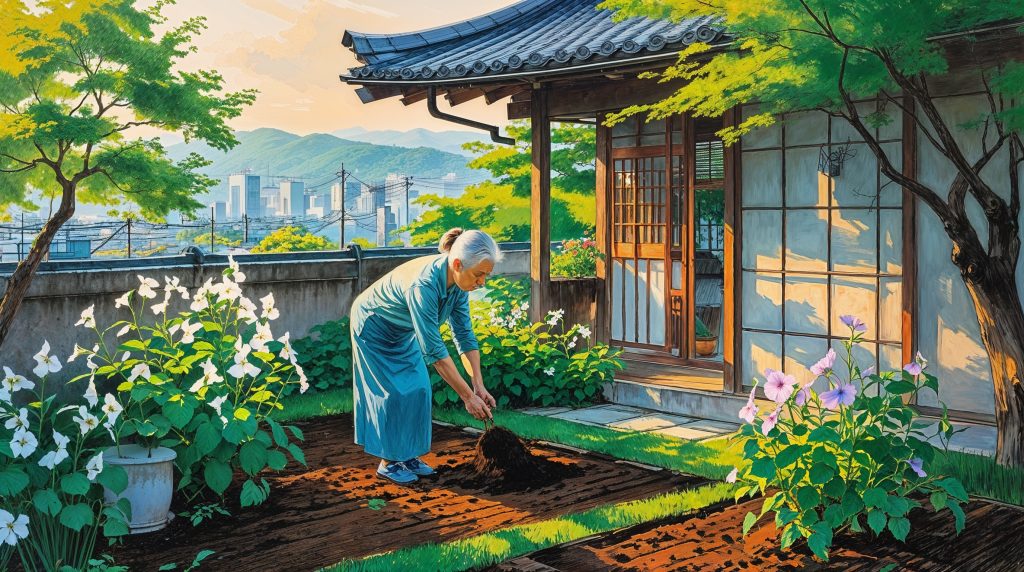
A Garden in Hiroshima
I saw a photograph of a tree that survived the atomic bomb. It was still growing, decades later, scarred and twisted but alive. I couldn’t get past the idea that something could endure that and keep reaching for the sun. A tree doesn’t decide to survive. It doesn’t choose hope. It just grows because that’s what trees do. The garden became a way to write about recovery without ever using the word. No inspirational speeches. No lessons learned. Just soil and water and patience and the stubborn refusal of living things to stay dead.
The ginkgo tree survived the bomb.
This is a documented fact, verified by botanists, historians, and the city of Hiroshima itself. On August 6, 1945, an atomic weapon detonated 580 meters above the city, leveling everything within a two-kilometer radius, killing an estimated 80,000 people instantly, and destroying virtually every living thing in its path. But the ginkgo tree at the Housenbou Temple, 1,130 meters from the hypocenter, survived. Its trunk was scorched, its branches shattered, its leaves vaporized. And the following spring, it put out new growth.
Tomoko Arai was born in 1952, seven years after the bomb, in a house three blocks from that ginkgo tree. Her mother, Sachiko, had been fifteen years old on the morning of August 6th, walking to school along the Motoyasu River when the sky turned white. She survived because she was on the far side of a concrete bridge that absorbed most of the blast wave. She walked home through a city that no longer existed, stepping over things she refused to describe to her daughter, and found her family’s house standing, impossibly, amid the rubble.
Sachiko never talked about the bomb. This was common among the hibakusha, the bomb survivors. The silence was not denial. It was a survival mechanism as effective as the concrete bridge, a way of containing something too enormous and too terrible to be processed through language. Tomoko grew up knowing that her mother had survived something unspeakable, and knowing that she would never hear the details.
What Sachiko did talk about was the garden.
The Arai family garden was small, a strip of earth behind the house that measured roughly three meters by six. Before the war, Tomoko’s grandfather had grown vegetables there, the practical crops of a family that couldn’t afford waste. After the bomb, the soil was contaminated. Nothing grew for two years. The neighbors said the earth was poisoned, that nothing would ever grow there again, that the family should pave it over and forget.
Sachiko, at seventeen, began planting.
She started with morning glories, because they were cheap and resilient and she remembered her grandmother growing them. The first season, nothing came up. The second season, three vines emerged, thin and pale, producing flowers so small you had to kneel to see them. By the third season, the morning glories had claimed the back fence, erupting in purple and blue blooms that the neighbors came to stare at, as if witnessing something they’d been told was impossible.
She expanded. Sweet potatoes, because they could grow in poor soil. Chrysanthemums, because they were traditional and she wanted tradition in a world that had erased it. A plum tree that took five years to fruit but eventually produced plums so sweet that children from three streets away came to ask for them.
By the time Tomoko was old enough to remember, the garden was an ecosystem. Her mother tended it every morning, before dawn, kneeling in the dirt in clothes she kept specifically for gardening, her hands moving through the soil with the practiced confidence of someone who’d been doing this for decades.
“Why do you garden?” Tomoko asked her once, at age ten.
“Because the ground remembered how to grow things,” Sachiko said. “And if the ground can remember, so can I.”
Tomoko didn’t understand this answer at ten. She understood it at thirty, after she’d moved to Tokyo, married an accountant named Yuji, had two children, and found herself, in the quiet moments between obligations, thinking about dirt.
She started gardening on the balcony of their apartment in Meguro. The first plants arrived in clay pots that she bought at a hardware store in Jiyugaoka, carrying them home on the train, cradling them in her lap the way her mother had cradled Tomoko as an infant (a comparison that occurred to her only later and made her laugh and then cry in quick succession). She set them on the balcony railing and stood back and felt something shift inside her, a recognition of continuity, a thread connecting her hands in this Tokyo apartment to her mother’s hands in the garden in Hiroshima.
The balcony was not an ideal growing environment. It faced west, which meant the afternoon sun was brutal in summer and the wind in winter stripped moisture from the soil faster than she could replace it. The containers limited root growth. The concrete absorbed heat and radiated it back in waves that wilted anything not adapted to urban conditions. Tomoko learned these limitations the way her mother had learned the limitations of contaminated soil: through failure, persistence, and the stubborn refusal to accept that something wouldn’t grow simply because conditions were against it.
Her mother’s influence showed in the choices she made. Morning glories on the railing, climbing a trellis made from bamboo sticks lashed together with twine, the same technique Sachiko used in the Hiroshima garden. Cherry tomatoes in the deepest pots, staked with chopsticks. A miniature citrus tree that produced lemons the size of golf balls, sour and intensely fragrant, that Tomoko used to make a lemon curd she’d serve to guests who always asked for the recipe and were always surprised when she said “my mother’s.”
Sachiko noticed the garden on her first visit. She stood on the balcony for ten minutes, saying nothing, examining each plant with the focused attention of a surgeon reviewing imaging. Then she adjusted the position of the citrus tree three inches to the left, pinched a dead leaf from the morning glory, and went inside to make tea. It was the closest thing to approval Tomoko had ever received.
Container gardens, because there was no yard. Tomatoes, herbs, a miniature citrus tree that produced lemons the size of golf balls. Yuji tolerated it with the patience of a man who’d learned to accommodate things he didn’t understand.
“Your mother gardens,” he said. “Now you garden. Is this genetic?”
“I don’t think so. I think it’s just the thing we do instead of talking about the thing we can’t talk about.”
Her mother visited Tokyo twice a year, in spring and autumn. She inspected Tomoko’s balcony garden with the critical eye of an expert, pinching off dead leaves, testing soil moisture, adjusting the position of pots to optimize sun exposure. She never praised the garden. She never criticized it. She just worked in it, and her presence in the small space transformed it from a hobby into a lineage.
In 1998, Sachiko was diagnosed with cancer. Leukemia. The doctors said it was likely related to radiation exposure from the bomb, fifty-three years delayed. The hibakusha had been getting cancer at elevated rates for decades, the bomb’s last wave of destruction, killing its survivors on a timeline measured in half-lives.
Tomoko took the bullet train to Hiroshima. Her mother was in the hospital, thin and gray, with tubes in her arms and a view of the river from her window. The same river she’d been walking beside when the sky turned white.
“The garden,” Sachiko said. It was the first thing she said, before hello, before asking about the grandchildren.
Her voice was thin, stripped of the authority that had defined her for sixty years. The cancer had taken her weight, her color, her strength. It had not taken her priorities. The garden was first. The garden had always been first, because the garden was the answer she’d given to the bomb, the response she’d constructed with seeds and soil and fifty years of patient, stubborn cultivation. If the garden died while she was in this hospital bed, connected to machines that beeped with the indifferent precision of technology keeping a body alive past its natural inclination, then the bomb won. Fifty-three years late, but it won.
Tomoko understood this. She’d spent her childhood watching her mother kneel in that garden before dawn, understanding without being told that the morning glories and the chrysanthemums and the plum tree were not decorations. They were arguments. Arguments against the bomb, against the poisoned soil, against the neighbors who’d said nothing would grow.
“I’ll take care of it.”
“The plum tree needs pruning. The morning glories are crowding the chrysanthemums. Don’t let the sweet potatoes spread past the stone border.”
“I know, Mom.”
“You don’t know. You’ve been growing tomatoes on a balcony. This is different.”
She was right. It was different. The garden in Hiroshima was not a collection of plants. It was a conversation with the ground, a negotiation between a woman and a piece of earth that had been destroyed and refused to stay dead. Tending it required an understanding that Tomoko had observed but never practiced.
Sachiko died in March 1999. She was sixty-nine. The funeral was small, attended by neighbors and a handful of other hibakusha, old people with old wounds, who stood at the gravesite with the particular stillness of people who’d been standing at gravesites for over half a century.
Tomoko moved back to Hiroshima. Yuji agreed to the transfer with minimal complaint. He was a quiet man, and the years had taught him that the Arai women’s relationship with the garden was not something to argue with.
The first morning, Tomoko knelt in the dirt at dawn, wearing her mother’s gardening clothes, and put her hands in the soil. The earth was cool and damp and alive, teeming with the worms and microbes that Sachiko had cultivated for four decades. It smelled of mulch and minerals and time.
She pruned the plum tree. She separated the morning glories from the chrysanthemums. She kept the sweet potatoes behind the stone border. She did exactly what her mother had told her to do, and she did it every morning, before dawn, for the next twenty-five years.
The garden changed her. Not dramatically, not in ways that showed on the surface. But the daily practice of putting her hands in the ground, of tending things that grew on their own schedule, of working with soil that had survived the worst thing humans had ever done to the earth, shifted something fundamental in her understanding of what it meant to continue.
Her daughter, Yuki, born in 1982, moved back to Hiroshima in 2020. She was thirty-eight, divorced, with a seven-year-old son named Kenji who was fascinated by bugs and had no interest in history.
“Grandma’s garden has caterpillars,” he announced on his first morning in the house.
“Those are swallowtail larvae,” Tomoko said. “They eat the citrus leaves. Your great-grandmother used to pick them off by hand and relocate them to the neighbor’s hedge.”
“Can I keep one?”
“You can watch one. Keeping them changes them.”
Yuki took over the morning gardening while Tomoko watched from the kitchen window. Yuki’s technique was rougher than Sachiko’s, less patient, more aggressive with the pruning shears. But the garden tolerated it, the way it had tolerated contaminated soil and barren seasons and the long, slow recovery from annihilation.
On August 6, 2025, the eightieth anniversary of the bombing, Tomoko walked to the Housenbou Temple to see the ginkgo tree. It was enormous now, fully recovered, its fan-shaped leaves casting dappled shadows on the temple grounds. A small plaque identified it as a hibaku jumoku, a survivor tree, one of roughly 170 trees in Hiroshima that survived the bomb and were still living.
She stood under it for a long time. The leaves rustled in a warm breeze. Around her, the city hummed with life, two million people going about their business on ground that had been sterilized eighty years ago.
She thought about her mother, kneeling in the dirt at seventeen, planting morning glories in soil everyone said was dead. She thought about the ginkgo tree, scorched to its heartwood, putting out new growth the following spring. She thought about her grandson Kenji, who was at home right now, probably watching caterpillars, unaware that the garden he played in had once been the floor of the apocalypse.
The ground remembered how to grow things. And if the ground could remember, so could they.
She walked home. The garden was waiting.