
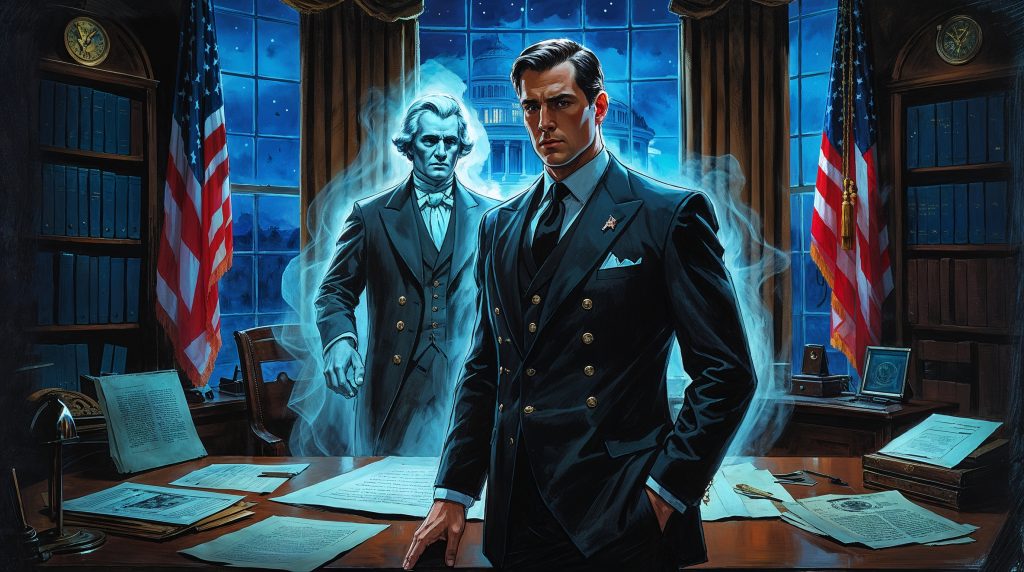
A Bullet for the President’s Ghost
I read about a conspiracy theory so elaborate and so completely insane that I thought: what if someone actually had to investigate this as if it were real? Not debunk it. Investigate it. Follow the logic, check the witnesses, examine the evidence with a straight face. The fun was in writing a detective who takes the absurd premise seriously and follows it all the way to its conclusion, which turns out to be stranger than the conspiracy itself. The best part was the research. Conspiracy theories have their own internal logic, and once you start following it, the rabbit hole has no bottom.
The ghost of President William Henry Harrison appeared in the Oval Office at 3:17 a.m. on a Tuesday in March, and the Secret Service agent who saw him almost drew his weapon.
Agent Cole Rennick had been stationed outside the door, standard graveyard-shift protocol, when the temperature in the hallway dropped twenty degrees in the span of a heartbeat. Frost formed on the brass door handles. His breath came out in white clouds. Then a light flickered under the door, not the steady glow of a desk lamp but something colder and more diffuse, like moonlight filtered through ice.
He opened the door. Protocol said he shouldn’t, not without authorization, but his instincts overrode his training. The Oval Office was empty of living people. But standing behind the Resolute desk, translucent and faintly luminous, was a tall man in nineteenth-century clothing. High collar. Long coat. Gaunt face framed by thinning hair. He looked like the portrait that hung in the ground-floor corridor, the one most tourists walked past without a second glance.
William Henry Harrison. Ninth president. Dead since 1841.
Rennick’s hand went to his holster. Then his brain caught up with his eyes, and he realized that shooting a ghost was beyond the scope of his training.
“Close the door,” the ghost said. Its voice sounded like wind through an empty room. “We need to talk.”
Rennick closed the door. Then opened it again. Then closed it and locked it, because whatever was about to happen, he didn’t want witnesses until he understood what he was dealing with.
“You’re not real,” he said.
“I am real. I’m just not alive. There’s a difference.”
“What do you want?”
“Someone is going to assassinate the president. Not this one. The next one. And I need your help to stop it.”
Rennick stared at the apparition. He was forty-three, a fifteen-year veteran of the Presidential Protection Division, and he’d been trained to assess threats with dispassionate precision. A ghost was not in the threat assessment manual. But the urgency in Harrison’s voice, if a dead president’s whisper could be called a voice, was unmistakable.
“Why you?” Rennick asked. “Why are you the one warning us?”
“Because I know what it’s like to die in this office. Thirty-one days after inauguration. Pneumonia, they said. It wasn’t pneumonia.”
“What was it?”
Harrison’s image flickered. “Sit down, Agent Rennick. This will take a while.”
The story Harrison told was not in any history book. He spoke for an hour, his form wavering in the cold air, and what he described was a shadow network that had existed since the founding of the republic. Not a conspiracy in the conventional sense, not a cabal of men in dark rooms plotting coups. Something older and stranger: a pattern embedded in the structure of the presidency itself, a curse if you were superstitious, a statistical anomaly if you weren’t.
Every twenty years, starting with Harrison in 1840, a president elected in a year ending in zero had died in office. Harrison. Lincoln. Garfield. McKinley. Harding. Roosevelt. Kennedy. The pattern was well-known. It even had a name: Tecumseh’s Curse, after the Shawnee leader whose defeat supposedly triggered it.
“The curse is real,” Harrison said. “But it’s not supernatural. It’s engineered. Someone, or some group, has been ensuring the pattern holds for nearly two centuries.”
“That’s insane. Kennedy’s assassination was investigated for decades. Lone gunman, conspiracy theories, none of them ever proved a pattern.”
“They weren’t looking for a pattern. They were looking for gunmen. The pattern is bigger than any single assassin.”
Harrison explained. The group operated across generations, passing the mission from one cell to the next like a relay baton. They had no name, no ideology, no political agenda beyond the maintenance of the cycle itself. They believed that the periodic sacrifice of a president served a necessary function, pruning the leadership at regular intervals, preventing any single vision from becoming entrenched.
“Reagan broke the pattern in 1980,” Rennick said. “He survived.”
“He survived because a Secret Service agent pushed him into a car 1.7 seconds faster than the pattern’s architects anticipated. But look at what happened. He was shot. The pattern tried. It always tries.”
“And now?”
“The next president elected in a year ending in zero will take office in January. The cycle will attempt to complete. I’ve been watching from my particular vantage point for a hundred and eighty years, Agent Rennick, and I can tell you that this time, the group is better prepared than they’ve ever been.”
Rennick rubbed his temples. The cold in the room was giving him a headache, or the conversation was, or both. “Why come to me? Why not appear to the current president? The FBI director? The Joint Chiefs?”
“Because none of them would believe me. You barely believe me, and you’re looking right at me. I need someone inside the protection detail, someone who can investigate without raising alarms. The group has people everywhere. Intelligence agencies. Law enforcement. The military. The only safe starting point is one agent who knows nothing and has no connections to the network.”
“You picked me because I’m nobody.”
“I picked you because you’re clean.”
Rennick spent the next six months investigating. He told no one about the ghost. He told no one about the investigation. He used his security clearance to access historical records, pulling files on every presidential death in office, cross-referencing personnel, timelines, logistics. He worked nights, on his own time, in his apartment in Arlington, surrounded by printouts and yellow legal pads.
The pattern Harrison described held up under scrutiny. Rennick spent nights cross-referencing personnel records from the Secret Service archives, pulling files that hadn’t been opened in decades, reading reports whose authors had been dead for generations. He developed a system: yellow legal pads for confirmed facts, blue for probable connections, red for speculation. His apartment began to resemble the office of a detective in a procedural drama, which would have been funny if the stakes hadn’t involved the assassination of a future president.
The work was painstaking and lonely. He couldn’t discuss it with colleagues, couldn’t run searches through official databases without triggering audit flags, couldn’t do anything that would connect his investigation to the protection detail where he spent his daylight hours. He was living two lives: the dutiful agent by day, the ghost-directed investigator by night. Not the supernatural elements, which Rennick still didn’t accept despite having seen a dead president standing in the Oval Office, but the operational ones. In every case, there were anomalies. Security gaps that shouldn’t have existed. Personnel transfers that placed specific people in specific positions at specific times. Financial transactions routed through shell companies that appeared, served their purpose, and dissolved.
The shell companies were the thread he pulled.
Using forensic accounting techniques he’d learned from a Secret Service financial crimes colleague, Rennick traced a web of transactions stretching back decades. The companies changed names, jurisdictions, and structures, but the underlying financial DNA was consistent. The same pattern of funding, disbursement, and dissolution, repeated every twenty years.
The current iteration was active. A company called Meridian Strategic Consulting, registered in Delaware three years earlier, had been making payments to a retired military contractor named Tobias Holt. Holt lived in Fredericksburg, Virginia, and his resume included a stint as a security advisor to the Congressional Protective Services Division.
Rennick drove to Fredericksburg on a Saturday morning. Holt lived in a modest colonial on a tree-lined street. He answered the door in a flannel shirt and reading glasses, looking like every other retired government employee in northern Virginia.
“Agent Rennick. Secret Service.” He showed his credentials.
“What’s this about?”
“Meridian Strategic Consulting.”
Holt’s expression didn’t change, but something shifted behind his eyes. A tightening. A calculation.
“I do consulting work for various firms. What’s your interest?”
“I’d like to come inside and discuss it.”
“I’d like to see a warrant.”
“This is a courtesy visit, Mr. Holt. The warrant comes later.”
They talked in Holt’s kitchen. The conversation was careful, oblique, two professionals circling each other. Rennick didn’t mention Harrison’s ghost or the curse or the two-hundred-year pattern. He stuck to the financial trail, asking pointed questions about Meridian’s funding sources and the nature of Holt’s consulting work.
Holt gave nothing away. He was polished, patient, and entirely unforthcoming. When Rennick left an hour later, he knew two things: Holt was involved, and Holt knew Rennick was onto him.
The ghost appeared again that night, in Rennick’s apartment. Harrison materialized in the living room, displacing the air with a wave of cold that frosted the windows.
“You visited Holt.”
“You’re following me?”
“I observe. It’s all I can do. I can’t interact with the physical world beyond speaking to you. I can’t move objects, open doors, or stop bullets. If I could, I wouldn’t need you.”
“Holt is part of it?”
“Holt is the operational planner. He’s been positioning assets for three years. The assassination is planned for the inauguration itself. Maximum symbolic impact.”
“That’s the most heavily secured event in the country.”
“Which is why they’ve spent three years infiltrating the security apparatus. Two members of the advance team are compromised. One sniper on the rooftop rotation has been replaced with an operative.”
Rennick felt the blood drain from his face. “You know this for certain?”
“I know what the dead know, Agent Rennick. The previous operatives who ran this cycle, the ones who planned Kennedy and McKinley and the others, they’re where I am now. The dead talk to each other. We compare notes.”
The next three months were the most intense of Rennick’s career. He couldn’t go to his superiors without evidence that would hold up to scrutiny, and “a ghost told me” was not admissible in any court or briefing room. So he built the case brick by brick, using the ghost’s intelligence as a roadmap and his own investigative skills to produce corroborating evidence.
He identified the two compromised advance team members through surveillance. He found the sniper replacement through a chain of military service records that revealed a connection to Holt’s previous contracting work. He documented the financial trail with enough detail to convince a prosecutor.
Two weeks before the inauguration, he walked into the office of the Director of the Secret Service and laid a three-hundred-page dossier on his desk.
“What is this?”
“An assassination plot targeting the incoming president. I have names, financial records, and operational details.”
The director read the dossier. It took him four hours. When he finished, he made six phone calls. Within twenty-four hours, Holt was in custody. The compromised advance team members were arrested at their homes. The replacement sniper was pulled from his position during a “routine rotation” and detained.
The inauguration went forward without incident. The new president took the oath of office under a clear January sky, unaware of how close the pattern had come to completing itself.
Rennick watched from his post on the perimeter, scanning the crowd out of habit, and felt the temperature around him drop five degrees. Harrison’s voice came to him like a breath of winter air.
“Well done, Agent Rennick.”
“Is it over? Is the pattern broken?”
“For now. The group will regroup. They always do. But you’ve bought time. Twenty years, perhaps.”
“Twenty years until the next cycle.”
“Yes.”
“Will you come back? To warn whoever’s standing post in twenty years?”
The ghost was silent for a long moment. The crowd cheered as the new president waved from the podium.
“I’ve been doing this for a hundred and eighty years,” Harrison said. “Standing in that office, trying to find someone who will listen. Most don’t see me. The ones who do usually convince themselves they’re hallucinating. You’re the first one who acted.”
“That doesn’t answer my question.”
“I’ll be here. I’ll always be here. Thirty-one days was not long enough to be president, but apparently it was long enough to be bound to the office forever.”
The cold faded. The temperature normalized. The crowd kept cheering.
Rennick stayed at his post and watched the peaceful transfer of power proceed exactly as the founders had intended, protected by the living and warned by the dead.